Personal Improvement
Companies hire people to work and perform and hope that those employed will be of good character. Character checks are usually carried out by employers through obtaining of routine references. From this point on the real challenge starts. At the time of recruiting and selecting, enough emphasis is not given to character traits of the candidate.
Of these two variables, performance and character, there are plenty of examples in the corporate world where either one or the other have been more evident. “He is such a sincere and devoted lad, pity he can’t deliver the results we need. I wonder who hired him!” Says a disgruntled manager about one of his newly inherited subordinate, soon after taking charge of a department. Here we have the classic employee who is considered polite and trustworthy, but is quite a liability to the company.
While we would like to believe that such instances are rare, the opposite is true. This could be because of various reasons. For instance, poor hiring on account of political pressures; or nepotism; or ineffective staffing (‘right person for the right job’) due to favoritism; or simply because of an incompetent HR manager. Many public sector organizations and government departments suffer from this kind of malaise. I was once describing the nature of our work to a federal minister as that of improving efficiency and effectiveness in organizations. On hearing this he laughed aloud, and said, “People like you are bad for us. We create inefficiencies to provide jobs!”
The flip side is very prevalent too. Example of a second in command of a commercial bank comes to my mind. What he said in a meeting with a colleague was pretty alarming. “It’s been two months since I took charge of the operations of this bank and I am still not clear about the figures being presented to me. An asset could so easily be a loss! Its hard to know who to believe. They are all so damned articulate and intelligent that facts get distorted by their slick presentations.” Here we have slick communicators and spin doctors who use their gift of the gab to either make an impression, get out of trouble or present data in a way that conveys a rosy picture of a bad situation. Such people are usually competent in their field and possess the street-smarts to secure business. They are great at misleading people within their business or have a knack of ruling over them through fear.
This category of people, which is high in competence but low in sincerity may perform well in the short term, but end up damaging the long term viability of their company. Companies are at times guilty of retaining managers on the basis of their performance, while aspects of character and integrity are conveniently overlooked.
High performers are valued by companies as they positively impact the top-line and bottom-line within months. One takes principle orientation lightly at his own peril. Glaring examples of major corporate failures serve to enlighten us of the value of integrity. Enron, Worldcom, Anderson Consulting and Baring Brothers are just a few well publicized cases where intelligence and greed of a few led to the eventual demise of the entities they led. In Pakistan we saw corporate scandals like Coop banks and Taj Company to name just a few.
The point is that integrity in people leads to superior business performance. The burden of regulation, checks and balances, simply add to bureaucratic delays and increase cost of supervision to a level that makes a company uncompetitive in terms of quality, price and speed.
How the nature of international travel for Pakistanis has changed in recent years illustrates the point I am making. Back in the 60s and 70s going abroad was a pleasant experience, with exchange control regulation being the main source of frustration. Obtaining visas, checking-in and boarding planes without suffering the ritual of intense security screening, clearing immigration – all this was quick and easy.
Today, obtaining a visa is an extremely slow and demeaning process. Just talk to anyone who has tried to apply for a US visa lately. Extra check and scrutiny at embassies have been necessitated due to several cases of false claims and bogus documents being presented by our nationals.
As a result of the conduct of some crooks, Pakistanis in general have lost credibility in the eyes of the international community. Consequently genuine people suffer delays of all sorts while transacting international business.
ISO 9000 certification was one way of ensuring that companies would ‘do what they say’ and ‘say what they do’. Sadly, only a few companies that have obtained such certification truly practice the spirit behind ISO. Others simply window-dress and prepare just in time for annual audits to retain the certificate.
I have known a retired captain of 747s who served PIA for a number of years. He was director Flight Operations when he left PIA to join Singapore Airlines in the 70s and flew their Jumbos, finally retiring to come back home. He is, therefore, very familiar with the workings of both the airlines. I asked him to describe the difference between both the airlines, explaining why Singapore Airlines was one of the world’s leading carriers today. His answer was simple. He said that they had twice the fleet of aircraft and half the number employees compared to PIA. And while their manuals were very similar in content to ours, they lived by the creed; whereas PIA personnel mostly paid lip service to guidelines. People in Singapore Airlines were held accountable for their misdeeds. In PIA this rarely happened. People at Singapore Airlines were evidently high on both performance and character, while in PIA it was not so.
Quality of people is not an ‘either/or’ proposition – we need both performance and character in each individual for the company to produce admirable performance on a sustainable long-term basis. Achieving desired results is just as important as HOW it is arrived at.

Uncategorized
MASTER YOUR
MiND
DESIGN YOUR
DESTINY
Proven Strategies that Empower You to Achieve Anything You Want in Life
WARNING:
Reading this book and participating fully in all the
activities could positively change your life forever
CONTENTS
Acknowledgements
Introduction
About the Authors
Chapters
- The Patterns of Excellence
- The Ultimate Success Formula
- How to Achieve Anything You Want
- The Key to Absolute Power
- The Incredible Power of Beliefs
- The Secret of Peak Performance
- Directing Your Brain for Optimum Results
- Anchoring: the Keyboard to Your Emotions
- The Transformation of Meaning
- Values: Your Driving Force
- Design Your Destiny
- How to Replicate Someone’s Success Blueprint
Bibliography
There was once a professor who wanted to go down a river, so he approached a local boatman who agreed to row him downstream for a small sum of money.
As they wound their way down the river, the professor decides to show-off his intelligence and high education so he started to test the simple boatman.
Taking up a stone he had picked up from the riverbank, the professor arrogantly asks the boatman, ‘Have you ever studied Geology?’ The boatman looks at him blankly and replies, ‘Eh…, no.’, hardly even understanding what the word meant.
‘Then, I am afraid 25 percent of your life is gone!’ the professor loftily says.
The boatman feels really bad about his ignorance but continues to row on.
As they move further downstream, the river currents begin to get stronger and stronger. The professor picks up a leaf floating on the river and asks condescendingly, ‘Boatman, have you ever studied Botany?’
Confused the poor boatman again says, ‘No.’
The professor shakes his head and says, ‘Tsk tsk, then 50 percent of your life is gone.’ He then signals him to carry on rowing. As they move further downstream, the currents get even stronger, the water is moving faster and the boat begins to sway violently.
Suddenly the professor sees a mountain range, points to it and asks,
‘Do you know anything about Geography?’ Feeling very inferior and humiliated, the boatman again says ‘No.’
The professor snaps back. ‘I thought so. Then 75 percent of your life is gone!’
At this point, the river has become a raging torrent. The water is moving so swiftly that the boatman loses control of the small boat.
Suddenly, the fragile craft smashes against a huge boulder, springs a leak and begins to sink.
This time the boatman turns to the professor and asks, ‘Professor! Do you know how to swim?’ The professor fearfully replies, ‘No!’
‘Then, I am afraid 100 percent of your life is gone!’ says the boatman as he leaps off the boat and powers his way to safety on the shore.
Just like the river, we are living in times of rapid and evolutionary changes. Is the river of life going to get faster and more unpredictable? You bet! This is only just the beginning.
What took a decade to change now takes merely months. Think about this: it took 50 years for cassette tapes to replace records. It then took less than ten years for compact discs to replace cassette tapes. Soon after, it took less than five years for Mini-Discs to appear on the scene. Today, less than three years later, MP3s are looking to make everything else totally obsolete. Mega million-dollar businesses can become bankrupt because of obsolescence overnight. At the same time, small companies can become worldwide market leaders in just a few years. Similarly, a professional with years of experience and a high market value can become economically unviable within a short period of time. Why?
The new economy is so dynamic that 80 percent of what you learn in school will become obsolete by the time you graduate. 30 percent of the jobs, companies, products and services that are commonplace now never existed a decade ago.
Who ever heard of a chief information officer, a website designer, technopreneurs, internet service providers (ISPs) or net nannies in the
1990s? Similarly, 50 percent of the jobs that exist today will no longer exist in their present form ten years from now.
In fact, the average person will probably go through four career changes (not job changes) in their entire lifetime. Why? Simply because the jobs they have and the companies they work for will not exist for very long.
‘The world must change and leaders are the ones who change it’
These seem like scary times, but they can also be awesome times with unrealized opportunities for those who not only embrace the change but lead the change! With change, comes incredible opportunity. Think about it!
There are now a hundred times more millionaires and many more billionaires as compared to decades past. And unlike the past when most of them were in their fifties, today’s billionaires are in their thirties! Today, with an innovative idea, you could become the owner of a billion dollar company in less than ten years. Think of Amazon.com, E-Bay, Oracle or Hotmail.
Do you have what it takes to swim in the dynamic and ever changing river of life? Will you crest the new age waves or get caught in the deadly undertow?
Will you be like the professor who thinks he knows everything but drowns in the river of the real world? You and I both know that academic success, knowledge and intelligence are no guarantees of success in the new economy. In fact, they could mean very little.
Some of the movers and shakers of the new economy are school dropouts who employ ‘professors’ to run their businesses. Bill Gates
(Microsoft), Larry Ellison (Oracle) & Richard Branson (Virgin group) never finished school.
While education and academic qualifications are important, they are not enough if you want to make it in these turbulent evolutionary times. Those who are the most successful in the new economy are not necessarily the ones with the highest IQ or the most letters behind their name. It is those who exhibit certain patterns of excellence.
The patterns of excellence I refer to is the ability to take charge of your mental resources and unleash your personal power! It is a set of beliefs, attitudes and behaviors exhibited by individuals who consistently produce exceptional results.
It is the ability to take charge of your life, be in control of your emotional state and bring out the best of your personal potential. It is about having the flexibility to constantly grow by learning, unlearning and relearning. It is the ability to model and replicate excellence within a very short period of time. It is being able to constantly respond in an empowering way to the events swirling around you.
Those who lack ‘swimming’ skills (professors, professionals or just plain ordinary people) will continue to be controlled by their external environment and be ruled by the fear of change and unpredictability.
They will end up frustrated and powerless victims of this massive wave of globalization, restructuring and change. Those who can ‘swim’ and ride this wave will experience wealth, success and fulfillment beyond their wildest imagination.
In this book, you will learn how to equip yourself with the mindset, skills and behavioral patterns to do just this. You will be armed with the patterns of excellence so you can master your mind and design your destiny – whatever the external circumstances.
Uncategorized
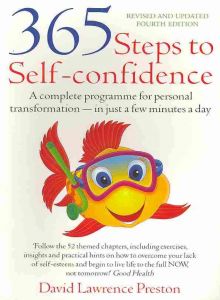
I have written this book for everyone – young and old, men, women, students, educators, business people, administrators, parents, homemakers, sports enthusiasts, entertainers – yes, and you!
It has been carefully structured into 52 sections, covering the following areas:
- Deciding to be confident
- Self-awareness
- Thinking confidently
- Using your imagination to improve self-image
- Acting with confidence
- Confident communication.
Each section contains information, insights and words of inspiration, plus seven exercises, practical hints or points to ponder. That’s one a day – not too taxing. Is it?
I guarantee that if you read the material carefully and apply what you learn, you’ll notice big changes taking place within two or three months, and a year from now you’ll look back amazed at how much more confident you’ve become.
Overview – Sections
- How to build confidence: an introduction to the life-changing formula that will transform your life.
- How confident are you? Defining your starting point
- Sow the seeds of confidence and watch them grow: why you are the way you are and how you can become what you want to be.
- Whose responsibility is your confidence? Why, yours, of course!
- Getting motivated: setting goals which give you the impetus to change and to grow Determination: identifying the reasons to change, and reinforcing your commitment to be confident.
- Thinking like a confident person: you start transforming your life by changing the way you think.
- The Four Step Method: a cast iron way to become a positive thinker.
- Silencing the Inner Critic: challenging the little voice in your head that loves to criticize you
- Affirmations: how to use them to build confidence and the difference they make.
- Who do you imagine yourself to be? Self-image and the subconscious
- Getting the most from creative imagery: life-transforming techniques which change your self-image permanently
- The ‘As If ’Principle: acting as if you’re confident to become more confident.
- Eat an elephant: the importance of taking it one step at a time.
- Self-awareness 1 – the past: examining how the past has affected you and what’s been holding you back.
- Self-awareness 2 – what are you like? Understanding yourself – the more self-aware you are, the more control you have over your life.
- Childhood: how you’re conditioning and your relationship with your parents as a child continue to affect you.
- Control dramas: how you learned to get what you wanted from others, and how it still governs your behavior.
- Take care of your Inner Child: learning to accept the child you once were as an important part of the adult you.
- Forgive, forget and be free: how to forgive those who have hurt you, take charge of your life and move on.
- Let go of the past: how to get rid of unwanted baggage from the past so it no longer affects you.
- Self-acceptance: accepting yourself as you are, especially those things you cannot change.
- Body image: love your body, warts and all!
- Get in shape: a health and fitness guide to give you more energy and more confidence.
- Calmness and confidence: deep relaxation and instant calmness for instant confidence.
- Anchoring: how to produce confident feelings any time you wish
- So far, so good: an opportunity to pause, take stock, reflect and review your progress to date.
- Find a purpose: one that inspires and motivates you, and gives your life meaning and direction.
- Goals revisited: consider what you wish to achieve in life, and get started right away.
- The Thinker thinks and the Proverb proves: how to draw on the power of the subconscious mind to build confidence.
- Confident self-talk: changing negative, restrictive thinking patterns to thoughts of confidence and self-worth.
- Beliefs: what they are, why they’re important, how to change them and create self-belief.
- Confident attitudes: seven attitudes of confidence for you to make your own.
- Self-love: self-worth, the key to happiness and fulfilling relationships.
- Concentrating on what you do well: identifying your strengths: acquiring new personal qualities.
- Overcoming weaknesses: building on your strengths. The importance of concentrating on what you do well, and cultivating patience and persistence
- Take a risk: how to get out of your comfort zone.
- Just do it: sure-fire confidence building activities. Go on – have a go!
- Confident body-language: adopt a confident posture and you feel more confident. You project confidence too.
- Conditions of worth: how others assess you. And how to deal with rejection
- Give up approval-seeking behavior: there’s only one person whose approval you really need – guess who?
- First impressions: conversational skills that make others want to talk to you, and allow you to be confident.
- Be a good listener: good listening is one of the secrets of confident communication and popularity.
- Stand up for yourself: introduction to assertiveness.
- How to be assertive: effective tools and techniques for standing your ground and getting your point across.
- Saying no when you mean no: one of the hardest things to do when you lack confidence.
- Compliments and criticism: how to handle criticism and give and receive compliments.
- How to ask for what you want: and what to say when you don’t get it.
- Lighten up: stop taking yourself too seriously and have a laugh.
- Emotional intelligence: understanding and managing your emotions; and relating to other people’s in an appropriate manner.
- Take an interest in others: helping others does wonders for your own confidence.
- Choose peace: becoming aware of your spiritual dimension and enjoying continual peace of mind.