
Most people who start a business spend their first weeks doing one of two things: perfecting their website, or waiting for clients to magically appear. Neither works.
Getting your first 10 clients is the hardest stretch of any business journey. You have no reputation, no reviews, no case studies, and no social proof. You’re essentially asking strangers to trust you with their money based on nothing but your word.
The good news? You don’t need an advertising budget to solve this. You need a strategy, some courage, and a willingness to do the unglamorous work that most people skip.
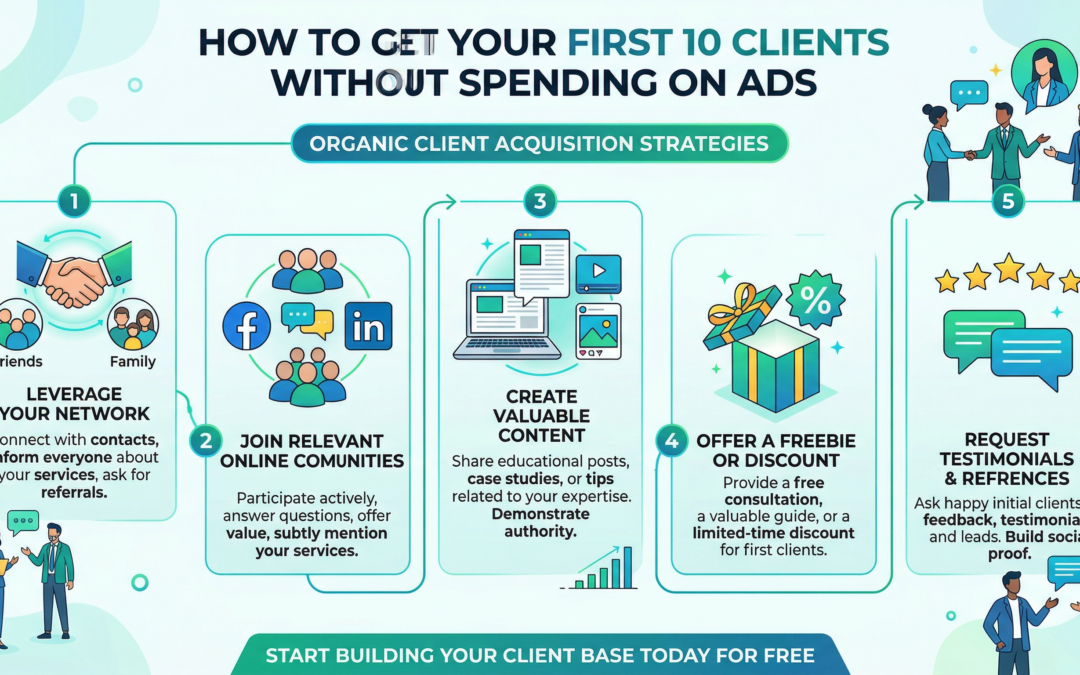
Here’s exactly how to get your first 10 paying clients — from scratch.
Step 1: Start With the People Already Around You
Before you think about strangers, think about your existing network. Your first clients are almost certainly closer than you realize.
Go through your phone contacts. Think about former colleagues, classmates, family members, and people you’ve done any kind of work with before. These people already have a baseline of trust in you — which is the hardest thing to build with a cold prospect.
Don’t make it awkward. You’re not begging for a favor. You’re informing people who know you about something valuable you now offer.
A simple, direct message works perfectly: “I’ve recently launched a service that helps businesses manage their sales and inventory systems more efficiently. I’m looking for my first few clients to work with closely. Do you know anyone who might benefit from this — or would you like to hear more?”
That one message, sent to 30 people in your network, can generate your first conversation. You only need one conversation to become your first client.
Step 2: Use WhatsApp Like the Business Tool It Is
In Saudi Arabia, WhatsApp is not just a messaging app — it’s where business gets done. Decision-makers respond to WhatsApp messages faster than emails, and the personal nature of the platform works in your favor when you’re building early relationships.
Identify small and medium business owners in your field and reach out directly. Keep your message concise, human, and focused on them — not on you.
A good template looks like this:
“Hello [Name], I came across your business and genuinely think there’s an opportunity to help you streamline your operations. I specialize in [specific service] and I’m currently working with a small number of businesses to deliver real results. Would you be open to a quick 10-minute call this week?”
The key is personalization. Reference something specific about their business. Mention their location, their industry, or a challenge you’ve noticed businesses like theirs commonly face. Generic messages get ignored. Personalized messages start conversations.
Aim for 10 to 20 targeted, personalized outreach messages per day. That’s a pipeline, not a spam campaign.
Step 3: Walk Into Local Businesses and Have Real Conversations
This is the step most people skip because it feels uncomfortable. It is also one of the most effective things you can do in the early stages of your business.
Jeddah, in particular, is a city of rapid commercial growth. New cafes, retail outlets, clinics, schools, pharmacies, and service businesses are opening constantly — and the majority of them are running on outdated systems, manual processes, or no systems at all. That’s your opportunity.
Walk in. Ask to speak with the owner or manager. Introduce yourself simply: “I work with businesses like yours to help them manage their point-of-sale, reduce customer waiting time, and get better visibility over their inventory. I’m not here to sell you anything today — I just want to understand how you’re currently handling this and whether there’s a fit.”
That approach — curious rather than pushy, consultative rather than sales-driven — opens doors. You’ll get turned away sometimes. That’s normal. But you’ll also get conversations that turn into clients, and you’ll learn more from those face-to-face interactions than from any amount of online research.
The sectors most receptive to this approach in the local market include retail shops, restaurants and cafes, private clinics and medical centers, small schools and tutoring centers, and logistics and delivery operations.
Step 4: Build Social Proof From Day One — Even If It’s Small
The most common objection you’ll face as a new business is: “Do you have any previous clients I can speak to?” When the answer is no, that conversation often dies.
The solution is to engineer your first few pieces of social proof deliberately.
Offer your service free or at a significant discount to two or three businesses in exchange for their honest feedback and permission to document the results. This isn’t charity — it’s investment. A single strong testimonial, a before-and-after screenshot, or a brief case study describing the problem you solved and the outcome you delivered is worth more than any ad you could run.
Once you have results — even small ones — document them publicly. Post them on your social media. Include them in your outreach messages. Put them on your website. Prospects who were hesitant suddenly have a reason to say yes.
Social proof compounds. Your first testimonial gets you your second client. Your second client gives you a stronger testimonial. By the time you’ve worked with five businesses, you have enough evidence to close the next five with far less resistance.
Step 5: Create Content That Solves Real Problems
You don’t need a large following to generate clients from content. You need the right content reaching the right people.
Instead of posting about your product or service, post about the problems your ideal clients are dealing with daily. If you sell POS systems, write about the five most common inventory mistakes that cost retail businesses money. If you offer school management software, write about how manual attendance tracking is quietly burning administrator time. If you provide IT services, write about the security gaps most small businesses don’t know they have.
This kind of content positions you as someone who understands the problem deeply — which is exactly the person a business owner wants to hire.
For the Saudi and Gulf market, LinkedIn is powerful for B2B audiences and decision-makers. Instagram works well for local businesses and visual demonstrations. Snapchat still commands strong engagement in the region. Choose one or two platforms and post consistently — three to five times per week — rather than spreading yourself thin across everything.
Content doesn’t need to be long. A single clear insight, a short video explaining one concept, or a case study summarized in five points can generate more inbound interest than a polished ad.
Step 6: Build Referral Partnerships With People Who Already Have Your Audience
You don’t have to find every client yourself. There are people out there who already have relationships with your ideal clients — and who would be happy to refer business to you in exchange for a commission or mutual referral arrangement.
Think about who serves the same audience you’re targeting without competing with you directly. If you sell software to schools, the people selling school furniture, printing services, or transportation solutions are already walking through the same doors you want to open. If you serve retail businesses, marketing agencies, accountants, and business consultants who work with retailers are natural partners.
Approach these people with a simple proposal: “I think there’s a real opportunity for us to refer clients to each other. When you encounter a client who needs what I do, I’ll pay you a referral commission. And when I meet someone who needs your services, I’ll send them your way.”
A handful of active referral partners can generate a consistent stream of warm introductions — which are far easier to convert than cold outreach.
Step 7: Make Your Offer Impossible to Say No To
In the early days, you cannot afford to make it difficult for someone to say yes. Remove every possible barrier to the first transaction.
This doesn’t mean working for free indefinitely. It means structuring your entry offer in a way that dramatically reduces the perceived risk for a new client. Some approaches that work well:
A free setup or onboarding process with the first paid month included. A discounted first contract with full price kicking in after the client has seen results. A money-back guarantee if specific outcomes aren’t delivered within a defined timeframe. A free audit or assessment that demonstrates your expertise before any money changes hands.
When a prospect is weighing up an unknown provider with no track record, the question in their mind is: “What happens if this doesn’t work?” Your job is to make that risk feel small enough that the answer becomes: “Nothing — so why not try?”
Step 8: Sell Outcomes, Not Features
Nobody buys software. Nobody buys IT infrastructure. Nobody buys a POS system. What people buy is the result those things produce.
This is one of the most important shifts in thinking you can make as an early-stage business owner. When you describe what you do, lead with the outcome the client will experience, not the technical components of how you deliver it.
Instead of: “Our system includes real-time inventory tracking and multi-branch reporting.”
Say: “Our clients typically reduce their inventory losses by 30% in the first three months and get a clear view of what’s selling and what isn’t — without needing to pull manual reports.”
Every feature you offer maps to a result someone cares about. Find that result and lead with it every time. Talk about saved time, reduced costs, increased revenue, eliminated headaches, or improved customer experience. That’s the language of business owners — and it’s what gets you hired.
Step 9: Follow Up — Because Almost Nobody Does
Here is a simple fact that will give you an edge over most of your competitors: the majority of deals that could have closed are lost because no one followed up.
A prospect says “let me think about it” and the conversation disappears. They got busy. They forgot. They assumed you moved on. Meanwhile, you assumed they weren’t interested.
The reality is that most buying decisions take time. A single follow-up message, sent three to five days after your last conversation, reopens doors that appeared closed.
Keep it brief and human: “Hi [Name], just wanted to check in — I know you had a few things to consider. I’m still happy to answer any questions or set up a quick demo if that would help. No pressure either way.”
That message takes 30 seconds to send. It will convert a meaningful percentage of your stalled conversations into clients. Make follow-up a non-negotiable part of your process, not an afterthought.
Step 10: Overdeliver to Your First 10 Clients — They Are Your Marketing Team
Your first 10 clients are not just revenue. They are the foundation of your reputation.
Treat them accordingly. Respond faster than expected. Solve problems before they escalate. Check in proactively. Go beyond what the contract requires when the situation calls for it. Make them feel like they got far more than they paid for.
A client who feels genuinely well-served doesn’t just stay — they talk. They mention you to their peers. They bring you into conversations you’d never have access to on your own. In the Saudi business community, where trust and word-of-mouth carry enormous weight, a handful of enthusiastic early clients can generate your next 20 without you having to do any additional outreach.
Your first 10 clients are your hardest work and your greatest leverage. Treat them like the asset they are.
Final Thoughts
The mistake most new business owners make is waiting until they have the perfect website, the polished brand, the refined pitch deck, and a comfortable advertising budget before they start talking to clients.
By then, months have passed and nothing has moved.
You don’t need any of that to get started. You need to reach out to people who know you. You need to walk into local businesses and start conversations. You need to create content that demonstrates your understanding of real problems. You need to follow up consistently and deliver exceptional results when someone gives you a chance.
Your first 10 clients will not come from algorithms. They will come from effort — direct, personal, unglamorous effort that most of your competitors aren’t willing to put in.
That’s your advantage. Use it.