

Plan-Do-Check-Act (PDCA)

Plan-Do-Check-Act (PDCA)

Implementing New Ideas in a Controlled Way

Also known as the PDCA Cycle, or Deming Cycle

Create a model before you build the final solution.

© iStockphoto/suprun

Something needs to change: Something’s wrong, and needs to be fixed, and you’ve worked hard to create a credible vision of where you want it to be in future. But are you 100% sure that you’re right? And are you absolutely certain that your solution will work perfectly, in every way?

Where the consequences of getting things wrong are significant, it often makes sense to run a well-crafted pilot project. That way if the pilot doesn’t deliver the results you expected, you get the chance to fix and improve things before you fully commit your reputation and resources.

So how do you make sure that you get this right, not just this time but every time? The solution is to have a process that you follow when you need to make a change or solve a problem; A process that will ensure you plan, test and incorporate feedback before you commit to implementation.

A popular tool for doing just this is the Plan-Do-Check-Act Cycle. This is often referred to as the Deming Cycle or the Deming Wheel after its proponent, W Edwards Deming. It is also sometimes called the Shewhart Cycle.

Deming is best known as a pioneer of the quality management approach and for introducing statistical process control techniques for manufacturing to the Japanese, who used them with great success. He believed that a key source of production quality lay in having clearly defined, repeatable processes. And so the PDCA Cycle as an approach to change and problem solving is very much at the heart of Deming’s quality-driven philosophy.


Step 1: Plan

First, identify exactly what your problem is. You may find it useful to use tools like Drill Down  , Cause and Effect Diagrams  , and the 5 Whys   to help you really get to the root of it. Once you’ve done this, it may be appropriate for you to
map the process   that is at the root of the problem.

Next, draw together any other information you need that will help you start sketching out solutions.
Step 2: Do

This phase involves several activities:

Generate possible solutions.
Select the best of these solutions, perhaps using techniques like Impact Analysis   to scrutinize them.
Implement a pilot project on a small scale basis, with a small group, or in a limited geographical area, or using some other trial design appropriate to the nature of your problem, product or initiative.

Our section on Practical Creativity includes several tools that can help you generate ideas and solutions. Our section on Decision Making includes a number of tools that will help you to choose in a scientific and dispassionate way between the various potential solutions you generate.
Note:

The phrase “Plan Do Check Act” or PDCA is easy to remember, but it’s important you are quite clear exactly what “Do” means. “”Do” means “Try” or “Test”. It does not mean “Implement fully.” Full implementation happens in the “Act” phase.
Step 3: Check

In this phase, you measure how effective the pilot solution has been, and gather together any learnings from it that could make it even better.

Depending on the success of the pilot, the number of areas for improvement you have identified, and the scope of the whole initiative, you may decide to repeat the “Do” and “Check” phases, incorporating your additional improvements.

Once you are finally satisfied that the costs would outweigh the benefits of repeating the Do-Check sub-cycle any more, you can move on to the final phase.
Step 4: Act

Now you implement your solution fully. However, your use of the PDCA Cycle doesn’t necessarily stop there. If you are using the PDCA or Deming Wheel as part of a continuous improvement initiative, you need to loop back to the Plan Phase (Step 1), and seek out further areas for improvement.
When to Use the Deming Cycle

The Deming Cycle provides a useful, controlled problem solving process. It is particularly effective for:

Helping implement Kaizen   or Continuous Improvement approaches, when the cycle is repeated again and again as new areas for improvement are sought and solved.
Identifying new solutions and improvement to processes that are repeated frequently. In this situation, you will benefit from extra improvements built in to the process many times over once it is implemented.
Exploring a range of possible new solutions to problems, and trying them out and improving them in a controlled way before selecting one for full implementation.
Avoiding the large scale wastage of resources that comes with full scale implementation of a mediocre or poor solution.

Clearly, use of a Deming Cycle approach is slower and more measured than a straightforward “gung ho” implementation. In true emergency situations, this means that it may not be appropriate (however, it’s easy for people to think that situations are more of an emergency than, in reality, they really are…)

The four phases in the Plan-Do-Check-Act Cycle involve:

  • Plan: Identifying and analyzing the problem.
  • Do: Developing and testing a potential solution.
  • Check: Measuring how effective the test solution was, and analyzing whether it could be improved in any way.
  • Act: Implementing the improved solution fully.

These are shown in Figure 1 below.
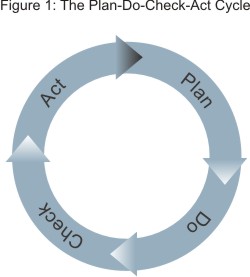
There can be any number of iterations of the “Do” and “Check” phases, as the solution is refined, retested, re-refined and retested again.

How to Use the Tool

The PDCA Cycle encourages you to be methodical in your approach to problem solving and implementing solutions. Follow the steps below every time to ensure you get the highest quality solution possible.

A Theory of Personal Development

A Theory of Personal Development

Some changes are forced upon people by circumstances beyond their control, others occur because of life events or through choice.  This page identifies skills you need to enable you to set goals and to enable personal empowerment.  These skills can help you to make relevant, positive and effective choices and decisions for your future.

Personal development is a lifelong process which enables people to assess their skills and qualities, to consider their aims in life and to set goals which will help them to maximize their potential.  Although early life development and early formative experiences within the family, at school, etc. can help to shape us as adults, personal development should not stop later in life.  This page contains information and advice that is designed to help you to think about your personal development and ways in which you can work towards goals and your full potential.

Theory

There are many ideas surrounding personal development, one of which is detailed below – Abraham Maslow’s process of Self Actualisation.

Self Actualisation

Maslow (1970) suggests that all individuals have an in-built need for personal development which occurs through the process called self-actualisation.

The extent to which people are able to develop depends on certain needs being met and these needs form a hierarchy.  Only when one level of need is satisfied can a higher one be developed.  As change occurs throughout life, however, the level of need motivating someone’s behaviour at any one time will also change.

  • At the bottom of the hierarchy are the basic physiological needs for food, drink, sex and sleep, i.e., the basics for survival.
  • Second are the needs for safety and security in both the physical and economic sense.
  • Thirdly, progression can be made to satisfying the need for love and belonging.
  • The fourth level refers to meeting the need for self-esteem and self-worth.  This is the level most closely related to ‘self-empowerment’.
  • The fifth level is the need to know and understand the environment, this level includes more abstract ideas such as curiosity and the search for meaning or purpose.
  • The sixth relates to aesthetic needs of beauty, symmetry and order.  At the top of Maslow’s hierarchy, is the need for self-actualisation.

Maslow (1970, p.383) says that all individuals have the need to see themselves as competent and autonomous, also that every person has limitless room for growth.

Self-actualisation refers to the desire that everybody has ‘to become everything that they are capable of becoming’.  In other words, it refers to self-fulfilment and the need to reach full potential as a unique human being.

For Maslow, the path to self-actualisation involves being in touch with your feelings, experiencing life fully and with total concentration.

Maslow, A. H. (1970), Motivation and Personality, (2nd Edition), Harper & Row, New York.

Be a winner

Be a winner

In a meeting with the successful entrepreneur of a multibillion dollar company, I had the chance to ask the question: What is one quality which you believe has contributed to your great success? And he promptly replied, ”The ability to be resilient.” He further added that it is also the one significant quality which he always looks for in the people he plans to promote in his company.

We can illustrate this phenomenon of resilience by just throwing a rubber ball against the wall or the floor. You would notice that the harder you throw the ball, the faster it would rebound. Resilience is harnessing your inner strength that helps you rebound from a setback or a challenge such as job loss or being superseded, etc. It is the strong ability to roll with the punches when stress, adversity or trauma strikes. Below are some tips to help you become super resilient:

• Always look at the bigger picture. Any adverse event is an opportunity to learn some valuable lessons, and failures are not personal – they are just the events leading to other events.

• Strive to stay physically fit as the better shape you are in, the higher the amount of energy you possess.

• Stay positive in all situations and circumstances. You can’t change what has happened in the past, but you always have the capacity to change your future.

• Learn from past challenges. Think back on how you’ve coped with hardships in the past. Consider the skills and strategies that helped you go through the rough and tough times.

• Focus on today. Do something that gives you a sense of accomplishment and purpose every day. Set goals to help you look towards the future with meaning.

Resilience won’t make your problems go away — but resilience gives you the ability to see past them and become an evergreen winner!

Handy Hints:

• Take each adverse event as an opportunity to learn new lessons.

• Learn from past challenges and remember how you coped.

• Do something that gives you a sense of accomplishment.

Being happy in the workplace

Being happy in the workplace

happy-workplaceEvery morning when I drive to work, I make it a point to notice the expression on the faces of other people. Most of them have an expression which tells me that they would rather do something else than go to their workplace. This feeling or attitude stems from the basic fact that many employees are not happy in the workplace.

But happiness is a matter of choice for it is not possible for all of us to have the best employer in the world. For optimum performance, enhanced productivity and greater profit, it is important to strive to be happy in one’s workplace. It is a fact that most employees work under great pressure with stress coming from different sources, but a few basic steps will ensure that the happiness index does not slip down leading to decreased morale and depression; hence, it is essential to identify the areas that cause depression, and work towards eliminating them.

Transparent and open communication play a crucial role. When an employee feels that his superior is willing to listen to him, it reduces the tension in his mind. Appreciation is yet another key happiness factor, as we all have the need to feel appreciated, in and out of work. When appreciation comes from the higher-ups, the employee’s efforts become worthwhile.

Another key happiness factor is the realization that one is not stuck in a rut, and that there is ample scope for growth. It is important for employees to know that they are not going to be doing the same thing for the many years to come. Remember, it is important to think positively about your work. It is equally important to avoid negative people and spend time with co-workers you genuinely like. Your choices at work largely define your experience, and you can choose to be happy at work so that each workday will be something you can look forward to.

Handy Hints:

• Identify the causes of stress and work at eliminating them.

• Transparent and open communication enhance work relations.

• Employees must be made to know they have scope for growth.

Verification: 1544cdbd1105873e