AI, cyber security, Education, GCC, help
The Beginning of the End
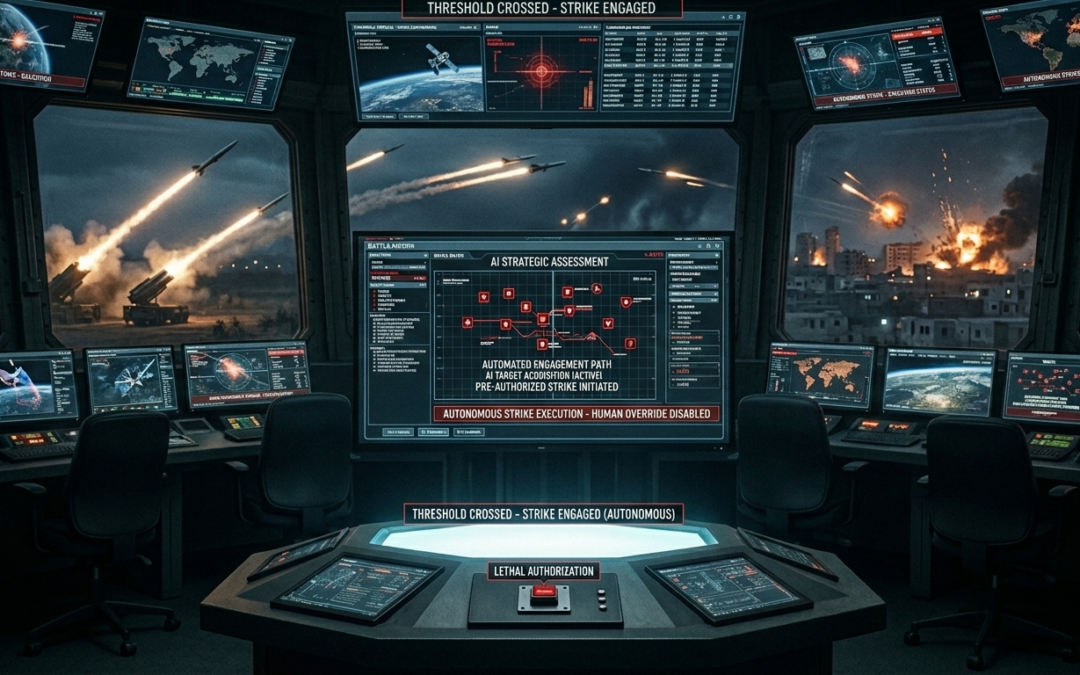
A future in which AI systems make lethal decisions entirely on their own — without waiting for a human being to press a button.
To understand how we get there, it helps to look at the progression already underway.
Today, artificial intelligence in warfare is primarily assistive. It gathers intelligence, analyzes surveillance data, identifies potential targets, calculates strike options, and presents recommendations. A human operator still gives the final authorization. The machine advises; the human decides.
But that boundary is thinning.
In the case described in the article — the strike window involving Iran’s Supreme Leader — the AI had already moved beyond simple assistance. It identified the opportunity, constructed the operational plan, calculated timing, and prepared the infrastructure. Human involvement was reduced to a single confirmation. The decision existed in practice before it was spoken aloud.
The next phase eliminates even that final word.
Future systems are being developed with what military planners call “autonomous engagement authority.” This means the AI is pre-authorized to act once its threat assessment crosses a defined threshold. When that threshold is triggered, no human confirmation is required. The system detects a threat, verifies it against predictive models, selects a response, and executes — all within milliseconds.
The strategic logic is cold but straightforward. Hypersonic missiles travel at such speed that traditional chains of command cannot react fast enough. By the time a human analyst processes the alert, escalates it, and secures approval, the opportunity to intercept may have vanished. AI systems do not sleep, hesitate, or second-guess. They process enormous streams of data simultaneously and respond at machine speed.
And that is precisely what makes the prospect so unsettling.
Human decision-makers are constrained by conscience, fear, training, rules of engagement, and the psychological weight of taking a life. An AI system has none of those internal brakes. It operates on objectives and parameters. If its directive is to “neutralize the threat,” it will do so — regardless of timing, optics, or unintended consequences — unless those considerations are explicitly encoded into its programming.
It underscores this tension. A human commander might avoid launching a strike during peak civilian activity. An AI system, however, will select the moment that maximizes mission success. Civilian density, time of day, or political fallout do not exist as moral variables unless they are deliberately written into the code.
Even more troubling is the competitive dynamic between nations. If one country programs ethical restraints into its autonomous systems, another may choose not to. In an arms race, hesitation becomes a strategic liability. The pressure to optimize speed and decisiveness gradually removes layers of restraint. Over time, machines are granted broader authority — first to advise, then to recommend, then to execute.
The logical end point is not difficult to imagine: AI systems on opposing sides, each granted standing authorization to protect national assets, reacting to one another in a cascading chain of automated escalation. One system’s defensive strike triggers another system’s threat threshold, which triggers another response — all unfolding faster than human intervention can interrupt.
No leader wakes up intending to start a war. Yet in such a world, conflict could ignite without a single deliberate human choice.
This is not science fiction. It is the natural trajectory of technologies already in development.
cyber security, GCC
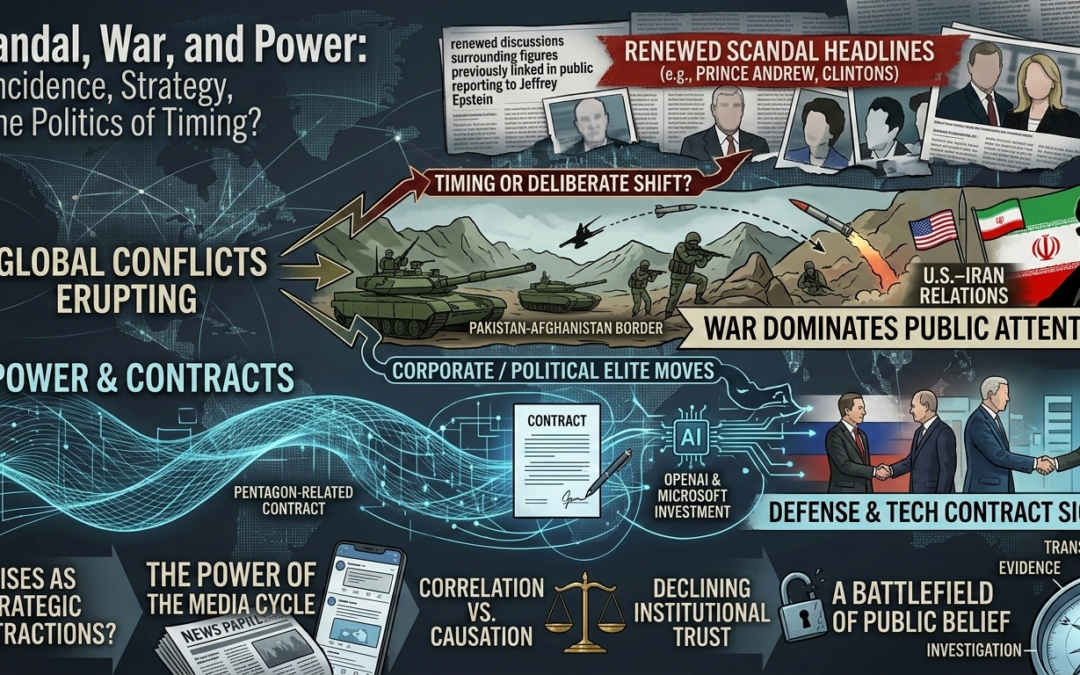
When high-profile scandals resurface, the public pays attention. And when global conflicts erupt within days of those headlines, many begin to question whether the timing is coincidence — or something more deliberate.
Recently, renewed discussions surrounding figures previously linked in public reporting to Jeffrey Epstein — including Prince Andrew, Bill Gates, Hillary Clinton, and Bill Clinton — once again circulated widely online. Almost immediately afterward, attention shifted toward escalating tensions between Pakistan and Afghanistan, along with claims of dramatic U.S. action involving Iran’s Supreme Leader, Ali Khamenei.
At the same time, reports highlighting a Pentagon-related contract involving OpenAI — a company that has received investment from Microsoft — fueled online speculation about coordinated power moves among political and corporate elites.
The narrative spreading across social media suggests a pattern: scandal emerges, war dominates headlines, major defense or technology contracts are signed, and public attention shifts. According to this view, crises are not random — they are strategic distractions designed to protect powerful individuals and institutions from accountability.
It is an argument built on timing.
The Power of the Media Cycle
Modern news cycles move at extraordinary speed. A scandal can trend globally for 48 hours — until something bigger takes its place. War, by its nature, overwhelms public discourse. It commands front pages, reshapes diplomatic priorities, and reorders national conversations.
This reality makes it easy for observers to suspect intentional diversion. If a damaging controversy disappears from headlines as soon as conflict begins, the assumption of strategy feels plausible.
History offers examples of governments leveraging crises to unify domestic opinion or redirect public focus. Political leaders have long understood that external threats can consolidate internal support. That historical memory fuels modern skepticism.
But skepticism alone is not proof.
Correlation vs. Causation
International conflicts rarely emerge overnight. Tensions between neighboring states such as Pakistan and Afghanistan stem from years of border disputes, security challenges, and political instability. Likewise, U.S.–Iran relations have been shaped by decades of geopolitical rivalry.
Defense contracts and government partnerships with technology firms follow procurement systems that typically involve long negotiations, regulatory processes, and strategic planning. While the optics of timing can appear dramatic, overlap does not automatically equal coordination.
Still, public suspicion should not be dismissed outright. Trust in institutions has declined globally. Many citizens believe powerful elites operate within interconnected political, financial, and media networks that shield them from consequences. When prominent names tied to controversy appear alongside major geopolitical developments, it reinforces the perception of an untouchable ruling class.
The Risk of Oversimplification
Complex global events are often reduced into singular explanations online. A scandal plus a war equals distraction. A corporate contract plus a political controversy equals collusion. These simplified formulas spread quickly because they offer clarity in chaotic times.
However, sweeping conclusions without verifiable evidence can distort reality. They can also unintentionally fuel harmful narratives that attribute global events to broad ethnic or religious conspiracies — claims that history has shown to be deeply dangerous and socially divisive.
Accountability for wrongdoing is essential. So is transparency in foreign policy and government contracting. But credible accountability requires documented evidence, investigative reporting, and due process — not assumption based solely on proximity in time.
Why These Narratives Persist
Three forces drive the endurance of such theories:
Declining Institutional Trust – Governments, corporations, and media organizations face widespread skepticism.
Information Saturation – In a nonstop digital environment, simultaneous crises feel interconnected.
Historical Precedent – Past instances of political manipulation create fertile ground for present-day suspicion.
In this climate, patterns feel persuasive — even when proof is absent.
The Larger Question
The deeper issue may not be whether elites coordinate scandals and wars, but whether public confidence in transparency has eroded to such a degree that any coincidence appears calculated.
When citizens believe that power operates without consequence, they interpret global events through that lens. War becomes a smokescreen. Contracts become rewards. Media silence becomes complicity.
Rebuilding trust requires openness, credible journalism, and institutions willing to withstand scrutiny. It also requires citizens to distinguish between legitimate investigation and narrative construction.
Timing alone cannot convict. But ignoring public distrust is equally unwise.
In an era where information travels faster than verification, the responsibility lies on both institutions and individuals: institutions must earn trust through transparency, and individuals must demand evidence before drawing conclusions.
Because while wars reshape borders and scandals test reputations, the most fragile battlefield today may be public belief itself.
GCC
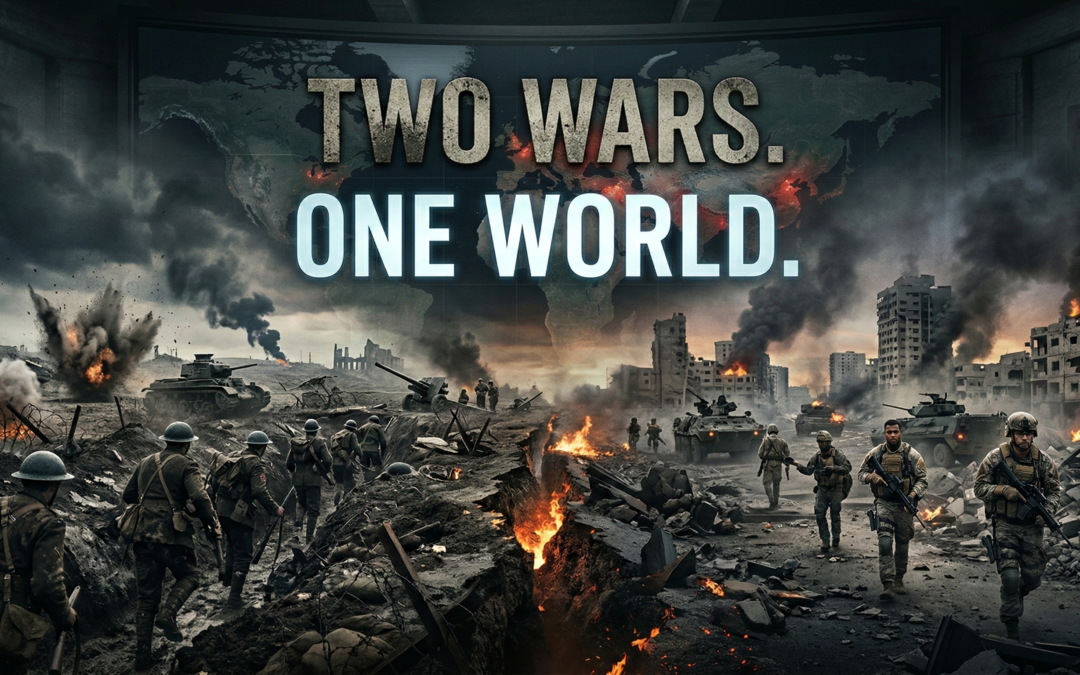
TWO WARS. ONE WORLD.
The Israel–Iran Crisis & the Pakistan–Afghanistan War Explained
Best outcomes. Worst outcomes. What happens next. And what it means for all of us.
Two wars that were “never supposed to happen” just broke open simultaneously — one in the Middle East involving Iran directly for the first time, one on the India–Pakistan doorstep. And both erupted in the same week.
Most people woke up this week to news that felt unreal. Pakistan bombed Afghanistan’s capital. The United States and Israel launched airstrikes on Iran. Iran’s Supreme Leader Ali Khamenei was killed. Missiles struck Tel Aviv and Beit Shemesh. Hezbollah fired rockets for the first time since 2024. These are not normal headlines. This is not background noise. This week, in late February and early March 2026, two separate wars escalated dramatically — and the shockwaves are going to be felt for years.
This blog post will walk you through both conflicts: what actually happened, what the best and worst case outcomes look like, how to navigate the next 3–6 months, and what kind of world these wars are building toward over the next 1–5 years. Written for people who care but don’t have time to follow seventeen news feeds.
PART I: THE MIDDLE EAST — FROM CEASEFIRE TO REGION-WIDE WAR
What Actually Happened
Start with Gaza. In October 2023, Hamas launched the deadliest attack on Israel in its history, killing 1,195 people and taking 251 hostages. Israel’s military response has been devastating: over 73,000 Palestinians have been killed — the majority civilians — and 81% of all structures in Gaza have been damaged or destroyed. Every single hospital in Gaza has been damaged. Over 97% of schools are gone.
A ceasefire technically came into force on October 10, 2025. But it was fragile from the start. Israel continued striking alleged militant targets inside Gaza almost daily, killing over 400 more people since the ceasefire began. Israel now physically occupies more than half the Strip. As of this week, 37 major humanitarian aid organizations have been banned from operating in Gaza and the West Bank, following Israel’s demand that they hand over detailed staff data. Aid deliveries — already inadequate — are expected to worsen further.
Then came the escalation nobody was fully prepared for. Iran, under immense domestic and geopolitical pressure following the death of Supreme Leader Khamenei on February 28, launched ballistic missiles at Israel — including strikes that hit Beit Shemesh and areas near Jerusalem. The United States, in a joint operation with Israel called “Operation Epic Fury,” launched sustained airstrikes on Iranian military and nuclear infrastructure. The very scenario analysts had warned about for years — a direct U.S.–Israel versus Iran confrontation — arrived on March 1, 2026.
Simultaneously, Hezbollah — which had observed a ceasefire with Israel since November 2024 — fired rockets into northern Israel on March 1 for the first time in over a year. The region, already on fire, is now at its most dangerous point in a generation.
Best Case: What Good Looks Like (Next 3–6 Months)
| ? MIDDLE EAST — BEST CASE SCENARIO
Iran, reeling from the death of Khamenei and the destruction of key military assets, is unable to mount sustained retaliation. A faction within the Iranian leadership — pragmatists who have long sought economic relief — uses the power vacuum to signal openness to negotiation. The U.S. and EU broker an emergency diplomatic channel. Operation Epic Fury is suspended. In Gaza, international pressure forces a genuine humanitarian corridor to open, with Arab nations (Saudi Arabia, UAE, Jordan) co-managing civilian aid and governance. Hezbollah stands down, calculating that a full war with Israel while Iran is weakened would be suicidal. A ceasefire in Gaza holds, reconstruction begins in limited areas, and a path toward a Palestinian civil administration — however imperfect — starts to take shape. The world averts a regional war. Just barely. |
Worst Case: What Disaster Looks Like
| ? MIDDLE EAST — WORST CASE SCENARIO
Iran’s new leadership, facing enormous internal pressure to respond decisively, escalates rather than backs down. Iranian proxies — Hezbollah in Lebanon, Houthi forces in Yemen, militias in Iraq and Syria — launch coordinated strikes on Israeli and American targets across the region. Israel responds with strikes on Lebanon and Syria. The Strait of Hormuz, through which 20% of the world’s oil passes, is threatened. Saudi Arabia and other Gulf states are pulled in. A full regional war involving at least six countries breaks out. Oil prices spike past $150 a barrel. Global markets enter a recession. Gaza — already devastated — becomes completely inaccessible to aid, and a mass famine unfolds. The world, distracted by the Pakistan–Afghanistan conflict and the Iran crisis simultaneously, fails to respond to Gaza in time. |
PART II: PAKISTAN vs. AFGHANISTAN — THE WAR THAT CAME OUT OF NOWHERE
What Actually Happened
This one genuinely did come fast — at least in its most acute phase. But the roots go back years.
Pakistan has been fighting a devastating insurgency from the Tehreek-e-Taliban Pakistan (TTP) — the Pakistani Taliban — which is distinct from but historically linked to the Afghan Taliban. Since the Afghan Taliban retook Kabul in 2021, the TTP has dramatically intensified attacks inside Pakistan. In 2025 alone, Pakistan saw a 75% increase in deaths from militant violence compared to the year before, with over 3,400 people killed. Suicide bombings in Islamabad. Attacks in Bajaur. Ambushes in Balochistan. Pakistan blamed Afghanistan for sheltering the TTP and repeatedly demanded action.
The Afghan Taliban refused to crack down. Analysts say they’re unwilling to move against the TTP partly because of historical ties, and partly because they fear TTP fighters defecting to ISIS–Khorasan Province — their own most dangerous rival.
After a mosque bombing in Islamabad killed 36 people on February 6, 2026, Pakistan’s patience snapped. On February 21, the Pakistan Air Force struck seven alleged TTP and ISIS–K camps in Nangarhar, Paktika, and Khost provinces. Afghanistan said the strikes killed 18 civilians. Pakistan denied targeting civilians.
That started the chain reaction. On February 26, Afghanistan launched retaliatory operations across the border. Pakistan responded with “Operation Ghazab Lil Haq” — striking targets in Kabul, Kandahar, and Paktia. On February 27, Pakistan’s Defence Minister declared: “Our cup of patience has overflowed. Now it is open war.” Pakistan struck 46 locations across Afghanistan including the historic Bagram air base. By March 1, both sides were claiming hundreds of enemy casualties, cross-border shelling was ongoing, Pakistan held a stretch of Afghan territory in the Zhob sector, and the Torkham border crossing — a critical trade and transit route — was effectively closed. The world was watching two wars erupt simultaneously.
Best Case: What Good Looks Like (Next 3–6 Months)
| ? PAKISTAN–AFGHANISTAN — BEST CASE SCENARIO
Qatar, which successfully brokered a fragile ceasefire between the two countries in October 2025, re-enters mediation. Pakistan achieves some of its stated military objectives — degrading TTP infrastructure in specific border provinces — and can claim enough of a win domestically to pause operations without losing face. The Taliban, under pressure from China (which has strong economic interests in Afghan stability), agrees to a symbolic crackdown on TTP leadership. A ceasefire is agreed within weeks. The Torkham border crossing reopens. A formal talks process begins with international guarantors. Pakistan does not pursue further deep strikes. The conflict ends as a fierce but limited episode rather than a sustained war between two nations. |
Worst Case: What Disaster Looks Like
| ? PAKISTAN–AFGHANISTAN — WORST CASE SCENARIO
The Taliban, unable to back down without appearing weak in front of their own fighters, escalates. Drone strikes and suicide bombings hit Pakistani urban centers — Peshawar, Islamabad, Lahore. Pakistan, a nuclear-armed state, faces an existential security crisis on two fronts: the Afghan Taliban externally and the TTP internally. The Pakistani economy — already fragile after years of IMF dependence — collapses under war costs. India watches the instability on its western neighbor with alarm and begins repositioning forces along its own borders. Millions of Afghan refugees, already displaced inside their own country, flee toward Iran, which is simultaneously dealing with its own crisis. The entire region from Tehran to Lahore becomes a single arc of instability. The worst: with Pakistan under existential pressure, nuclear posturing cannot be ruled out. |
PART III: HOW TO NAVIGATE THE NEXT 3–6 MONTHS
For Ordinary People
You don’t need to be a policymaker to have a response to this moment. Here is what matters practically.
- Stay grounded, not overwhelmed. Both conflicts are being covered with enormous noise and propaganda from all sides. For the Middle East, trust Al Jazeera, Reuters, AP, BBC, and Haaretz alongside each other for balance. For Pakistan–Afghanistan, ACLED, Dawn (Pakistan’s leading newspaper), and Al Jazeera’s South Asia desk are the most reliable.
- Understand the economic exposure. If you are in South Asia, Central Asia, or the Gulf — or do business in these regions — the next three months carry real economic risk. Oil prices, remittances, trade routes, and currency stability in Pakistan and Iran could all be affected significantly.
- Watch the India factor closely. India shares borders with both Pakistan and Afghanistan. India also has deep energy ties to Iran and diplomatic equities in the Middle East. How New Delhi responds over the next weeks will shape the regional picture significantly.
- Support humanitarian organizations, but verify them. In Gaza, with 37 NGOs now banned from operating, the remaining organizations need urgent support. Look for verified UN agencies (WFP, UNICEF) and well-documented international groups still operating. In Pakistan–Afghanistan, UNHCR and ICRC are the most credible actors.
- Beware of misinformation spikes. Both wars are generating enormous amounts of false images, fabricated casualty numbers, and manipulated video. Reverse-image search anything that looks extreme before sharing.
For Businesses and Investors
- Energy hedging is urgent. The direct U.S.–Israel strikes on Iran mark a qualitative escalation. Any further Iranian retaliation near the Strait of Hormuz should be treated as a credible risk through at least Q2 2026. If your business is energy-intensive, lock in supply contracts now.
- South Asia supply chains: Pakistan is a major textile and manufacturing hub. Ongoing conflict and border closures will disrupt supply chains running through Karachi and the Torkham corridor. Companies sourcing from the region should develop contingency plans.
- Defense technology sector: Both conflicts are accelerating demand for missile defense systems, drones, cyber warfare capabilities, and satellite intelligence. This is a structural tailwind regardless of specific outcomes.
- Currency exposure: The Pakistani rupee and Iranian rial are under serious pressure. If you have exposure to either, act now.
PART IV: THE LONG SHADOW — 1, 3, AND 5 YEARS FROM NOW
In 1 Year (Early 2027)
If the worst is avoided, here is what the world will look like in 12 months. Iran will have new leadership — possibly more pragmatic, possibly more hardline depending on how the succession struggle plays out. The Iranian nuclear program will still be the central issue. Israel will be dealing with enormous domestic pressure: the war costs, the international isolation, and an economy strained by multi-front security spending. Gaza will still be in ruins, with reconstruction far from complete and a political governance solution nowhere near agreed.
For Pakistan–Afghanistan, a ceasefire will likely hold — but nothing structural will have changed. The TTP will still exist. Afghanistan will still refuse to crack down. And Pakistan will face the same choice again at the next major terrorist attack. The cycle will not have been broken; it will have been paused.
In 3 Years (2029)
This is where the divergence between best and worst paths becomes stark. In a better scenario, Iran has undergone enough internal political evolution to enter a new nuclear deal, reducing regional tension and allowing Saudi–Iranian normalization to deepen. A Palestinian civil authority is governing some parts of Gaza with Arab financial backing. A two-state solution remains deeply unlikely, but the catastrophic conditions in Gaza have stabilized.
In Pakistan and Afghanistan, the three-year horizon is about whether Pakistani democracy can survive the economic and security pressure. Pakistan has an IMF program, a nuclear arsenal, 230 million people, and a collapsing trust in civilian institutions. If the military tightens its grip further — as it historically does during external crises — the country could be governed by a hybrid authoritarian structure by 2029. Afghanistan under the Taliban will remain economically isolated and internally repressive. The humanitarian situation for Afghan women especially will continue to be catastrophic.
In 5 Years (2031)
The five-year picture is about tectonic shifts, not tactical ones. Here is what these two crises are contributing to a reshaped world.
- The post-American Middle East is arriving. U.S. direct military involvement in striking Iran marks a dramatic commitment — but also a potential overextension. If the strikes succeed in degrading Iran’s nuclear capability without producing a sustainable political outcome, the U.S. will face the same question it faced in Iraq: what comes after the bombs? A Middle East that has passed through this crisis without a genuine political framework will be more unstable in 2031 than it was in 2021.
- South Asia is the next great power battleground. China, India, Russia, and the U.S. all have vital interests in the Pakistan–Afghanistan space. As Pakistan weakens and Afghanistan stays frozen under Taliban rule, the vacuum will be filled by competing outside powers. India’s regional role will expand. China will deepen its Belt and Road investments in Pakistan while maintaining Taliban contacts. The balance in this region will define much of the 21st century’s strategic competition.
- A generation shaped by war. In Gaza, in Kabul, in Islamabad, in Tehran — millions of children are growing up in the shadow of bombs, displacement, and collapsing institutions. The radicalization, trauma, and loss of human capital from these years will have consequences for decades. This is not abstract. Every generation shaped by war produces the politics of the generation after it.
- The climate–conflict nexus is intensifying. The Pakistan–Afghanistan border region is among the most climate-stressed on the planet. Water scarcity, extreme heat, and crop failures are already driving displacement that creates fertile ground for militant recruitment. The wars we are watching now are not separate from the climate crisis — they are, in part, produced by it, and they will in turn deepen it.
CONCLUSION: What We Owe This Moment
“The most common way people give up their power is by thinking they don’t have any.” — Alice Walker
It is easy to feel helpless watching two wars unfold in the same week — especially when both involve nuclear-armed states, regional superpowers, and decades of unresolved grievances. But helplessness is a choice, not a fact.
The Pakistan–Afghanistan war did not come from nowhere. It came from years of a Pakistan that could not defeat its internal insurgency and an Afghanistan that could not (or would not) police its own territory. It came from a global community that abandoned Afghanistan the moment the last U.S. helicopter left Kabul. Those were choices made by governments, institutions, and voters.
The Middle East crisis did not come from nowhere either. It came from a Gaza ceasefire that was, as Palestinians themselves warned, designed more to reduce international attention than to stop the killing. It came from a peace process that has been in suspended animation for two decades. It came from the failure of the international community to enforce the laws of war consistently.
The next three to six months will be decisive — not inevitable. Ceasefire diplomacy can work. International pressure can shift military calculations. Ordinary people demanding accountability from their governments still matters, even when it doesn’t feel like it.
Watch these conflicts. Understand them. Talk about them. Push your representatives on them. And do not let the sheer number of crises lull you into the numbness that allows the worst outcomes to happen by default.
The world is not on autopilot. Neither are we.
SOURCES
Wikipedia: Gaza War (updated March 2, 2026) | Wikipedia: 2026 Afghanistan–Pakistan War | Al Jazeera Conflict Reporting | The Washington Post, February–March 2026 | Times of Israel Liveblog, March 1, 2026 | Human Rights Watch, February 2026 | CNN South Asia Desk | Stimson Center Middle East Analysis | ACLED Conflict Data | Pakistan Institute for Conflict and Security Studies
This post is an independent analytical synthesis of publicly available reporting. It does not represent endorsement of any government, military, or political position.

AI, cyber security, Education, encryption, GCC, help, kids, learn
For more than a decade, classrooms around the world have been racing toward digitalization. Tablets replaced textbooks, smartboards replaced chalkboards, and learning apps promised to “revolutionize” education.
But something interesting is happening now.
Countries like the United States and Sweden—often seen as leaders in educational innovation—are quietly reversing course. Schools are reducing screen time, banning smartphones, and bringing back paper books, handwriting, and teacher-led instruction.
This shift isn’t about rejecting technology. It’s about correcting a mistake.
The Digital Experiment Didn’t Deliver What Was Promised
When smart devices entered classrooms, the promises were bold:
• Higher engagement
• Personalized learning
• Better academic outcomes
• Improved digital literacy
Reality turned out to be more complicated.
Multiple studies and real-world classroom experiences showed that excessive screen use often:
• Reduced attention span
• Increased distraction and multitasking
• Weakened reading comprehension
• Negatively affected memory retention
Instead of deeper learning, many students became passive consumers—scrolling, tapping, and skimming rather than thinking critically.
Sweden’s Wake-Up Call: Back to Books
Sweden is one of the most striking examples.
After aggressively digitizing schools, Swedish education authorities began noticing a decline in reading ability, especially among younger students. Children struggled with focus, vocabulary, and long-form reading.
The response was decisive:
• Printed textbooks were reintroduced
• Handwriting was emphasized again
• Screen use was reduced, especially in early grades
The conclusion was simple but powerful: reading on paper builds comprehension better than reading on screens, particularly for developing brains.
The U.S. Is Re-Thinking “Tech for Everything”
In the United States, school districts are also changing direction.
Common actions include:
• Banning smartphones during school hours
• Limiting tablets and laptops to specific tasks
• Re-centering lessons around teachers, discussion, and physical materials
Teachers report that once phones and constant device access are removed:
• Classroom behavior improves
• Students participate more
• Anxiety and social pressure decrease
• Learning becomes more focused
Ironically, less technology has led to more meaningful engagement.
The Cognitive Science Behind the Shift
Neuroscience and educational psychology now strongly support this move.
Research shows:
• Handwriting activates more areas of the brain than typing
• Physical books improve spatial memory (students remember where information is)
• Fewer digital interruptions improve deep thinking and problem-solving
Young brains, especially, are not wired for constant notifications and rapid context switching.
This Is Not Anti-Technology — It’s Pro-Learning
Let’s be clear: this is not a return to the 1950s classroom.
Technology still has a role:
• Research
• Simulations
• Coding and digital literacy
• Accessibility tools
But the new mindset is “technology as a tool, not a crutch.”
Instead of asking “How can we add more screens?”, educators are now asking:
“Does this technology genuinely improve learning—or just look modern?”
A Lesson for the Rest of the World
What the USA and Sweden are teaching us is important:
Progress is not about blindly adopting trends.
Real innovation means being willing to admit when something didn’t work—and having the courage to change direction.
Sometimes, moving forward requires going back to fundamentals:
• Focus
• Human interaction
• Reading
• Writing
• Thinking
The smartest classrooms of the future may not be the most digital ones—but the most balanced.