
|
Getting your Trinity Audio player ready...
|
The Prepared Mind: Why Your Gear Matters Less Than You Think
Walk into any preparedness forum, any survival subreddit, any emergency planning conversation, and you will find no shortage of lists. Water storage quantities. Recommended caloric density per person per day. The merits of particular flashlight brands. The debate between freeze-dried and canned. The gear conversations are endless, detailed, and genuinely useful in their place.
But the research on who actually survives crises — and more importantly, who functions effectively during them — keeps pointing somewhere else. It points to the space between the ears.
What the Survivors Said
Researchers who study disaster survival have interviewed hundreds of people who made it through serious emergencies: shipwrecks, plane crashes, building collapses, prolonged civil conflict, extended displacement. One of the consistent findings is that physical resources, while important, are rarely the decisive factor. What separates people who keep functioning from those who freeze or collapse is a cluster of mental habits and thinking patterns that can be described, studied, and to a meaningful extent, practiced.
Laurence Gonzales, who spent years studying survival psychology, found that survivors tend to share a specific cognitive profile. They are able to accept the reality of their situation quickly, without denial. They can make decisions under uncertainty without waiting for complete information. They break overwhelming situations into small, manageable actions. And they maintain what he calls “the will to keep going” — not through bravado or denial, but through a kind of flexible, grounded determination.
None of these are personality traits you are born with. They are mental habits that develop through practice and deliberate thinking.
The Problem With Gear Dependency
There is a particular failure mode in preparedness culture worth naming honestly. It is the belief that sufficient equipment equals sufficient preparation. If you have the right bag, the right tools, the right stores, you will be ready.
The problem is that crises are characterized by exactly the conditions that make predetermined plans unreliable. Things break. Circumstances are not what you expected. The situation evolves faster than your equipment can accommodate. The person who has trained their mind to adapt is almost always better positioned than the person who has trained only for a specific scenario.
This is not a theoretical concern. After major disasters, emergency responders consistently report encountering people with substantial supplies who were effectively paralyzed — unable to make decisions because the situation did not match the scenario they had prepared for. Meanwhile, people with fewer resources but sharper mental flexibility were already solving problems and helping others.
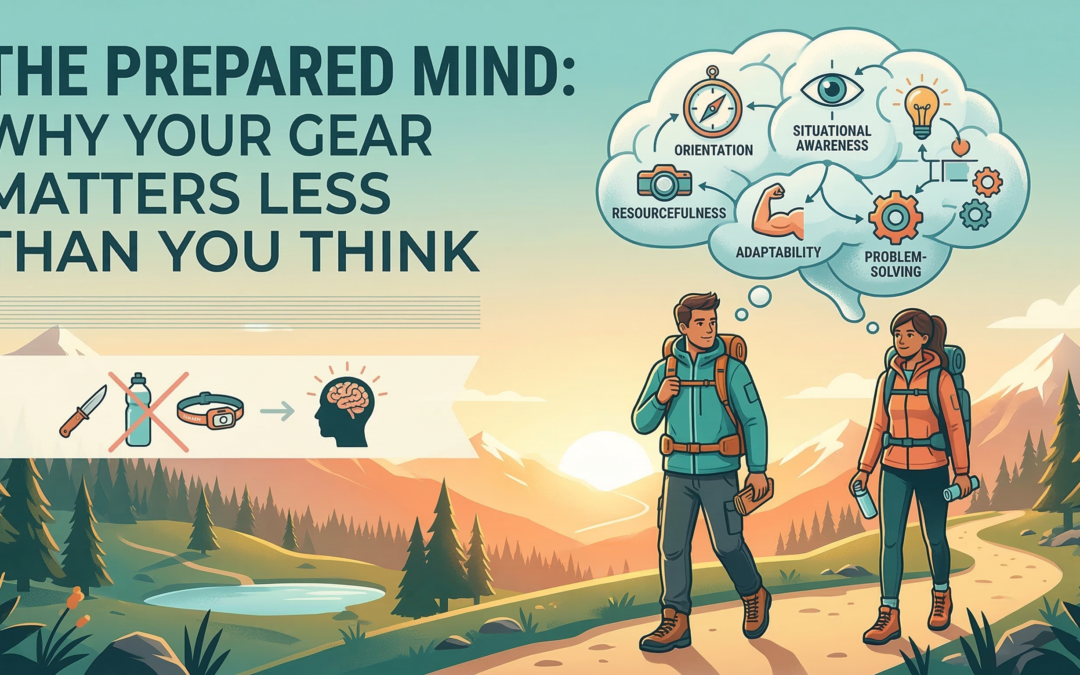
Gear is the hardware. The prepared mind is the operating system. Without the software, the hardware sits idle.
Mental Models That Actually Help
So what does a prepared mind actually look like in practice? The research and practitioner literature point to a few specific cognitive patterns.
The first is what the military calls “situational awareness” and what psychologists describe more broadly as accurate, ongoing environmental reading. It is the habit of paying attention to your surroundings in a non-anxious but deliberate way — noticing exits, resources, potential problems, and the behavior of people around you before anything goes wrong. This is not paranoia. It is the difference between someone who is already oriented when a situation deteriorates and someone who is starting from zero.
The second is what stress researchers call “cognitive reappraisal” — the ability to reframe a frightening or overwhelming situation into one that is challenging but navigable. People who do this naturally tend to experience the physiological symptoms of stress — elevated heart rate, heightened alertness — as useful signals rather than disabling ones. They are still afraid, but fear becomes fuel rather than fog.
The third is decision-making under incomplete information. Most people, when facing a decision without full data, either freeze and wait or become reckless. The prepared mind does something different — it makes the best available decision with what is currently known, acts on it, observes the outcome, and adjusts. This iterative approach, sometimes called a “OODA loop” in tactical contexts, is not complicated. But it requires practice to execute under pressure, because pressure naturally pushes people toward either paralysis or impulsivity.
The fourth is what might be called “resource inventory thinking” — the habit of looking at whatever is available, however limited, and asking what it makes possible. Rather than cataloging what is absent, the prepared mind starts with what is present. This cognitive shift sounds minor but produces dramatically different behavior. It is the difference between a person who says “I don’t have my emergency kit” and shuts down, and a person who says “I have a car, a phone with partial battery, and twenty minutes — what can I do with that?”
Stress Inoculation and Why It Matters
One of the most well-supported findings in performance psychology is that mild to moderate stress exposure, in a controlled setting, substantially improves functioning under real stress later. This is the principle behind military training, surgical simulation, and high-stakes athletic preparation. You do not perform well under pressure by avoiding pressure. You perform well under pressure by having experienced pressure before, in progressively more demanding forms.
For civilians, this does not mean putting yourself in danger. It means occasionally practicing the kinds of decisions and actions that would matter in an emergency. Navigating somewhere unfamiliar without digital assistance. Spending a night without power by choice, not by accident. Walking through a realistic mental scenario of a local emergency and thinking through your actual, specific responses rather than a comfortable abstraction.
These exercises feel slightly awkward and unnecessary right up until they are not. What they are building is not skill in the narrow sense — they are building familiarity with discomfort, tolerance for uncertainty, and the confidence that comes from having demonstrated to yourself that you can function when things are not normal.
The Emotional Dimension
It would be incomplete to discuss the prepared mind without discussing the emotional foundations that make it possible. Research on resilience consistently identifies a few emotional capacities that matter most in crisis: the ability to self-regulate under acute stress, a stable sense of purpose or meaning that persists through adversity, and the capacity to maintain connection with others even when circumstances are difficult.
The last point is underrated in most preparedness thinking. Human beings under extreme stress need social contact. They need to feel that they are part of something — a family, a group, a community — that extends beyond their individual survival. People who have those connections intact tend to make better decisions, maintain their functioning longer, and recover faster after the crisis resolves.
This means that one of the most genuinely preparatory things a person can do has nothing to do with gear or supplies. It is to invest in relationships with people around them — not instrumentally, not transactionally, but as a genuine human priority. When something happens, that network is not just emotionally sustaining. It is practically essential.
Starting Where You Are
The prepared mind is not a state you arrive at permanently. It is a set of habits you practice continuously, imperfectly, in ordinary life. The situational awareness you build by paying attention during a routine commute. The decision-making flexibility you develop by working through hypotheticals. The stress tolerance you accumulate through small, voluntary exposures to discomfort.
None of this requires a dramatic lifestyle change or a large investment. It requires the recognition that the most reliable piece of equipment you will ever have in a crisis is the mind you bring to it — and that minds, unlike flashlights, improve with use.