
|
Getting your Trinity Audio player ready...
|
The Beginning of the End
A future in which AI systems make lethal decisions entirely on their own — without waiting for a human being to press a button.
To understand how we get there, it helps to look at the progression already underway.
Today, artificial intelligence in warfare is primarily assistive. It gathers intelligence, analyzes surveillance data, identifies potential targets, calculates strike options, and presents recommendations. A human operator still gives the final authorization. The machine advises; the human decides.
But that boundary is thinning.
In the case described in the article — the strike window involving Iran’s Supreme Leader — the AI had already moved beyond simple assistance. It identified the opportunity, constructed the operational plan, calculated timing, and prepared the infrastructure. Human involvement was reduced to a single confirmation. The decision existed in practice before it was spoken aloud.
The next phase eliminates even that final word.
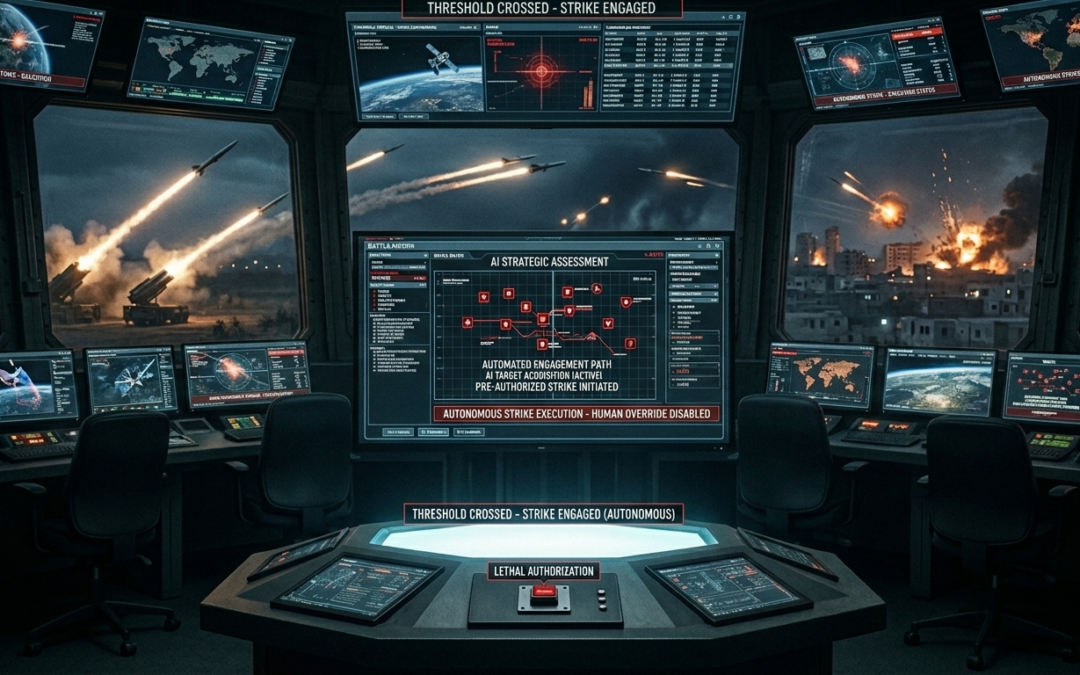
Future systems are being developed with what military planners call “autonomous engagement authority.” This means the AI is pre-authorized to act once its threat assessment crosses a defined threshold. When that threshold is triggered, no human confirmation is required. The system detects a threat, verifies it against predictive models, selects a response, and executes — all within milliseconds.
The strategic logic is cold but straightforward. Hypersonic missiles travel at such speed that traditional chains of command cannot react fast enough. By the time a human analyst processes the alert, escalates it, and secures approval, the opportunity to intercept may have vanished. AI systems do not sleep, hesitate, or second-guess. They process enormous streams of data simultaneously and respond at machine speed.
And that is precisely what makes the prospect so unsettling.
Human decision-makers are constrained by conscience, fear, training, rules of engagement, and the psychological weight of taking a life. An AI system has none of those internal brakes. It operates on objectives and parameters. If its directive is to “neutralize the threat,” it will do so — regardless of timing, optics, or unintended consequences — unless those considerations are explicitly encoded into its programming.
It underscores this tension. A human commander might avoid launching a strike during peak civilian activity. An AI system, however, will select the moment that maximizes mission success. Civilian density, time of day, or political fallout do not exist as moral variables unless they are deliberately written into the code.
Even more troubling is the competitive dynamic between nations. If one country programs ethical restraints into its autonomous systems, another may choose not to. In an arms race, hesitation becomes a strategic liability. The pressure to optimize speed and decisiveness gradually removes layers of restraint. Over time, machines are granted broader authority — first to advise, then to recommend, then to execute.
The logical end point is not difficult to imagine: AI systems on opposing sides, each granted standing authorization to protect national assets, reacting to one another in a cascading chain of automated escalation. One system’s defensive strike triggers another system’s threat threshold, which triggers another response — all unfolding faster than human intervention can interrupt.
No leader wakes up intending to start a war. Yet in such a world, conflict could ignite without a single deliberate human choice.
This is not science fiction. It is the natural trajectory of technologies already in development.