
|
Getting your Trinity Audio player ready...
|
Prophets, Empires & the Modern World Part VI : The Reckoning — From the Twelve-Day War to the Edge of the Abyss
Where History Arrives
There is a particular kind of vertigo that comes from watching a long historical argument collapse into the present tense. Across five installments, this series has traced a thread that begins with the theological fractures between Judaism, Christianity, and Islam; winds through the trauma of Karbala and the slow death of the Ottoman Caliphate; passes through the immigration waves that reshaped Palestine and the founding of Israel in 1948; and arrives at the geopolitical architecture of petrodollars, proxy networks, and manufactured dependency that has defined the Middle East for eighty years.
We argued, in Part V, that this architecture was not accidental — that Israel was embedded in the Arab world as a permanent source of strategic anxiety, that Arab monarchies were kept in a loop of fear and financial dependence, and that Iran’s crime, in Western eyes, was not its theocracy but its insistence on controlling its own resources. We noted that the confrontation between Israel and Iran was building toward something. We could not have known, at the time of writing, how quickly it would arrive.
In June 2025, it arrived.
The Twelve-Day War
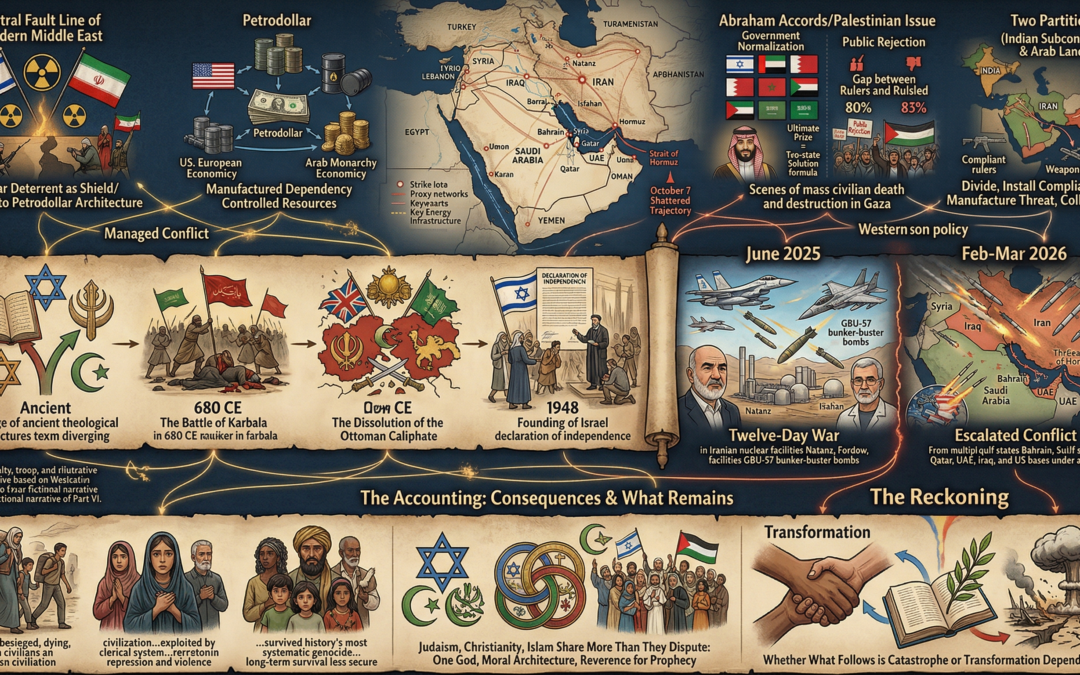
Israel launched attacks on Iran in June 2025, targeting nuclear facilities, military sites, and regime infrastructure. The opening salvo was devastating in its precision. Conducted by 200 Israeli fighter jets striking more than a hundred targets, it killed top military leaders — most notably Hossein Salami, the head of the Islamic Revolutionary Guard Corps; Mohammed Bagheri, the chief of staff of the armed forces; and Amir Ali Hajizadeh, the commander of the IRGC’s air force — as well as several nuclear scientists.
Nine days later, the United States entered directly. On June 22, 2025, the United States Air Force and Navy attacked three nuclear facilities in Iran under the code name Operation Midnight Hammer. The Fordow Uranium Enrichment Plant, the Natanz Nuclear Facility, and the Isfahan Nuclear Technology Center were targeted with fourteen GBU-57A/B bunker-buster bombs carried by B-2 Spirit stealth bombers and Tomahawk missiles fired from a submarine.
The Iranian Health Ministry reported that around 1,062 people were killed. In Israel, 29 people were killed. A ceasefire was announced on June 24, 2025. The conflict lasted twelve days.
The debate over what the strikes actually achieved will continue for years. The Israeli-US military campaign inflicted heavy damage but did not eliminate Iran’s nuclear program. Iran’s nuclear knowledge, its stockpile of enriched uranium, its centrifuge manufacturing capacity, its third underground enrichment site, and its determination to keep the program going remain. The IAEA director-general assessed that Iran could resume uranium enrichment in a matter of months. The CIA director offered a more optimistic assessment, claiming facilities were “severely damaged” and would take years to rebuild. The truth, as is often the case in military assessments issued under political pressure, probably lies somewhere between these two positions.
What is not in dispute is the strategic significance of what happened. For the first time in decades, American forces struck Iranian soil directly. The red line that had been approached so many times — through sanctions, through proxy wars, through covert assassinations of nuclear scientists, through the Stuxnet cyberattack — had been crossed. The confrontation that this series identified as the central fault line of the modern Middle East had become a shooting war.
The Prophecy That Wasn’t a Prophecy
In Part V of this series, we made an observation that now reads as almost prophetic: that America’s concern about Iran’s nuclear program was not primarily about the bomb itself, but about what the bomb represented — a guarantee against regime change, a shield behind which Iran could consolidate its influence over Iraq, Syria, Lebanon, and Yemen, and a direct challenge to the petrodollar architecture that has sustained Western dominance of the Middle East since 1945.
We also noted the practical paradox: that Iran could not use a nuclear weapon against Israel without destroying Muslim-majority cities in the blast radius, and could not reach the American mainland without capabilities it did not possess. The nuclear program, we argued, was a deterrent — not an offensive tool.
Prior to Israel’s attack, there was no imminent threat posed by Iran’s nuclear program, and diplomacy had not been exhausted. U.S. intelligence agencies assessed that Iran’s leaders had not yet decided to build a bomb, and it would take a year or more to assemble a deliverable warhead. The IAEA director-general stated plainly, days before the American strikes, that his agency “did not have proof of a systemic effort by Iran to move into a nuclear weapon.” These were not minor caveats buried in classified documents. They were the considered assessments of the world’s leading nuclear monitoring body, delivered publicly, before the bombs fell.
The strikes proceeded regardless.
This gap — between the stated justification and the known facts — is not incidental. It is the heart of the matter. The Twelve-Day War was not a response to an imminent threat. It was the culmination of a decades-long project to destroy Iran’s capacity for strategic autonomy. Understanding this does not require excusing Iran’s behavior — its support for proxy militias, its domestic repression, its repeated threats against Israel are all real and documented. It requires only reading the sequence of events honestly: negotiations were underway, diplomacy was not exhausted, and the strikes were launched anyway.
The War That Would Not End
The ceasefire of June 24, 2025 did not hold as a political settlement. On February 28, 2026, Israel launched coordinated strikes on Iranian targets, including sites in and around Tehran. Trump announced that the operation’s objective was “to defend the American people by eliminating imminent threats from the Iranian regime.”
Iran responded to these strikes with missile and drone attacks against Israel, while also targeting other countries in the region that host US military facilities — including Bahrain, Saudi Arabia, Qatar, the United Arab Emirates, and Iraq. The conflict had metastasized. What began as a targeted campaign against nuclear facilities was now a regional war, with missiles falling on Gulf capitals, American military bases under attack, and the Strait of Hormuz — through which nearly a fifth of the world’s oil and gas passes — under threat of closure. The Iranian parliament approved a motion calling for the closure of the Strait of Hormuz as a retaliatory measure. Whether or not Tehran would follow through, the mere possibility sent tremors through global energy markets.
The world that exists as this series concludes — in March 2026 — is more dangerous than the world that existed when we began. The architecture this series has described, built over a century, is now cracking under its own weight.
The Abraham Accords: A Dream Interrupted
One of the most consequential near-events of this era was the normalization of relations between Saudi Arabia and Israel — a deal that, had it been completed, would have represented the most significant reconfiguration of Middle Eastern politics since the founding of Israel itself.
This arrangement was reportedly nearing completion shortly before Hamas carried out its attack on Israel on October 7, 2023, and included undefined assurances that steps would be taken to improve the lives of Palestinians. The Abraham Accords, signed in 2020 between Israel and the UAE, Bahrain, Morocco, and Sudan, had already broken the Arab consensus that normalization must be preceded by Palestinian statehood. Saudi Arabia, the custodian of Islam’s holiest cities and the most symbolically significant Arab state, was to be the capstone.
October 7 shattered that trajectory. The war in Gaza that followed produced scenes of mass civilian death, famine, and destruction that Arab publics could not ignore — regardless of what their governments were willing to sign. In a survey conducted across sixteen Arab countries between December 2023 and January 2024, 89 percent of respondents rejected recognition of Israel outright, compared to 4 percent who supported it. In the case of Saudi Arabia, those rejecting normalization had grown by 30 percent in a single year.
Saudi Arabia plays a unique role as the “ultimate prize” of normalization. The kingdom differs fundamentally from the small Gulf states — in size, in its responsibility as custodian of the holy places for the Muslim world, and in its position on the Palestinian issue. Following MBS’s visit to Washington in November 2025, Saudi Crown Prince Mohammed bin Salman told reporters: “We want to be part of the Abraham Accords, but we want also to be sure that we secure a clear path toward a two-state solution.” The formula has not changed in substance since the Arab Peace Initiative of 2002: normalization in exchange for a Palestinian state. Israel has never accepted this formula, and shows no sign of accepting it now.
What the Abraham Accords revealed, however, is something important: that Arab governments and Arab publics are not the same thing. The governments were willing to normalize. The publics were not. This gap between rulers and ruled — sustained for decades by the very structure of authoritarianism that American policy has supported — may be the most dangerous fissure in the entire system. When it closes, it will close suddenly.
The Two Partitions, Revisited
We began this series with theology and ended with missiles. But the connective tissue between them has always been the same: the question of who controls the land, the resources, and the narrative of sacred geography.
Britain partitioned two worlds after World War II — the Indian subcontinent and the Arab lands of the former Ottoman Empire. Both partitions were designed to produce managed conflict: conflict sufficient to generate dependency, but not so catastrophic as to destroy the revenue stream. India and Pakistan have fought four wars, come to the nuclear brink twice, and continue to purchase weapons from the same Western suppliers. Palestine was absorbed into Israel, its people dispersed across refugee camps and diminished territories, their cause alternately championed and abandoned by Arab governments who used it as political currency while investing their oil revenues in Western banks.
The pattern in both cases is the same: divide the people, install compliant rulers, manufacture a permanent security threat, and collect the proceeds. When a leader breaks the arrangement — as Gaddafi did, as Saddam did, as Mossadegh did in Iran in 1953, as Khomeini did in 1979 — the machinery of removal is activated. The assets are frozen. The opposition is funded. The narrative is shifted. And if none of that works, the bombers are dispatched.
What has changed, in 2026, is that the machinery is visible. The justifications have worn thin. The gap between what Western governments say — about democracy, sovereignty, international law, and human rights — and what they do has become impossible to paper over with diplomatic language. The IAEA said Iran posed no imminent nuclear threat. The bombs fell anyway. The UN Security Council has passed resolutions on Palestinian rights for seventy years. They have been vetoed or ignored. The International Court of Justice issued a ruling on the situation in Gaza. It was disregarded.
The question is not whether the world can see this clearly. The question is what it will do about it.
What Remains
This series has not been an argument for any particular political solution. It has been an attempt to trace honestly how the present came to be — through theology, through empire, through oil, through the long aftermath of decisions made in the corridors of London and Washington and, before them, in the courts of the Umayyads and the Ottomans.
The Muslim world sits at a crossroads that it has occupied before. After the fall of the Abbasid Caliphate to the Mongols in 1258, it recovered. After the slow dissolution of the Ottoman Caliphate — which we examined in Part III — it fractured into the nation-states that now struggle against each other in ways that serve everyone’s interests except their own peoples’. After Karbala, the wound took centuries to express itself in geopolitical form. History is patient in ways that contemporary politics is not.
What the current moment demands is clarity about causes. The Israeli-Palestinian conflict is not, at its root, a religious war between Jews and Muslims. It is a political conflict over land, sovereignty, and resources — one that has been systematically theologized by all sides, because theological framing is more emotionally mobilizing and more difficult to negotiate than political framing. The Iran-Israel confrontation is not, at its root, a clash of civilizations. It is a competition over regional hegemony and resource control — one that has been framed as an existential ideological war because that framing serves the interests of those who profit from the conflict.
The Palestinian people are not abstractions in this story. They are a population of millions, displaced, besieged, and dying — in numbers that, as this final installment is written, continue to rise. The Iranian people are not abstractions. They are a civilization of extraordinary depth and antiquity, whose legitimate grievances against external interference have been exploited by a clerical system that has its own record of repression and violence. The Israeli people are not abstractions. They are the descendants of a people who survived history’s most systematic genocide, built a state against extraordinary odds, and now find themselves led by governments whose policies are making their long-term survival less, not more, secure.
None of these peoples are served by the architecture of permanent war. All of them are imprisoned by it.
The Thread That Began in the Desert
We began this series with a question embedded in the origins of monotheism itself: what happens when the children of a single revelation diverge so profoundly that they can no longer recognize each other? Judaism, Christianity, and Islam share more than they dispute. They share a God, a moral architecture, a reverence for prophecy, and a belief that history is moving toward something — toward justice, toward judgment, toward an accounting.
The accounting, in the form that history delivers it, does not come with trumpets. It comes in the form of consequences — of actions taken and not taken, of opportunities for peace declined, of the slow accumulation of injustice until the weight of it becomes insupportable.
We are living, in 2026, in the middle of that accumulation. Whether what follows is catastrophe or transformation depends on choices that have not yet been made — by leaders who have not yet found the courage to make them, and by peoples who are only beginning to understand how thoroughly they have been managed.
The prophets are gone. The empires are dying. What remains is us — and the question of what kind of modern world we choose to build from the wreckage of the one being destroyed.