
|
Getting your Trinity Audio player ready...
|
Prophets, Empires & the Modern World
Part IV: The Slow Collision — From Karbala to the Creation of Israel
One Faith, Three Trajectories
To understand why the modern Middle East is what it is — why Jerusalem is contested, why Jews and Muslims stand on opposite sides of a conflict that shows no sign of resolution — you have to go back further than 1948. You have to go back to the very architecture of the Abrahamic faiths themselves.
The Torah was the first of God’s revealed books to humanity; the Psalms of David, the second. Both contain references to a final prophet — a Messiah — whose coming would mark the completion of divine guidance to mankind. This expectation was embedded in Israelite tradition, in the teachings of David and Solomon, and it became the central tension around which the three great monotheistic religions would fracture.
When Jesus appeared, the early Christians identified him as the promised Messiah. The Jews refused. For Judaism, the prophetic chain stopped at that moment of refusal — not out of stubbornness, as its critics often charge, but out of genuine theological conviction that the criteria for the Messiah had not been met. Jesus himself, according to the Gospel of John, appears to have indicated that the one who was to come would be after him — and would be the final prophet. Christianity, nonetheless, declared Jesus to be the Messiah, the Son of God, and the seal of divine revelation. And so Christianity, too, stopped at its own moment.
When the Prophet Muhammad arrived six centuries later with the final message, both traditions rejected it. The Jews, who had already closed their prophetic canon, saw no reason to reopen it. The Christians, having already assigned the role of final prophet to Jesus, could not accommodate another. And so three distinct communities solidified around three distinct stopping points — separated by theology, yet bound together by an extraordinary amount of shared belief: one God, angels, revealed scripture, and the Day of Judgment. In the words of the Quran itself, they are communities of a single chain.
One geographical fact bound all three together: Jerusalem. The Torah was revealed in its orbit. The Psalms and the Solomonic tradition pointed toward it. Jesus preached, suffered, and — according to Christian belief — rose from the dead within its walls. And Islam, though it emerged in Mecca and Medina and eventually reoriented its prayer toward the Kaaba, retained a deep spiritual connection to Jerusalem through the Prophet’s Night Journey and Ascension. For seven centuries after Jesus, Jews and Christians managed, through war and accommodation, to find an uneasy coexistence around the city. Then Islam arrived — and the city acquired a third claimant.
The Wound at Karbala and Its Political Aftermath
The Muslim community had been torn in two before it fully consolidated. The Battle of Siffin during the caliphate of Ali ibn Abi Talib set the Islamic world on a trajectory that would define its political geography for centuries. The Hijaz — the sacred heartland of Islam, encompassing Mecca and Medina — fell under the authority of Ali’s household. Syria came under Muawiyah ibn Abi Sufyan, who established the Umayyad dynasty with Damascus as its capital. After the assassinations of Ali and later his son Hasan, even the Hijaz was absorbed into the Umayyad state. Only Mecca and Medina retained a certain moral distance.
Then came Karbala. In 680 CE, on the tenth of Muharram, Husayn ibn Ali — the grandson of the Prophet — was killed along with nearly all the male members of his family on the plains of Iraq, at the hands of the Umayyad army of Yazid ibn Muawiyah. Only Husayn’s son Ali ibn Husayn, known as Zayn al-Abidin, survived, spared by illness. The massacre was militarily decisive but morally catastrophic for the Umayyads. It handed their opponents an indictment that could never be fully answered. As we examined in Part III of this series, the shadow of Karbala would stretch across centuries, eventually shaping the fault lines of modern geopolitics.
For the Umayyads, one consequence was practical and immediate: they had conquered a vast empire but could not comfortably enter its holiest cities. The Hijaz became psychologically — and at times physically — hostile territory. Pilgrimage to Mecca, one of Islam’s most fundamental obligations, became politically complicated.
The Caliph Who Reengineered Holiness
It was in this context that one of the most consequential architectural decisions in human history was made.
Abd al-Malik ibn Marwan was the fifth Umayyad caliph, ruling from 685 to 705 CE — a reign of twenty years that transformed both the administration and the physical landscape of the Islamic world. He was, by most accounts, a formidable ruler: a member of the first generation of born Muslims, his early life in Medina was occupied with religious pursuits. He standardized the coinage of the caliphate, arabized its bureaucracy, and crushed a series of internal revolts that had threatened Umayyad rule.
One revolt in particular forced his hand. Abdullah ibn al-Zubayr, based in Mecca, had challenged Umayyad legitimacy and controlled the Kaaba — the most sacred site in Islam. When Abd al-Malik began construction on the Dome of the Rock, he had not yet retaken control of the Kaaba.
Between 685 and 692 CE, Abd al-Malik commissioned the construction of an extraordinary monument on the Temple Mount in Jerusalem — the Dome of the Rock, known in Arabic as Qubbat al-Sakhra. Construction was ordered during the Second Fitna (the second Islamic civil war), and completed in 691–692 CE. The monument stands upon the site of the Second Jewish Temple, which was destroyed by the Romans in 70 CE. The two principal architects were Raja ibn Haywa, a Muslim theologian and jurist from Beisan (Beit She’an, in present-day northern Israel — not Damascus, as some sources erroneously claim), and Yazid ibn Salam, a client of Abd al-Malik from Jerusalem.
Why did Abd al-Malik build it? This question has generated genuine controversy among historians for over a millennium. One widely accepted explanation holds that Abd al-Malik intended the Dome of the Rock as a monument of Islamic victory over Christianity — a statement of Islam’s unique theological position within the Abrahamic religious landscape of Jerusalem, home of the two older revealed faiths. The inscriptions inside the dome, which directly address Christian theology by rejecting the Trinity and the divinity of Jesus, strongly support this interpretation.
A more controversial explanation, recorded by the 9th-century historian al-Yaqubi, alleges that Abd al-Malik sought to divert pilgrims away from Mecca — where his rival Ibn al-Zubayr was using the Hajj season to extract pledges of allegiance from Syrian Muslims — and toward Jerusalem instead. According to this account, Abd al-Malik told his subjects that the Rock from which the Prophet ascended to heaven could serve in place of the Kaaba for their obligatory circumambulation.
Most modern historians reject this account as anti-Umayyad propaganda, likely originating in Shia or Abbasid sources hostile to the Umayyad legacy, and consider it implausible that Abd al-Malik would attempt to replace one of Islam’s Five Pillars. However, other scholars caution against dismissing it entirely, noting that such accounts cannot be conclusively disproven. What is not disputed is the result: the Dome of the Rock became one of the most spectacular structures in the world — the oldest extant Islamic monument — and it permanently and irrevocably transformed the sacred geography of Jerusalem.
What matters for our story is what Abd al-Malik built over and upon. The Temple Mount — known to Muslims as al-Haram al-Sharif, the Noble Sanctuary — was the site of Solomon’s Temple and the Second Temple that replaced it after the Babylonian exile. It was the holiest ground in Judaism. Among Jews, the Rock at the center of the Dome is considered the spot where Abraham prepared to sacrifice Isaac and the site of Solomon’s original Temple. Among Muslims, it is the very rock from which the Prophet Muhammad was taken up to heaven during the Mi’raj. By constructing this monument on the ruins of both Jewish temples, Abd al-Malik — whatever his precise intentions — ensured that the most politically charged patch of earth in the world would become inextricably tied to Muslim sovereignty. The problem this created has not been resolved to this day.
Zion: A Mountain, A Symbol, A Movement
Before we arrive at the 20th century and the founding of Israel, we need to understand one word that has come to define a global political movement: Zion.
Zion, or Mount Zion, is a hill in Jerusalem — adjacent to the Temple Mount. It is the site of the Tomb of David, making it sacred to both Jews and Christians. It was on this hill that Jesus observed the Last Supper; it was here that Mary, according to Christian tradition, passed away; it is here that important Christian churches of Jerusalem stand. The six-pointed Star of David — the hexagram that appears on the Israeli flag — became associated with the Davidic royal tradition and appears prominently on David’s tomb on Mount Zion.
In 586 BCE, the Babylonian king Nebuchadnezzar conquered Jerusalem, destroyed Solomon’s Temple, and deported the Jews to Babylon. During their captivity, some Jews settled near a place called Tel Aviv — an Akkadian/Hebrew phrase meaning “hill of the spring flood” or “mound of ruins.” When they finally returned to Jerusalem under Cyrus the Great, they rebuilt on the ruins of Solomon’s Temple — what historians call the Second Temple. When modern Jewish immigrants began building their first modern city in Palestine in 1909, they named it Tel Aviv — a deliberate act of historical memory, reclaiming the name associated with their ancient exile and turning it into a symbol of homecoming.
It was during the Babylonian captivity that the concept of political return to Zion — a disciplined, organized effort to recover the ancestral homeland through leveraging relationships with great powers — was first practiced in recorded history. When Cyrus conquered Babylon in 539 BCE and issued his famous decree permitting the Jews to return to their homeland, it represented, from a Zionist perspective, the prototype of all future Jewish political organizing: a minority people using their relationships with the dominant imperial power to reclaim their ancestral land. Twenty-five centuries later, an Austro-Hungarian journalist named Theodor Herzl would consciously revive this tradition.
The Man Who Dreamed a State Into Existence
Theodor Herzl (1860–1904) was a Hungarian-born, Vienna-based journalist and lawyer who became the father of modern political Zionism. Born on May 2, 1860, in Pest (the eastern half of what is now Budapest), he moved to Vienna with his family in 1878 following the death of his sister. He studied law at the University of Vienna, where he briefly pursued a legal career before devoting himself entirely to journalism and literature. He eventually became the Paris correspondent and later the literary editor of the prestigious Viennese newspaper Neue Freie Presse.
[Correction note: Some earlier accounts describe Herzl as a “Swiss journalist” — this is incorrect. Herzl was Austro-Hungarian, born in Budapest and based in Vienna throughout his career. The First Zionist Congress was held in Basel, Switzerland, but Herzl himself was not Swiss. This distinction matters because Herzl’s identity as a product of Central European Jewish emancipation — educated, assimilated, and yet still exposed to violent antisemitism — was precisely what drove his political vision.]
Herzl was, by his own account, not particularly preoccupied with Jewish identity in his early life. That began to change in 1894, when he covered the Dreyfus Affair as Paris correspondent — the trial of Alfred Dreyfus, a Jewish French army captain falsely convicted of espionage — and witnessed the explosion of antisemitic sentiment in what was supposed to be the most enlightened country in Europe. It is worth noting that some modern scholars, examining Herzl’s diaries closely, believe the Dreyfus affair’s impact on his conversion to Zionism has been somewhat overstated in the popular account; several argue that the rise to power of the antisemitic demagogue Karl Lueger in Vienna in 1895 may have had an equal or greater influence. Herzl himself, however, stated that the Dreyfus case was the decisive turning point.
In February 1896, Herzl published the pamphlet Der Judenstaat — The Jewish State — arguing that after centuries of restrictions, pogroms, and hostilities, the Jews of Europe had no secure future in the countries that persecuted them. His argument was not primarily religious but political: the Jews were a nation, and a nation required a state.
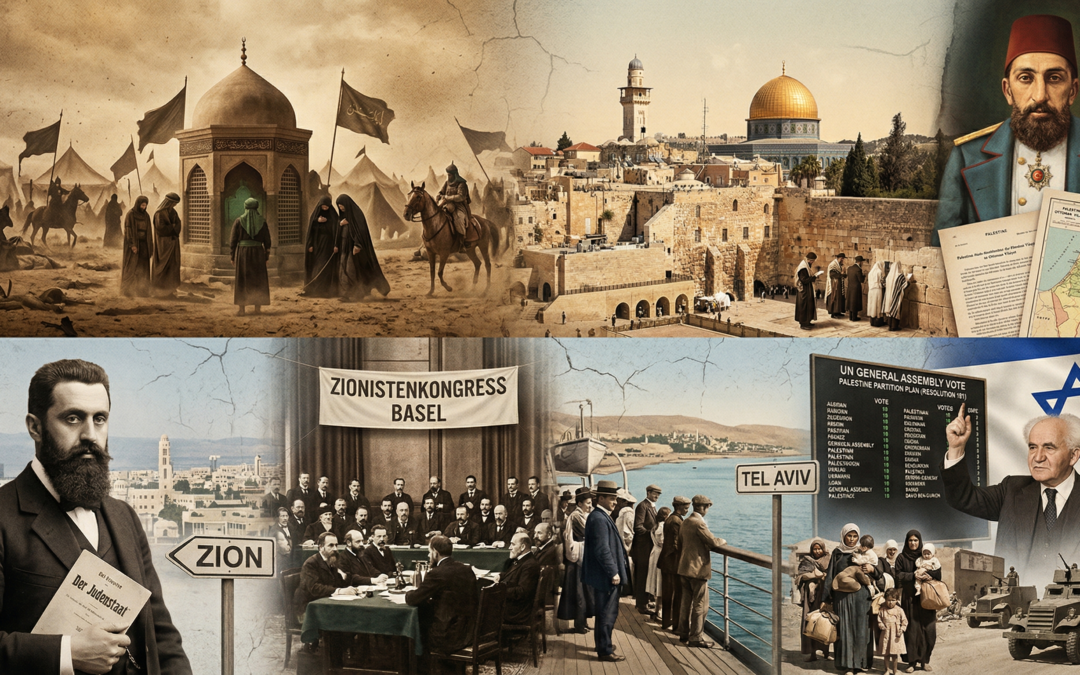
In August 1897, Herzl convened the First Zionist Congress in Basel, Switzerland. The original venue in Munich had been blocked by opposition from local Jewish leaders who feared the event would jeopardize their community’s standing, so Basel was chosen as an alternative. Approximately 200 delegates from seventeen countries attended — the precise number is disputed in the historical record, with figures ranging from 197 to 208 — along with 26 press correspondents. After the Congress, Herzl wrote privately in his diary on September 3, 1897, with characteristic precision: “At Basel I founded the Jewish State. If I said this out loud today I would be greeted by universal laughter. Perhaps in five years, and certainly in fifty, everyone will know it.” The UN General Assembly passed its partition resolution for Palestine exactly fifty years later, in November 1947. The State of Israel was declared fifty-one years after Herzl’s diary entry, in May 1948.
The Congress established the World Zionist Organization and adopted the Basel Program, declaring Zionism’s goal as securing a publicly recognized, legally guaranteed homeland for the Jewish people in Palestine.
The Ottoman Wall
Palestine in the late 19th century was part of the Ottoman Empire, and Jewish settlement there was heavily restricted. The Ottoman authorities had, since 1882, formally prohibited Jewish settlement specifically in Palestine while permitting Jewish immigration elsewhere in the empire. By 1845, the Jewish population of all of Palestine stood at roughly 12,000 out of a total population of several hundred thousand — representing approximately 4 percent of the inhabitants.
Herzl set about changing this through high-stakes diplomacy. In May 1901, he secured a personal audience with Sultan Abdul Hamid II in Istanbul — the first time the Sultan had openly received him. Herzl proposed that Jewish financiers could consolidate the Ottoman Empire’s enormous foreign debt in exchange for a charter granting Jewish settlement rights and some form of autonomy in Palestine. The Sultan received him warmly on the personal level, presenting him with the Grand Cordon of the Order of Mejidiye, the highest Turkish decoration, and a diamond tie pin.
However, the diplomatic outcome was a complete failure. The Sultan was willing to allow Jewish immigration to other parts of the empire, but Palestine was explicitly excluded. As subsequent negotiations made clear, Abdul Hamid refused to issue any charter linking debt relief to Jewish settlement in Palestine. His position was unambiguous — and historically famous. He reportedly told intermediaries that he would not sell “even a foot” of that land, for it belonged to his people who had won it with their blood. Herzl described the Sultan as a man who, despite personal warmth, would not move on the fundamental question.
[Important correction: The claim that “by 1902 the Ottomans had relaxed restrictions on Jewish immigration to Palestine” as a result of Herzl’s negotiations is historically inaccurate. Herzl’s negotiations with Abdul Hamid II failed entirely. The Sultan never granted a charter for Palestine. Jewish immigration to Palestine during this period grew despite Ottoman restrictions — primarily because European Jews with foreign citizenship used the capitulations system (protections granted to foreign nationals by their home governments’ consulates) to circumvent Ottoman immigration rules. Herzl himself died in 1904 having never secured a formal Ottoman concession for Palestine.]
Jewish immigration nevertheless continued and accelerated, driven by pogroms and persecution in Eastern Europe and funded by wealthy Jewish philanthropists such as Baron Edmond de Rothschild. According to demographic estimates from this period, the Jewish population of Palestine had grown from around 12,000 in the mid-19th century to somewhere between 60,000 and 85,000 by 1914 — scholars give varying figures. Demographic estimates for the total population of Ottoman Palestine at the outbreak of World War I also vary considerably between sources. Based on scholarly analysis of Ottoman census data, the most widely cited estimates place the total population at roughly 600,000–750,000 people at that time, the overwhelming majority being Muslim and Christian Arabs, with Jews representing approximately 8–12 percent of the total.
Britain’s Promise and the Partition of the Arab World
The decisive external intervention came in 1917. Arthur James Balfour, Britain’s Foreign Secretary, issued a letter dated November 2, 1917, to Lionel Walter Rothschild, 2nd Baron Rothschild, a leader of the British Jewish community, expressing the British government’s support for the establishment of a national home for the Jewish people in Palestine. The letter contained the critical safeguard that nothing should be done to prejudice the civil and religious rights of the existing non-Jewish communities in Palestine — a qualification that would prove hollow in practice. The Balfour Declaration, as it came to be known, was the first formal endorsement by a major world power of the Zionist project.
The context matters. World War I had broken the Ottoman Empire. The victorious Allied powers divided the Arab territories of the former empire into administrative units: Iraq, Syria, Lebanon, Transjordan, and Palestine. Most of these eventually became independent states. Palestine alone was designated a British Mandate — with the Balfour Declaration embedded as its underlying ideological framework. The Arab world, which had fought alongside Britain against the Ottomans in part on promises of independence and self-determination, found itself partitioned and administered by European colonial powers instead. This was not an accident. It was a design.
Between 1920 and 1947, under the British Mandate, Jews from Europe and beyond immigrated to Palestine in waves. By 1948, the Jewish population had reached approximately 630,000. The Arab population — Muslim and Christian combined — was still the majority at over 1.2 million, but the demographic and political balance had been fundamentally transformed within a single generation.
The Birth of Israel
In 1947, an exhausted Britain handed the Palestine question to the newly formed United Nations. On November 29, 1947, the UN General Assembly passed Resolution 181, proposing the partition of Palestine into a Jewish state, an Arab state, and an internationally administered Jerusalem.
The Arab states rejected the partition. The Zionist leadership accepted it and immediately moved to consolidate their position. David Ben-Gurion, who had spent decades building the Haganah and other Jewish paramilitary organizations into a formidable fighting force, reorganized them into the Israel Defense Forces (IDF). On May 14, 1948, as the British Mandate expired, Ben-Gurion declared the establishment of the State of Israel. Within hours, the United States recognized the new state. The first Arab-Israeli war began immediately.
In that war, approximately 700,000–750,000 Palestinian Arabs fled or were expelled from their homes — an event Palestinians call the Nakba, the Catastrophe. The infant state of Israel, facing multiple Arab armies, not only survived but expanded significantly beyond the boundaries the UN partition plan had allocated to it. Ben-Gurion became Israel’s first Prime Minister — the father of a nation whose ideological foundations had been laid in a Basel concert hall fifty-one years earlier.
The story does not end with Israel’s founding. In a sense, it begins there. The dispossession of 1948 left a wound in the Arab world that has never healed — a wound intersecting with the older trauma of Karbala, with the collapse of the Ottoman Caliphate just twenty-four years earlier, and with the emergence of new ideological movements that would transform the struggle for Palestine into a civilizational confrontation. In Part V, we will examine how the fall of the Caliphate in 1924 — the severing of the last institutional link between the Muslim world and its political identity — transformed the conditions under which Israel was born, and ask what it means that two of the most consequential events in modern Islamic history happened within a single generation.
Corrections and Editorial Notes
The following factual errors were identified and corrected in this installment:
1. Herzl’s nationality and residence. He was born in Budapest (then part of the Austro-Hungarian Empire) and lived and worked in Vienna. He is correctly described as Austro-Hungarian, not Swiss. The First Zionist Congress was held in Basel, Switzerland, because Herzl’s preferred venues — Munich and Vienna — faced opposition from local Jewish community leaders who feared the event would endanger their hard-won civil standing.
2. The Dome of the Rock architect Raja ibn Haywa. He was from Beisan (Beit She’an, in present-day northern Israel), not Damascus.
3. Abd al-Malik’s motivation for building the Dome of the Rock. The claim that the monument was built specifically to divert Hajj pilgrims away from Mecca is a historically contested thesis recorded by the 9th-century Shia historian al-Yaqubi. The majority of modern scholars regard it as anti-Umayyad propaganda and consider it implausible that a caliph would attempt to override one of Islam’s Five Pillars. The more widely accepted view is that the Dome was built as a monument of Islamic triumph and theological distinctiveness over Christianity. Both interpretations have been represented accurately in this text.
4. Herzl’s Ottoman negotiations — the most significant factual correction. The original source material claims that Herzl’s 1901 meeting with Sultan Abdul Hamid II resulted in relaxed Ottoman restrictions on Jewish immigration to Palestine by 1902. This is historically incorrect. Herzl’s negotiations with the Sultan failed completely. Abdul Hamid II refused to grant any charter linking Palestinian land to Jewish settlement, regardless of financial incentives offered. The Sultan reportedly told intermediaries he would never sell Ottoman land. Herzl himself departed Istanbul in diplomatic failure and died in 1904 without securing any Ottoman agreement. Jewish immigration to Palestine grew during this period not because of Ottoman concessions but despite Ottoman restrictions, primarily through the capitulations system that protected foreign nationals from Ottoman legal jurisdiction.
5. Palestine’s population in 1914. The text’s original figure of “1.3 million people, roughly 1.1 million Muslim Arabs, 200,000 Christian Arabs, and 85,000 Jews” is overstated. Scholarly estimates based on Ottoman census data and demographic analysis place the total population of Ottoman Palestine at the outbreak of World War I at approximately 600,000–750,000, not 1.3 million. Justin McCarthy’s detailed study of Ottoman census data gives approximately 657,000 Muslim Arabs, 81,000 Christian Arabs, and 59,000 Jews. Other demographic estimates give higher Jewish figures (up to 94,000) but the total population figures remain well below 1.3 million. The text has been revised to reflect this range with appropriate scholarly qualification.
6. Herzl’s diary entry and the timing of Israel’s founding. The original text states Herzl “was off by exactly one year” when he predicted the Jewish state would be recognized within fifty years. In fact, the UN partition resolution — the formal international recognition of the principle of Jewish statehood — was passed exactly fifty years after his diary entry (November 1947 vs. September 1897). The Declaration of Independence was proclaimed fifty-one years later (May 1948). The text has been clarified to reflect this distinction accurately.