|
Getting your Trinity Audio player ready...
|
A Comprehensive Overview of Government, Private & International Schools Across the Gulf
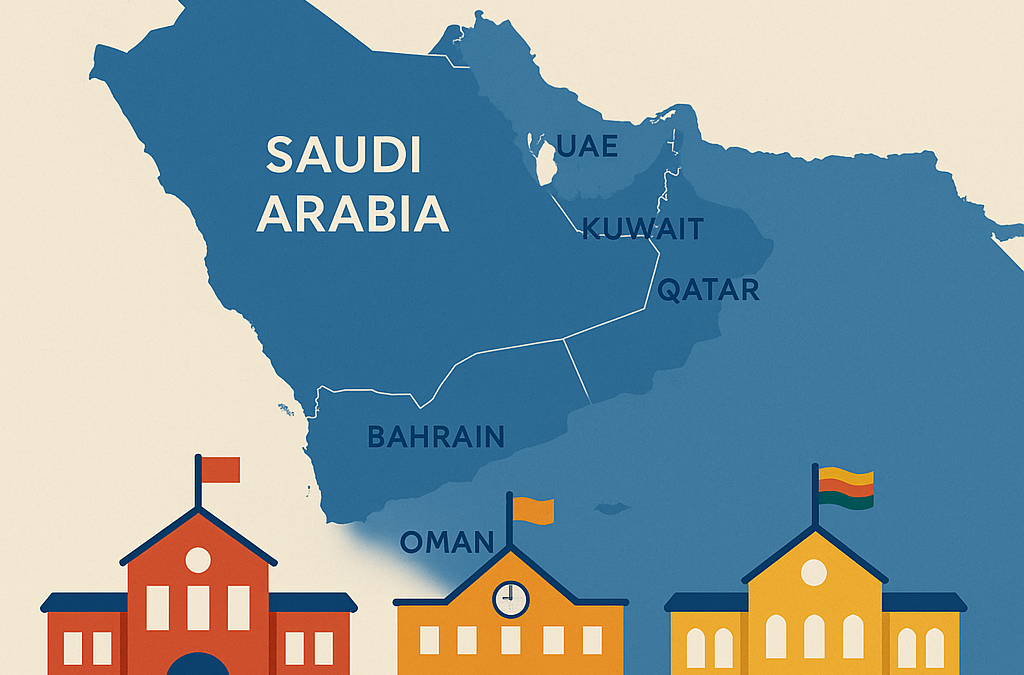
The Gulf Cooperation Council (GCC) continues to experience rapid growth in the education sector, driven by population expansion, economic diversification, and national visions focused on human capital development. As of 2025, the GCC hosts tens of thousands of schools across government, private, and international sectors, reflecting a dynamic and competitive educational environment.
This report summarizes the latest available school counts for each GCC country, highlights important trends, and provides a consolidated view of the regional education ecosystem.
- Country-by-Country Breakdown (2025 Updates)
Saudi Arabia
Saudi Arabia remains the largest education market in the GCC, with one of the most extensive public-school networks in the world.
Latest published statistics show:
- Government Schools: 24,384
- Private Schools: ~6,847
- International Schools: ~100+ (varies by definition/curriculum)
Saudi Arabia’s private sector continues to grow steadily, driven by Vision 2030 reforms and strong demand from expatriate communities. Public schools still account for the majority—more than 78% of all schools.
United Arab Emirates
Data availability varies across emirates, but Dubai is the most transparent and internationally benchmarked.
Dubai Alone (2024–2025):
- Private Schools: 227
- International Schools: Included within private categorization
UAE-Wide Estimates:
- Government Schools: ~300–400
- Private Schools: ~580+
- International Schools: ~800+
(The UAE has one of the highest densities of international schools globally.)
The UAE continues to be the most diverse schooling ecosystem in the region, with over 15 international curricula and strong investment from global operators.
Kuwait
Kuwait’s school data is less frequently updated publicly, but consistent ranges indicate:
- Government Schools: ~650–660
- Private Schools: ~580–600
- International Schools: ~400–500
Kuwait has a balanced mix of public and private schools, with international schools playing a major role to meet expatriate community needs.
Qatar
Qatar’s education sector is expanding with international operators and increased private-sector participation:
- Government Schools: ~210–220
- Private Schools: ~330–340
- International Schools: ~90–140
Private education in Qatar accounts for more than half of all schools, driven by Doha’s rapidly growing expat population and Qatar’s long-term national development plans.
Bahrain
School count variations exist due to different classification criteria and KG inclusion.
- Government Schools: ~200–210
- Private Schools: ~76–287
- International Schools: ~70–100
Despite its small size, Bahrain maintains a diverse mix of private and international schooling options.
Oman
Oman publishes detailed open datasets that make its statistics clearer than most GCC countries.
- Government Schools: 1,287
- Private Schools: ~360
- International Schools: 47
Oman’s private education sector is steadily expanding as part of its Vision 2040 objectives.
- GCC-Wide Totals (2025 Estimates)
Using updated numbers and midpoints for ranges where countries do not publish exact data, the regional totals can be estimated as follows:
Government Schools (Total GCC)
? 27,097 schools
Private Schools (Total GCC)
? 8,892 schools
International Schools (Total GCC)
? 1,597 schools
(This is a subset—many international schools are counted inside the private-sector totals.)
Overall GCC School Count (Government + Private)
? 35,989 schools
This confirms the GCC as one of the largest and fastest-evolving education regions in the world, with heavy investment in digital transformation, accreditation, compliance, and internationalization.
- Key Regional Trends in 2025
Accelerated Private School Growth
Private and international schools are expanding faster than public schools in most GCC countries, especially in the UAE, Qatar, and Saudi Arabia.
National Visions Driving Reform
Saudi Vision 2030, UAE Centennial 2071, Bahrain Vision 2030, and Oman Vision 2040 all place education modernization as a core pillar.
Increasing Demand for International Curricula
British, American, IB, Indian, Filipino, and bilingual programs continue to dominate private sectors, especially in the UAE, Qatar, and Bahrain.
Digital Transformation & AI Adoption
The GCC is leading digital education adoption:
- ERP systems
- AI-assisted learning tools
- Smart classrooms
- Data-driven school management
This modernization wave creates opportunities for EdTech providers, consultants, and entrepreneurs.
Expansion of Regulatory & Compliance Requirements
Schools are increasingly required to align with:
- National accreditation standards
- Cybersecurity frameworks
- Data protection policies (e.g., PDPL in KSA)
- ISO 21001 for educational organizations
This creates new service markets across the region.
Conclusion
The GCC education ecosystem in 2025 is vast, fast-growing, and undergoing significant modernization. With nearly 36,000 total schools, including more than 1,600 international schools, the region represents a powerful opportunity for school operators, EdTech innovators, and educational consultants.
As GCC countries push their national visions forward, education remains at the center—driving economic transformation, digital capability, and future-ready skills for the next generation.