AI, cyber security, Education, GCC
The most dangerous thing a school can do right now is prepare students for a world that no longer exists.
Think about it: the jobs that will define 2040 haven’t been invented yet. The industries that will employ today’s ten-year-olds are still being imagined in labs, garages, and late-night conversations between people who haven’t even met. And yet most curricula still orbit around frameworks built for the industrial age — fixed subjects, fixed paths, fixed assumptions about what “success” looks like.
Future-focused schools are breaking that mold.
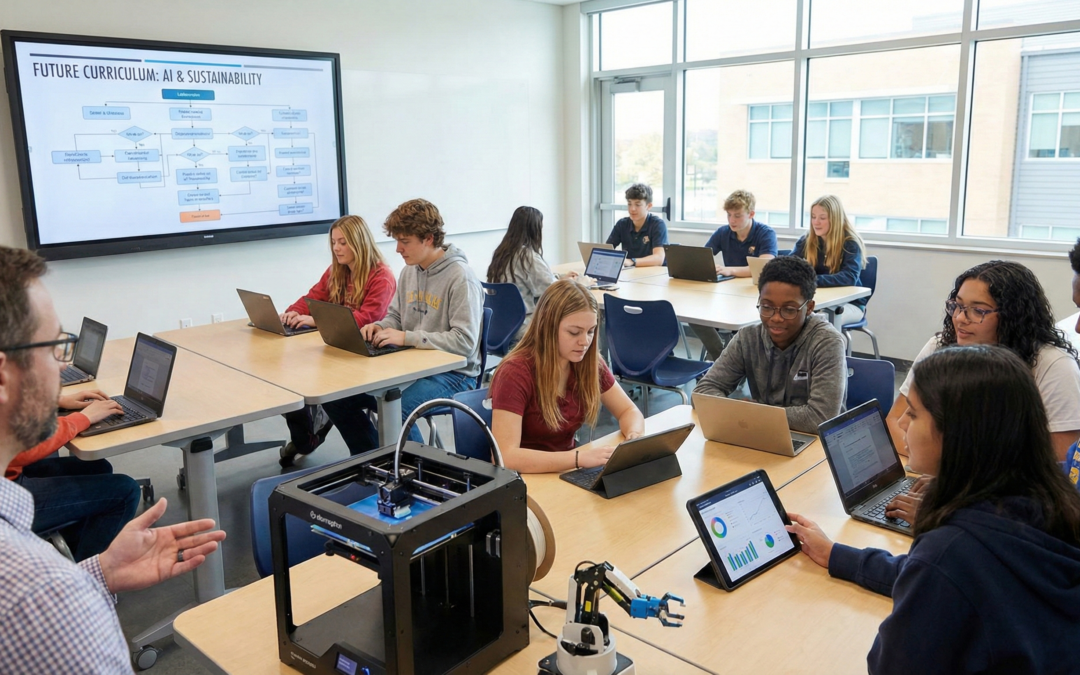
Rather than forcing every student down the same corridor, AI-ready institutions are designing curriculum tracks built around where the world is actually heading. Think AI and Data Science, Green Technologies and Sustainability, Digital Health, Smart Cities, Creative Technologies, and Entrepreneurship — not as electives or afterthoughts, but as core pillars of learning. These aren’t trendy additions to a traditional timetable. They’re a complete re-imagining of what school is for.
The shift goes deeper than subject names. Interdisciplinary learning replaces rigid silos, so a student exploring climate solutions might weave together data science, economics, engineering, and communication — because that’s exactly what solving real problems requires. Project-based learning puts students inside genuine challenges rather than textbook simulations.
And this is where AI becomes a genuine game-changer. Not as a gimmick, but as a guide. AI tools can analyze a student’s strengths, learning patterns, and passions — then help map a pathway toward careers that actually fit who they are. Personalization at scale, something no single teacher managing thirty students could ever fully deliver alone.
The schools that will lead by 2040 aren’t the ones scrambling to react when the future arrives. They’re the ones already living in it.
AI, cyber security, Education, GCC
Trust, Ethics, and Security in the AI Age
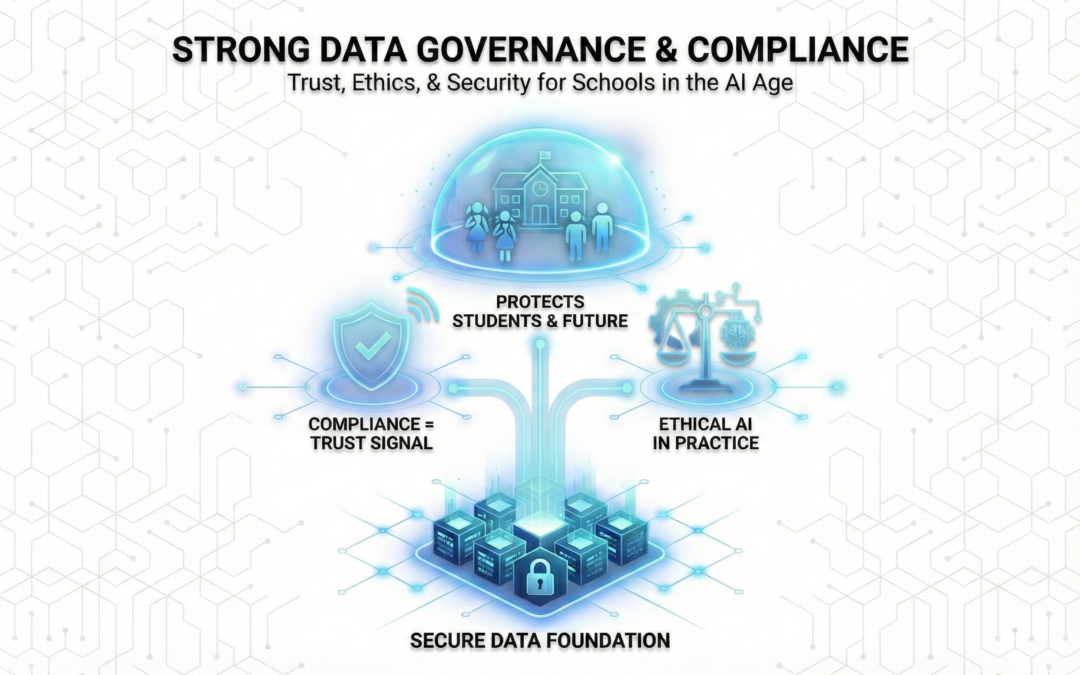
Data is the engine behind every AI system — but without proper governance, it quickly becomes a risk rather than an asset. Schools that are truly ready for the AI era don’t treat data governance as an afterthought. They build it into the foundation.
Why This Matters Now
By 2040, educational institutions will be generating and storing more sensitive data than ever before — from student learning patterns and behavioral analytics to staff records and third-party platform integrations. The stakes are high, and the window to build the right systems is now.
Strong data governance means having clear, enforceable policies across five critical areas: who owns the data, who has consented to its use, who can access it, how long it is retained, and how AI systems are permitted to use it. Without clarity on all five, schools expose themselves — and the people they serve — to serious risk.
Compliance Is a Trust Signal, Not Just a Legal Obligation
Meeting national regulations and aligning with international standards such as GDPR or ISO 27001 does more than keep schools out of legal trouble. It sends a powerful message to families, regulators, and institutional partners: we take your trust seriously.
Compliance, done well, becomes a competitive advantage.
Ethical AI Requires Ethical Data Practices
Automated decisions — whether about student progress, resource allocation, or staff performance — carry real consequences. Ethical AI frameworks ensure those decisions are fair, explainable, and accountable. They prevent bias from being quietly embedded in algorithms and ensure that humans remain meaningfully in the loop.
Data governance is not separate from ethics. It is ethics, made operational.
The Bottom Line
A school that protects its data protects its students, its staff, its reputation, and its long-term future. In the AI age, data governance is not a compliance checkbox — it is a core institutional value.

AI, cyber security, Education
The future of education doesn’t belong to the student with the highest GPA — it belongs to the student with the most verifiable, portable, and future-proof skills. The question is whether schools are ready to help them earn those credentials.
For generations, the transcript ruled. A grade point average, a class rank, a diploma — these were the currency of academic achievement and the primary language of hiring. But the world of work has shifted dramatically, and that language is becoming obsolete faster than most institutions realize.
The most forward-thinking schools are responding with a new model: structured, AI-powered student skill certification pathways that align education with globally recognized standards and the actual demands of future employers. This is not an incremental update to the curriculum. It is a fundamental rethinking of what a school delivers to its graduates.
Why Credentials Are Replacing Grades
The evidence is unambiguous. By 2040, leading employers across technology, finance, healthcare, and creative industries will prioritize verified competencies over traditional academic credentials. A diploma proves a student sat through twelve years of schooling. A skill certification proves they can actually do something with that time.
The competencies employers will seek are no longer confined to domain expertise. Communication, critical thinking, entrepreneurial mindset, and technological fluency are the new baseline. Employers want evidence — not inference — that candidates possess them.
The most in-demand competency areas already emerging include: AI and machine learning basics, coding and computational thinking, data analysis and literacy, communication and collaboration, critical problem-solving, entrepreneurship and innovation, digital ethics and cyber literacy, and financial and global fluency.
How AI Powers Personalized Certification Pathways
The traditional one-size-fits-all curriculum cannot generate individualized results at scale. But AI can. Modern assessment tools don’t just measure what students know — they map where they are, identify gaps, and dynamically recommend the most efficient path to globally recognized certifications.
Imagine a student in Grade 9 whose AI-powered learning profile reveals a natural aptitude for pattern recognition. The system routes them toward data analytics modules, recommends relevant certification tracks, and adjusts the pace based on demonstrated mastery — not time in seat. By the time they graduate, they hold industry-recognized credentials that speak directly to employers, regardless of their local school ranking.
“Students should graduate not just with diplomas, but with portfolios of portable, industry-recognized credentials that travel with them across borders and industries.”
AI-driven platforms are already mapping learner trajectories, flagging readiness for external certifications, and personalizing intervention — all in real time. Schools that integrate these tools into their core academic journey — rather than treating certifications as optional add-ons — will produce graduates who are measurably ahead.
Building the Pathway: A Four-Stage Model
Implementing a skill certification pathway doesn’t require scrapping the curriculum — it requires restructuring how outcomes are recognized and recorded. Here is a practical four-stage model:
Stage 1 — Map and Align Audit your curriculum against global certification standards. Identify where existing subjects already build certifiable competencies — and where the gaps are. Align course outcomes with frameworks from industry bodies, not just national exam boards.
Stage 2 — Embed, Not Add Certifications must be woven into the academic journey, not offered as optional extracurriculars. Treat each relevant certification milestone as a formal academic outcome with the same weight as a term grade or exam.
Stage 3 — Personalize with AI Deploy AI assessment tools to build individual learner profiles. Track competency development in real time, recommend certification readiness windows, and adapt learning paths based on each student’s demonstrated trajectory.
Stage 4 — Credential the Graduate Graduate students with a dual portfolio: the traditional academic transcript alongside a verified skill credential record — portable, digitally verified, and internationally legible. Credentials that work in Nairobi, Singapore, Berlin, and Boston alike.
Closing the Employment Gap
The persistent mismatch between what schools produce and what economies need is not a mystery — it is a design failure. Schools were designed for a world that no longer exists, optimized for sorting students by academic rank rather than equipping them with transferable, in-demand capabilities.
Student skill certification pathways are the structural correction. They bridge the gap between the classroom and the workplace not by lowering academic standards, but by expanding what counts as achievement. A student who can analyze datasets, communicate findings clearly, and deploy basic AI tools is an asset to any organization on earth — and a certification pathway makes that capacity legible, verifiable, and exportable.
The schools that build these pathways now are not just preparing students for employment. They are building the infrastructure of a generation that is competitive — locally, nationally, and globally — before they ever receive their first paycheck.
Key Takeaway: The diploma of the future is a portfolio of skills the world can verify. AI-ready schools don’t wait for the job market to tell them what graduates need. They build the certifications in — and let the results speak for themselves.
Uncategorized
The Silent Revolution: How WebAssembly is Reshaping Web Development
Why the technology you’ve never heard of might be the most important innovation in web development since JavaScript
Remember when Steve Jobs famously refused to support Flash on the iPhone? That single decision in 2010 accelerated the death of browser plugins and ushered in the era of HTML5 and JavaScript as the undisputed kings of web development. For over a decade, if you wanted to build something for the web, JavaScript was your only real option for client-side logic.
But there’s been a quiet revolution brewing in the background. WebAssembly (Wasm) has been sneaking into production systems at companies like Google, Disney+, Figma, and Autodesk—and most developers haven’t even noticed. Yet this technology might be the biggest shift in web development since the introduction of JavaScript itself.
What Exactly Is WebAssembly?
At its core, WebAssembly is a binary instruction format designed to run in web browsers alongside JavaScript. Think of it as a compilation target—a low-level assembly-like language that browsers can execute at near-native speeds. Unlike JavaScript, which is interpreted or just-in-time compiled, WebAssembly code is already optimized when it arrives at the browser.
Here’s what makes it special: developers can write code in languages like C, C++, Rust, or Go, compile it to WebAssembly, and run it in the browser at speeds that were previously impossible with JavaScript. We’re talking about performance improvements of 10x to 100x for certain computational tasks.
Why Should You Care?
The implications are staggering. Here’s what WebAssembly enables:
- Desktop-class applications in the browser: Figma runs its entire design engine in WebAssembly. Google Earth loads massive 3D geographical data using Wasm. Adobe is porting Photoshop to the web with it. These aren’t watered-down web versions—they’re full-powered applications that previously required native desktop apps.
- Gaming revolution: Unity and Unreal Engine both support WebAssembly compilation, meaning AAA-quality games can run in browsers without plugins. The web is becoming a legitimate gaming platform again, but this time with modern graphics and performance.
- Serverless edge computing: Cloudflare Workers, Fastly Compute@Edge, and other edge platforms use WebAssembly for serverless functions. Wasm’s sandboxed execution model makes it perfect for running untrusted code at the edge with minimal overhead.
- Cross-platform code reuse: Write once in Rust or C++, compile to WebAssembly, and run the same code in browsers, on servers, in mobile apps, and even on IoT devices. WASI (WebAssembly System Interface) is making Wasm a truly universal runtime.
The Real-World Impact
Let’s talk concrete examples. When Disney+ launched, they used WebAssembly to deliver consistent DRM across platforms. Shopify uses it to run customer-provided code safely in their platform. Amazon Prime Video reduced their video player CPU usage by 35% by switching parts of their stack to Wasm.
The blockchain industry has been quick to adopt WebAssembly as well. Ethereum 2.0 uses Wasm as an execution environment. Polkadot, Near, and Cosmos all use it for smart contracts. The reason? Better performance and the ability to write contracts in multiple languages instead of being locked into Solidity.
But perhaps the most exciting development is in AI and machine learning. TensorFlow.js can use WebAssembly as a backend for running ML models in browsers with significantly better performance. Imagine facial recognition, natural language processing, or image generation running entirely client-side, with no server roundtrip and complete privacy.
The Developer Experience Today
Here’s where I’ll be honest: WebAssembly isn’t always easy to work with yet. The tooling is improving rapidly, but you’re essentially dealing with lower-level programming. If you’re comfortable with JavaScript frameworks like React or Vue, there’s definitely a learning curve.
However, the ecosystem is maturing fast. Rust has become the de facto favorite language for targeting WebAssembly, thanks to excellent tooling like wasm-pack and wasm-bindgen. AssemblyScript lets JavaScript developers write TypeScript-like code that compiles to Wasm. And frameworks like Yew and Leptos are bringing React-style component models to WebAssembly development.
The Challenges Ahead
WebAssembly isn’t perfect. DOM manipulation from Wasm is still awkward—you typically need JavaScript glue code. Debugging tools lag behind what we have for JavaScript. The bundle sizes can be larger than equivalent JavaScript for simple tasks. And the learning resources are scattered compared to the mature JavaScript ecosystem.
There’s also the question of when to use it. WebAssembly isn’t meant to replace JavaScript—it’s meant to complement it. For typical CRUD applications or content websites, JavaScript is still the better choice. Wasm shines when you need computational performance, are porting existing codebases, or want to use languages other than JavaScript in the browser.
Looking Forward: The Next Five Years
The WebAssembly roadmap is ambitious. The component model proposal aims to enable true language-agnostic composition—imagine mixing React components, Rust libraries, and Go services seamlessly. Thread support is improving, bringing true parallelism to web applications. Exception handling, garbage collection integration, and SIMD support continue to mature.
We’re also seeing Wasm expand beyond browsers. The WASI standard is turning WebAssembly into a universal runtime that could challenge Docker’s dominance in certain use cases. Wasm modules are smaller, start faster, and have better security isolation than containers.
Major cloud providers are betting on this future. AWS Lambda now supports WebAssembly. Microsoft is integrating it into .NET 8. The momentum is undeniable.
The Bottom Line
WebAssembly won’t replace JavaScript, but it’s creating a new category of web applications that simply wasn’t possible before. It’s lowering the barrier for desktop applications to move to the web, enabling new categories of browser-based tools, and solving real performance problems that were previously insurmountable.
If you’re a web developer, you don’t need to drop everything and learn Rust tomorrow. But you should be aware that the landscape is shifting. The applications you build five years from now might look very different from what you build today. And WebAssembly will likely be a big part of that transformation.
The revolution might be silent, but it’s very real. And it’s happening right now, one compiled binary at a time.
Have thoughts on WebAssembly? I’d love to hear from you. Follow me on Twitter or drop a comment below.