
|
Getting your Trinity Audio player ready...
|
Richard Nixon was the 37th President of the United States and, like Donald Trump, belonged to the Republican Party. During his presidency, in 1972, surveillance devices were secretly planted in the Democratic Party’s headquarters. Nixon’s associates used these devices to monitor Democratic campaign strategies ahead of the election. Two Washington Post reporters, Bob Woodward and Carl Bernstein, caught wind of it, investigated, and broke the story. The publication ended Nixon’s political career. Since the Democratic Party’s office was located in the Watergate Complex in Washington, the scandal became known as the Watergate Scandal — arguably one of the most consequential political stories in modern history.
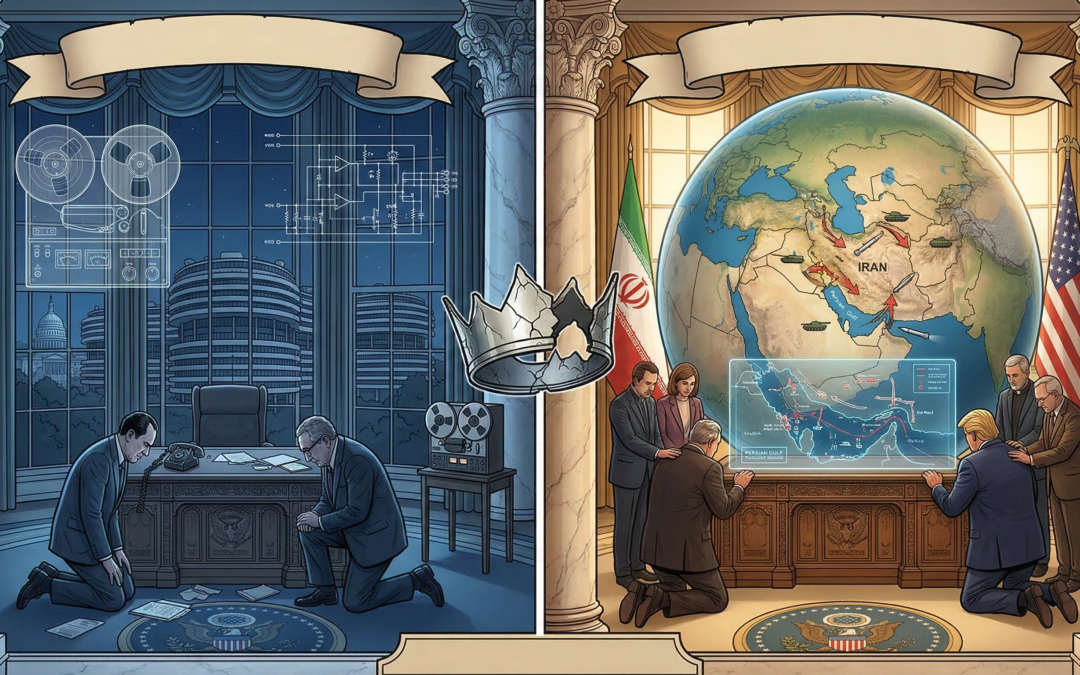
Nixon was nominally Christian but held little genuine religious conviction. He rarely attended church and reportedly disliked clergy. His Secretary of State, Henry Kissinger, was similarly a non-practicing Jew with little religious inclination. Yet at the height of the Watergate crisis, Nixon called Kissinger to the White House late one night. Kissinger, sensing urgency, rushed to the Oval Office. Nixon closed the door and turned to him:
“I am a weak Christian and you are a Jew in name only — but I feel that if we pray together, perhaps our troubles may ease. Perhaps God will have mercy on us.”
Nixon then dropped to his knees, faced Jerusalem, and began reciting verses from the Bible. Kissinger, as his subordinate, followed suit — kneeling and calling upon God in Hebrew.
Kissinger himself recorded this episode and recounted it in multiple speeches. It reveals something profound about human nature. Our professions, titles, and responsibilities can make us feel invincible — but the moment we encounter our own “Watergate,” something breaks inside us. Whether you are Richard Nixon or Henry Kissinger, whether you sit in the most powerful office on earth or behind a modest shop counter, you inevitably fall to your knees before God.
History bears this out repeatedly. Alexander the Great marched to war with religious representatives by his side. Darius III had his own spiritual advisors. Genghis Khan followed no formal religion, yet on the battlefield he sought prayers from Christian, Muslim, Buddhist, and Hindu clergy alike. Timur the Lame — one of history’s most brutal conquerors — would pray before every battle, and immediately after combat, wash the blood from his hands, perform ablution, and offer prayer. Every Ottoman sultan kept personal scholars and spiritual guides who traveled with them and provided religious and emotional support in times of crisis.
In Pakistan’s own political history, the pattern is unmistakable. Ayub Khan was deeply superstitious, leaning on figures ranging from Baba Lal to Qudratullah Shahab for spiritual reassurance. Benazir Bhutto, in the depths of political turmoil, once traveled to the hills of Mansehra to seek blessings from a renowned mystic. Nawaz Sharif kept spiritual figures close throughout his career. Asif Ali Zardari was a devotee of over a dozen saints, keeping three spiritual personalities resident in the presidency itself — they reportedly blew prayers over the tires of his presidential motorcade before every departure. A black goat was sacrificed as charity each time he left the building — a ritual said to continue to this day. Imran Khan, for his part, brought his spiritual guide into his own home. Bushra Bibi reportedly threw meat from rooftops daily to ward off evil, and even today, prayers are being offered at three shrines for his release from prison.
What does all of this prove? It proves that whether you are Alexander the Great, Genghis Khan, or Richard Nixon, human beings seek refuge in the idea of God when the ground shifts beneath them. We kneel — and that kneeling is not a sign of faith so much as it is a sign of fear. It is an acknowledgment that the crisis before us is greater than our own capacity, and that we need a power beyond ourselves to survive it.
Trump’s Oval Office Prayer — A Modern Parallel
If you keep this fundamental human weakness in mind and watch what unfolded at the White House on March 6, the picture becomes clear. Trump summoned prominent pastors from across America to the Oval Office, sat in the presidential chair, and had them stand behind him, place their hands on his shoulders, and pray for victory against Iran. After this footage circulated, even figures like Senator Lindsey Graham began suggesting that the conflict between America, Israel, and Iran is a religious war. The debate spread from Washington to Islamabad.
But it is not a religious war. It is a war over resources — over oil, over gas, over geopolitical control. Religion has nothing to do with it. Trump’s summoning of pastors, his bowed head, his seeking of divine blessing — these are symptoms of fear, not faith. Like Nixon before him, he is reaching for religion because he is afraid. Iran’s unexpected resilience, its unity following the martyrdom of Ayatollah Khamenei, its fierce and sustained resistance shook both Trump and Netanyahu. They had anticipated that Iran would fracture and fall into internal chaos, opening the door to the world’s second-largest reserves of oil and gas. Instead, Iran held together and hit back hard — hard enough that even Donald Trump felt compelled to seek God.
Netanyahu, meanwhile, has been photographed wearing the traditional black Jewish kippah with increasing frequency. This, too, is the same signal. It is fear dressed as faith.
The Roots of Judaism: A Historical Overview
To understand the deeper context of this conflict, it helps to trace the historical roots of Judaism, Christianity, and Islam — beginning with the origins of the Jewish people.
“Israel” was the title given to the Prophet Jacob (peace be upon him). His twelve sons became the progenitors of the twelve tribes of Bani Israel. Their names were Reuben, Simeon, Levi, Judah, Issachar, Zebulun, Dan, Naphtali, Gad, Asher, Joseph, and Benjamin. These tribes eventually settled in twelve different regions of Egypt.
The Prophet Moses (peace be upon him) belonged to the tribe of Levi. Interestingly, the globally famous clothing brands Levi’s and Levis take their name from this very tribe. The Levites were traditionally craftsmen and religious scholars — even today, most Jewish rabbis trace their lineage to the Levite tribe. Moses’s brother, the Prophet Aaron (peace be upon him), was the world’s first Cohen (high priest), and the priestly lineage has continued through his descendants.
Moses united the tribes and led them back toward Canaan (Palestine). The tribe of Dan was lost along the way and has never been accounted for. Some Pashtuns in Pakistan’s Khyber Pakhtunkhwa province claim descent from the lost tribe of Dan — but this claim does not hold up historically. The distance from the Sinai Desert to the Khyber Pass spans dozens of major civilizations and kingdoms. Why would a tribe bypassing all of those settled societies settle in a comparatively remote and underdeveloped region, especially one that was then a passage for violent nomads like the Huns? Furthermore, the tribe of Dan was known for strategy and intellect, not warfare — while the tribal communities of that region have historically been defined by martial culture. Modern DNA science has also now confirmed that Pakistan’s Pashtuns are not descended from Bani Israel.
Moses led the remaining eleven tribes to the borders of Canaan. At Mount Nebo in present-day Jordan, his journey ended and he passed away. His successor, the Prophet Joshua bin Nun (peace be upon him), led Bani Israel forward. The Battle of Jericho followed, and God granted them victory — returning to them the land that had been promised.
After reclaiming Palestine, ten of the eleven tribes united and expelled the eleventh — the tribe of Judah — from Jerusalem. The tribe of Judah settled on the western bank of the Jordan River, in the area now known as the West Bank. They were a poor and marginalized people: shepherds who worked in the homes and fields of other communities in Jerusalem. They were permitted into the city only during daylight hours and were forbidden from spending the night inside — returning each evening to the West Bank after a day of labor.
These were the descendants of Jacob’s fourth son, Judah — written in English as “Judah.” In time, his descendants became known as “Jews” — the word itself derived from his name.
According to the Book of Genesis in the Bible, when the Prophet Joseph’s (peace be upon him) brothers decided to kill him, it was the eldest brother Reuben who saved him, arguing that Joseph was their blood. Simeon and Levi then suggested throwing him into a dry well in the desert, reasoning he would either die of thirst or be taken by wild animals. But Judah proposed selling him to passing Midianite traders. The city of Midian — associated with the people of the Prophet Salih (peace be upon him) — stretched across what is now Saudi Arabia to Salalah in Oman, and hosted the largest slave markets of the ancient world. Traders moved between the great civilizations of Egypt and Mesopotamia, and Joseph’s well lay directly along this trade route.
According to the biblical account in Genesis, Judah convinced his brothers: “What profit is it if we kill our brother? Let us sell him to the Ishmaelites.” The going price for a handsome young slave was twenty silver coins. The brothers initially refused, threw Joseph into the well, and walked away — only to see a Midianite caravan approaching. Judah persuaded them again, and this time they agreed. They returned to the well, retrieved Joseph, and sold him for twenty-two silver shekels to the Midianite traders who were heading to Egypt.
(Note: This is the biblical version. According to the Quran, it was the traders themselves who discovered and pulled Joseph from the well — his brothers were not present at that moment.)
The descendants of Judah came to be called Jews. And in the pattern of their ancestor, they have historically been traders by nature — people who, when the price was right, would sell even a brother.
________________________________________
The article continues with the origins of Christianity and Islam, and their historical relationship with political power and warfare — a story for the next time.