
|
Getting your Trinity Audio player ready...
|
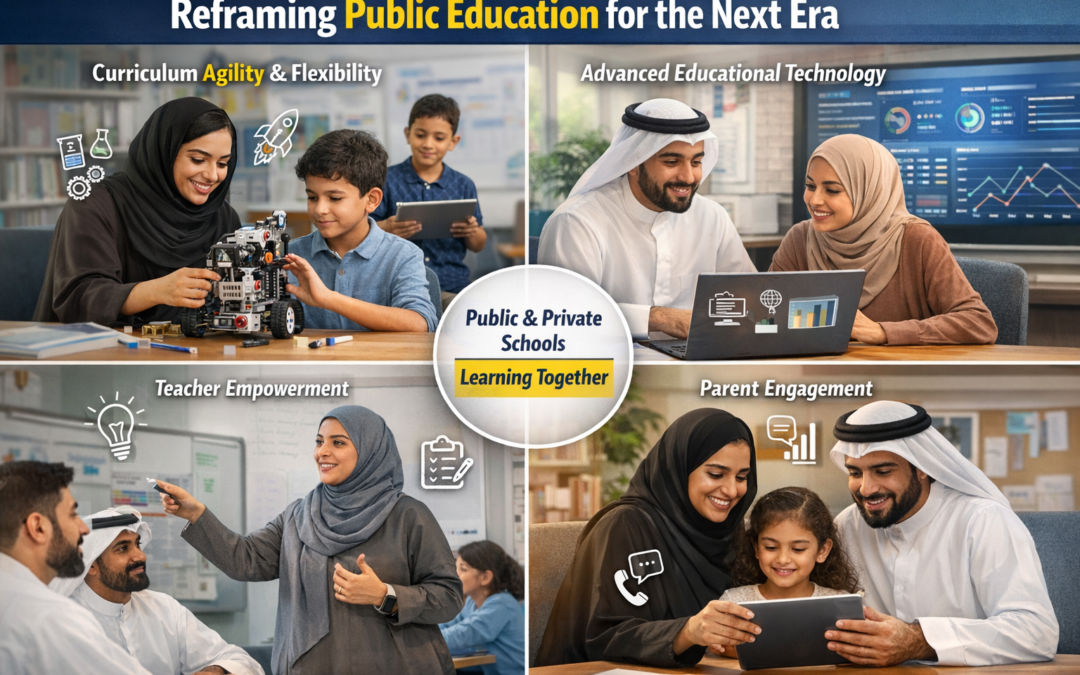
Reframing Public Education for the Next Era
Government schools across the GCC have historically excelled at scale, access, and equity, educating millions of students and forming the backbone of national development. However, private and international schools—operating under competitive pressure—have evolved faster in pedagogy, technology adoption, and learner personalization.
The goal is not privatization, but strategic cross-learning.
- Curriculum Agility and Pedagogical Flexibility
One of the strongest advantages of private and international schools is curriculum agility.
While government curricula are often centrally defined and standardized (which ensures fairness and national alignment), private schools:
- Pilot project-based learning (PBL) faster
- Integrate STEM, robotics, AI, and entrepreneurship earlier
- Adapt assessment models quickly (rubrics, portfolios, competency-based grading)
What Government Schools Can Do:
- Introduce modular curriculum extensions alongside national syllabi
- Allow controlled pilot programs in selected schools
- Enable teachers to co-design interdisciplinary projects without violating national standards
The future curriculum must be stable at the core, flexible at the edges.
- Technology as an Operational Backbone, Not an Add-On
Private schools treat technology as infrastructure, not decoration.
They commonly deploy:
- School ERP systems (attendance, academics, finance, HR)
- LMS platforms integrated with assessments
- Parent portals with real-time visibility
- Data dashboards for leadership decision-making
Government schools, by contrast, often use:
- Fragmented systems
- Manual processes at scale
- Limited data integration between departments
What Government Schools Can Learn:
- Centralized national ERP + LMS platforms reduce cost and chaos
- Data-driven leadership enables proactive intervention
- Automation frees teachers from administrative overload
When systems are unified, teachers teach more, students learn better, and leaders decide smarter.
- Teacher Empowerment and Professional Autonomy
Private and international schools invest heavily in continuous teacher development, often linking:
- Performance to training
- Training to classroom innovation
- Innovation to student outcomes
Teachers are encouraged to:
- Experiment with tools
- Redesign lesson delivery
- Personalize instruction
Government systems often emphasize compliance over creativity.
Strategic Shift Needed:
- Move from “teacher supervision” to teacher enablement
- Introduce AI-assisted lesson planning
- Provide structured freedom within policy boundaries
Empowered teachers are the fastest catalyst for system-wide change.
- Parent Engagement as a Strategic Asset
Private schools treat parents as partners, not observers.
They use:
- Weekly performance analytics
- Digital communication platforms
- Parent feedback loops
Government schools can benefit immensely from similar models at scale.
Impact:
- Improved student accountability
- Reduced behavioral issues
- Stronger school-community trust
Key Takeaway
Government schools already have reach and legitimacy. By adopting agility, technology, and empowerment models from private education, they can modernize without sacrificing equity or national identity.