
|
Getting your Trinity Audio player ready...
|
Part II of the Series: Prophets, Empires & the Modern World
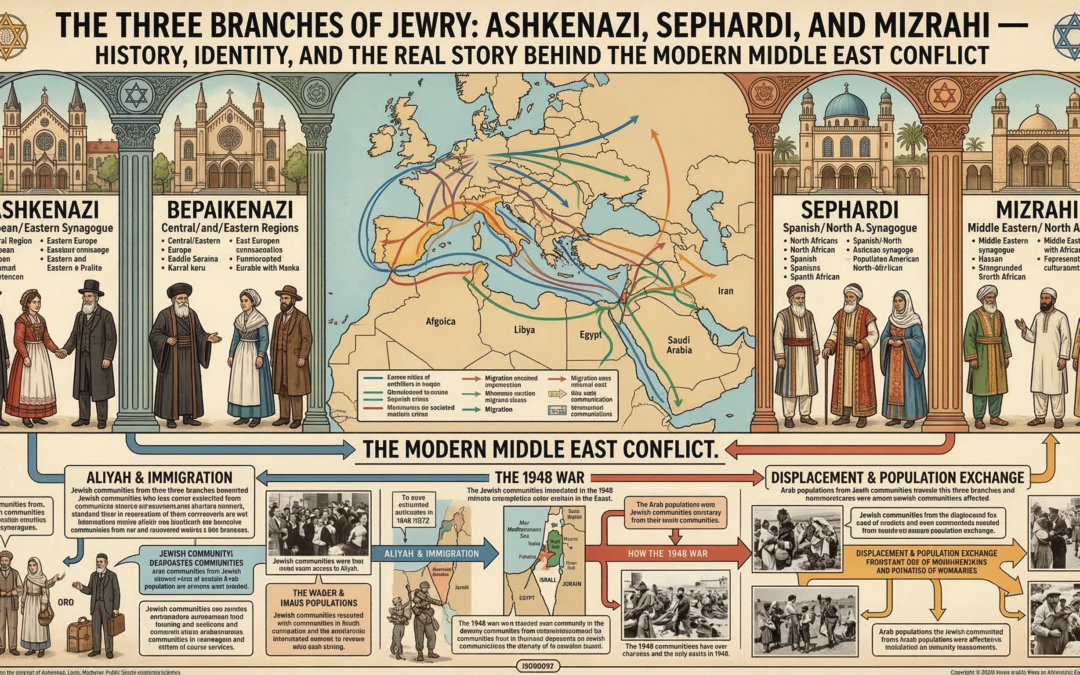
The Three Branches of Jewry: Ashkenazi, Sephardi, and Mizrahi — History, Identity, and the Real Story Behind the Modern Middle East Conflict
Who are the Ashkenazi, Sephardi, and Mizrahi Jews? How did two ancient catastrophes — one Babylonian, one Roman — forge three entirely distinct civilizations from a single people? And why is the current Middle East conflict not, as it is so often framed, a Jewish-Muslim conflict at all?
Published as Part II · Series: Prophets, Empires & the Modern World · Continued from Part I
Jewish History Ashkenazi Sephardi Mizrahi Bani Israel Israel-Palestine Islam & Judaism Jesus of Nazareth
Two Catastrophes That Changed Jewish History Forever
To understand who the Jewish people are today — and why the current conflict in the Middle East is so deeply misunderstood — we must go back to two seismic moments of destruction that scattered a single people across the entire known world.
The first catastrophe came in 586 BCE, when Nebuchadnezzar II, the Babylonian king, marched on Jerusalem, razed the First Temple (known in Islamic tradition as Haikal-e-Sulaymani — the Temple of Solomon), and took the Jewish people into captivity in Babylon (present-day Iraq). This event, known as the Babylonian Exile, would fundamentally reshape Jewish identity, theology, and geography.
The second blow came in 70 CE, approximately seventy years after the birth of Jesus. The Romans, under General (later Emperor) Titus, destroyed the Second Temple — the same temple that the Jews had rebuilt with the permission and financial patronage of Cyrus the Great of Persia. (Muslims widely identify Cyrus with Dhul-Qarnayn, the “Two-Horned One” mentioned in Surah Al-Kahf of the Quran. The reasons for Cyrus’s special relationship with the Jewish people will be explored in detail in a future installment of this series.)
Between and after these two disasters, a significant number of Jewish families fled south and east, seeking refuge in the Arab territories of the region — areas corresponding to present-day Lebanon, Jordan, Syria, Saudi Arabia, and Iraq. Their descendants would come to be known as the Mizrahi Jews. These were the Jewish communities present in Medina during the time of the Prophet Muhammad (?). They were, in the truest sense, Arab Jews.
It is from this single historical rupture — the scattering of the Jewish people — that three major branches of world Jewry were born.
The Three Branches: A Comparative Overview
Understanding these three groups is not merely an academic exercise. It is, in fact, the key to unlocking the real nature of the modern conflict in Gaza, the West Bank, and the broader Middle East.
Branch One
Ashkenazi Jews
Etymology: From Hebrew “Ashkenaz,” associated with Germany Origins: Largely derived from communities in Persia, then Central Asia, and into Eastern Europe Spread: Russia, Poland, Germany, and eventually Western Europe and the Americas Language: Yiddish (Germanic-Hebrew hybrid) Notable: Dominant group in the founding of the State of Israel; every Israeli Prime Minister has been Ashkenazi
Branch Two
Sephardi Jews
Etymology: From Hebrew “Sepharad,” meaning Spain Origins: Jews who migrated from Jerusalem toward the Iberian Peninsula Spread: After 1492 expulsion — Algeria, Tunisia, Morocco, Istanbul Language: Ladino (medieval Spanish-Hebrew hybrid) Character: Scholars, scientists, philosophers — intellectually formative in the Islamic Golden Age
Branch Three
Mizrahi Jews
Etymology: From Hebrew “Mizrach,” meaning East Origins: Jews who fled to Arab territories during the Babylonian and Roman destructions Spread: Iraq, Iran, Yemen, Syria, Egypt, North Africa Language: Judeo-Arabic dialects Character: Scholars and merchants; the majority of great Jewish religious authorities were Mizrahi or Sephardi
The Ashkenazi Jews: Warriors, Scholars, and Survivors
The Ashkenazi Jews represent the most politically dominant branch of contemporary Judaism. Their name derives from the Hebrew word Ashkenaz, historically associated with Germany. However, their earliest traceable communities after the destructions of Jerusalem were situated in Persia and Central Asia, before gradually migrating westward into Russia and Eastern Europe.
Genetically, studies published in the National Library of Medicine confirm that approximately 40–60% of the Ashkenazi gene pool derives from European sources, particularly along the maternal line — suggesting significant intermarriage with local European women who converted to Judaism. This makes the Ashkenazi community genetically distinct from both the Sephardi and Mizrahi branches, who retain a far higher proportion of ancient Middle Eastern ancestry.
Historically, the Ashkenazi experience in Europe was one of cyclical persecution. They faced pogroms under the Christian Tsars of Russia, expulsions across medieval Europe, and ultimately the Holocaust under Hitler’s Nazi Germany — a campaign that murdered approximately six million Jews, the overwhelming majority of whom were Ashkenazi.
Key Historical Fact
It is a profound and rarely discussed irony of modern history: the people who suffered most in twentieth-century Europe — the Ashkenazi Jews — went on to become the political founders and dominant ruling class of the State of Israel. Today, every single Israeli Prime Minister has been Ashkenazi, despite Mizrahi Jews now constituting more than half of Israel’s Jewish population.
Today, it is largely Ashkenazi political and military leadership that governs Israel, conducts military operations in Gaza, and pursues confrontation with Iran. This distinction — between which branch of Jewry is actually directing these actions — is critical to any honest analysis of the conflict.
The Sephardi Jews: Architects of the Golden Age of Islam
The Sephardi Jews — whose name derives from Sepharad, the Hebrew word for Spain — represent one of the most remarkable stories of inter-civilizational collaboration in world history.
After fleeing Jerusalem, these communities made their way to the Iberian Peninsula. For centuries, under Muslim rule in Andalusia, they did not merely survive — they thrived. Córdoba and Granada, the twin capitals of Islamic Spain, were cities of extraordinary intellectual ferment. Jewish scholars, physicians, philosophers, and scientists worked alongside Muslim and Christian counterparts in what historians call the Convivencia — the coexistence. Figures such as Maimonides (Rabbi Moshe ben Maimon), born in Córdoba in 1138, produced works of philosophy and medicine that shaped the entire medieval world.
“In Arab-Muslim territories during the Middle Ages, the Jewish condition was easier, as a rule, than it was in Europe.” — Historian Paul Johnson, cited in academic research on Jewish ethnic divisions
This era ended brutally in 1492 — the same year Columbus sailed to the Americas — when the Catholic monarchs Ferdinand and Isabella issued the Alhambra Decree, expelling all Jews from Spain. It was Muslim rulers who opened their doors: the Ottoman Sultan Bayezid II famously welcomed the expelled Jews, reportedly saying that Ferdinand had impoverished his own kingdom by expelling such talented people. Sephardi communities rebuilt in Algeria, Tunisia, Morocco, and Istanbul — where many still thrive today.
The Sephardi character, shaped by centuries in Islamic civilization, tends toward intellectualism, peacefulness, and coexistence. They have historically been the least bellicose of the three branches — a fact with direct relevance to the current conflict.
The Mizrahi Jews: The Arab Jews of the Ancient World
The Mizrahi Jews are, in many ways, the oldest continuous diaspora community in the world. Mizrahi means “Eastern” in Hebrew, and these are the Jews who fled south and east during the Babylonian and Roman catastrophes — settling in the Arab lands of the Levant, the Arabian Peninsula, and Mesopotamia.
Their culture, appearance, language, and customs were so deeply intertwined with the surrounding Arab world that distinguishing them from their Muslim and Christian Arab neighbors was, for centuries, nearly impossible without deliberate inquiry. The Jewish communities of Medina whom the Prophet Muhammad (?) encountered were Mizrahi Jews — Arab-speaking, Arab-looking, Arab-cultured. The great scholars of Jewish law in the medieval period — the Geonim of Babylon — were Mizrahi. The majority of revered Jewish religious authorities throughout history have come from the Mizrahi or Sephardi traditions, not the Ashkenazi.
Today, Mizrahi Jews remain deeply opposed to the Israeli occupation and military campaigns. Their reasoning is not merely political — it is theological. Many Mizrahi religious authorities hold that God did not promise the Jewish people a modern nation-state, and that every attempt to establish one has historically brought catastrophe. They argue, with compelling historical evidence, that Israel’s misfortunes have always followed attempts at political statehood. These communities maintain warm relations with Palestinian Muslims and are among the most vocal Jewish critics of Israeli military policy.
Remarkable Fact
When Hamas or Hezbollah targets an Israeli building, it is widely reported in Arabic-language news — sometimes from the groups themselves — that Mizrahi Jews (Arab Jews) are warned to evacuate before an attack. The distinction between branches is not abstract: it is, in some conflict zones, literally a matter of life and death.
Jesus of Nazareth: A Mizrahi Jew
One of the most consequential and least discussed historical facts about Jesus is that he was, by any meaningful definition, a Mizrahi Jew. He was born in a Jewish community that had been living in the Arab lands for centuries, spoke Aramaic (a Semitic language closely related to Arabic), and in physical appearance — as described by historical and scriptural accounts — would have resembled the Arab people of his region: olive-toned skin, dark hair, brown eyes.
The name we know him by in English — “Jesus” — is a Latinization of the Greek “I?sous,” which is itself a rendering of the Hebrew/Aramaic name Yeshua (also written Yehoshua). His mother, Mary (Maryam in Arabic and Aramaic), was from the village of Nazareth in Galilee. The practice of appending one’s hometown to one’s name was a Persian custom that the Jewish people adopted during their long exile in Babylon — hence Yeshua min Natzrat: Jesus of Nazareth. This is also why Muslims refer to Christians as Nasrani — derived from Nazareth, the hometown of their prophet.
It is one of the great ironies of Western art history that a man who, by every historical and ethnographic account, had the features of an Arab Levantine, has been depicted for centuries with blonde hair and blue eyes — the physical characteristics not of Mizrahi Jews, but of Ashkenazi ones.
The Birth, Flight, and Ministry of Jesus
The story of Jesus’s birth is one of political danger from the outset. Jerusalem at the time was under Roman colonial rule — referred to as Judaea after the Jewish people — with the local client king Herod (Herodes the Great) exercising authority under Roman oversight. The Roman governor of the province was Pontius Pilate.
~6–4 BCE
The Annunciation and the threat from Herod
Mary (Maryam), betrothed to Joseph (Yusuf), a carpenter, conceived Jesus miraculously before the marriage was consummated. Upon learning of this, Herod — warned by astrologers of the birth of a “King of the Jews” — ordered the massacre of all male children under two years of age in Bethlehem and its surroundings.
~6–4 BCE
Flight to Egypt
Joseph, warned in a dream, fled with Mary and the infant Jesus to Egypt, where they lived for approximately four years — until Herod’s death. Islamic and Christian traditions both record this flight, though the Quran does not name Joseph.
~4 BCE – 26 CE
Return to Nazareth; years of ministry in Galilee
After Herod’s death, the family returned to Nazareth in Galilee — a fertile valley between mountains and the Mediterranean coast. Jesus spent his formative years and the majority of his ministry in this region. His earliest disciples were Galilean fishermen. Saint Peter — as foundational to Christianity as Abu Bakr al-Siddiq (R.A.) is to Islam — was himself a fisherman from Galilee who met Jesus on the shores of the Sea of Galilee.
~29–33 CE
Entry into Jerusalem; trial and crucifixion
Jesus, accompanied by his twelve disciples, entered Jerusalem at approximately 32–33 years of age (scholars disagree on the precise date). The Jewish rabbinical authorities charged him with blasphemy. The Roman governor Pontius Pilate, under pressure, ordered his flogging and crucifixion.
~33 CE
The Ascension — Islamic and Christian accounts diverge
Here the Islamic and Christian narratives part ways. According to the Quran and Islamic tradition, God raised Jesus alive to the heavens — he was not crucified, and a likeness was cast upon another. In Christian theology, Jesus died on the cross, was buried, and rose physically on the third day. Both traditions agree on one critical point: Jesus will return before the Day of Judgment, descending — according to Islamic hadith — at the white minaret of the Umayyad Mosque in Damascus.
What is significant for our historical analysis is this: the people who persecuted Jesus, brought him before the Roman authorities, and demanded his crucifixion were the Pharisaic rabbinical establishment of Jerusalem — themselves Jewish. The earliest Christians fled from Jewish persecution into Central Asia, Greece, Rome, and across the Mediterranean. For nearly two thousand years after the death of Jesus, it was Christians who persecuted Jews — not Muslims.
The Real History of Jewish-Muslim Relations: Not What You Think
Here is a historical argument that will surprise most readers accustomed to the contemporary framing of the “Jewish-Muslim conflict”: for the vast majority of recorded history, Jews and Muslims did not have a fundamental conflict. The real, deep, centuries-long conflict was between Jews and Christians.
Consider the evidence:
After the fall of Granada in 1492, it was the Spanish Christians who expelled the Sephardi Jews — and it was the Muslim Ottoman Empire that welcomed them. The Jews of Muslim Andalusia lived in relative peace for seven centuries. Under the Christian Tsars of Russia, Jewish communities faced systematic pogroms, legal discrimination, and mass murder. Hitler’s Germany — a country with a deeply Christian cultural heritage — perpetrated the Holocaust. For nearly two thousand years, the principal persecutors of the Jewish people were European Christians, not Muslims.
Muslim societies, from Baghdad to Cairo to Istanbul, repeatedly offered Jewish communities refuge, legal protections, and intellectual freedom. The great Jewish philosopher Maimonides was a refugee from Christian persecution in Córdoba who found safety and career in the Muslim court of Saladin in Cairo. The Ottoman Empire absorbed hundreds of thousands of Sephardi Jews after 1492. The Fatimid Caliphate in Egypt was home to one of the most flourishing Jewish communities in the medieval world.
This does not mean the relationship was without friction. During the Prophet’s time in Medina, three specific incidents — involving treaty violations, espionage, and collaboration with the enemy during the Battle of the Trench — led to military confrontations with the Bani Qaynuqa, Bani Nadir, and Bani Qurayza tribes. The Quran addresses these episodes directly. These were political conflicts arising from specific betrayals, not a theological declaration of eternal enmity.
The modern conflict between the State of Israel and the Muslim world is not an ancient religious war resumed. It is a 20th-century political project — Zionism — that arose in Europe, was shaped by European Jewish experience, and was imposed on the Middle East by a specific branch (Ashkenazi) of a deeply divided people.
Four Conclusions That Reframe the Modern Conflict
If we analyze Jewish history up through the era of Jesus with clear eyes, four conclusions emerge that fundamentally alter how we should understand the present:
Jews are not synonymous with the Children of Israel (Bani Israel). The Jewish people are one tribe — Bani Yehuda — among the original twelve tribes of Israel. For approximately 2,700 years, the tribe of Judah has denied the other ten tribes their share of political power and ancestral land. The first conflict of the Jewish people is not with Muslims or Arabs — it is an internal one, with their own kinsmen among the other tribes of Israel, who have been dispossessed for nearly three millennia.
The “Promised Land” was not promised exclusively to the Jews. According to both the Torah and Islamic understanding, the land of Canaan (modern Israel-Palestine) was designated for all twelve tribes of Bani Israel — not for Bani Yehuda alone. The current Israeli state, controlled almost exclusively by Ashkenazi Jews, is thus engaged in a double injustice: the dispossession of Palestinian Muslims and the exclusion of the other eleven tribes of Israel from their covenanted inheritance.
Not all Jews support the Israeli state or its military campaigns. The Mizrahi and Sephardi communities — historically the most peaceful, most learned, and most integrated branches of world Jewry — are largely opposed to Israeli military aggression. Many hold the theological position that God never intended for the Jewish people to have a modern nation-state, pointing to the pattern of catastrophe that has historically followed every such attempt. These communities maintain solidarity with Palestinian Muslims and are among the most vocal Jewish critics of Israeli policy on the global stage.
If there is a deep religious grievance between Jews and any other faith community, it is with Christians, not Muslims. Jewish communities crucified (or facilitated the crucifixion of) the prophet of Christianity, burned the Gospel, and persecuted early Christians into exile. In return, Christian Europe persecuted Jews for two thousand years. Muslims, by contrast, provided refuge, legal protection, and intellectual partnership to Jewish communities in almost every era. The framing of the current Middle East conflict as a “Jewish-Muslim” conflict is historically illiterate. It is, in its modern form, the product of one specific group — the Ashkenazi political and military leadership of Israel — and bears no essential relationship to the long history of Jewish-Muslim coexistence.
What Comes Next: When Did the Modern Conflict Between Muslims and Jews Begin?
After reviewing this history, a natural question arises: if Jews and Muslims have historically lived in relative peace, when did the modern hostility begin? The answer will surprise you.
The roots of the current confrontation between the Israeli state and the Muslim world — and in particular, the specific antagonism between Israel and Iran — do not lie in the founding of Israel in 1948, nor in the Arab-Israeli Wars of the twentieth century. The seeds were planted much earlier, in the sands of seventh-century Arabia, in the immediate aftermath of one of the most consequential events in Islamic history: the tragedy of Karbala.
That story — and the long shadow it has cast across fourteen centuries — is where we turn next.
Continued in Part III From Karbala to the Khilafat: How the tragedy of 680 CE planted the seeds of the modern Israel-Iran confrontation — and why this conflict is far older, and far deeper, than most analysts acknowledge.