
|
Getting your Trinity Audio player ready...
|
The Psychology of Staying Put: Why People Don’t Run When They Should
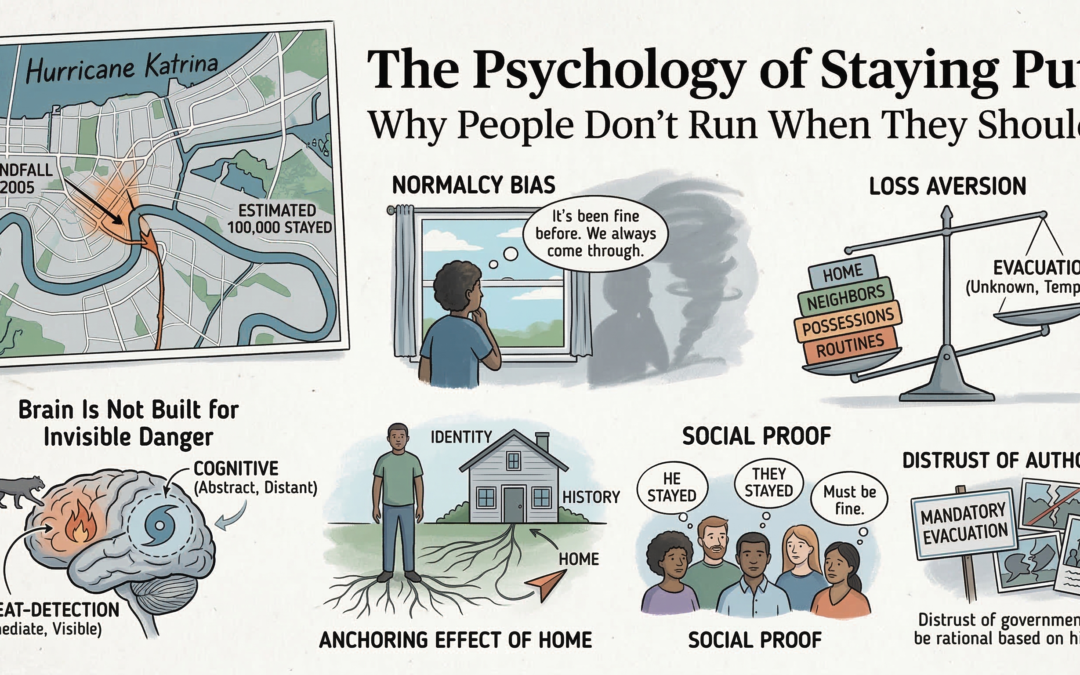
When Hurricane Katrina made landfall in August 2005, officials had issued a mandatory evacuation order for New Orleans more than 24 hours in advance. The storm’s path was well-documented. The warnings were loud and clear. And yet, an estimated 100,000 people stayed behind.
They weren’t all uninformed. They weren’t all unable to leave. Many of them simply didn’t go.
This pattern repeats itself with uncomfortable regularity across disasters of every kind — wildfires, floods, wars, chemical spills. The evacuation order goes out, and a significant portion of the affected population makes the quiet, often fatal decision to stay. Understanding why isn’t just an academic exercise. It’s one of the most important things a person can know about how human beings actually behave under threat.
The Brain Is Not Built for Invisible Danger
The human threat-detection system was shaped over hundreds of thousands of years to respond to immediate, visible danger. A predator. A fire in front of you. A flood already at your door. It is exquisitely calibrated for the present tense.
Abstract danger — a storm system still two hundred miles offshore, a front line advancing slowly through a region, a chemical plume that hasn’t reached your street yet — doesn’t trigger the same visceral alarm. The brain registers the information intellectually, but the gut doesn’t follow. There’s no spike of adrenaline, no overwhelming urge to move. Just a kind of uneasy uncertainty that’s easy to rationalize away.
This is part of why official warnings are less effective than they should be. The information is there, but it arrives in the wrong format for the part of the brain that actually drives behavior.
Normalcy Bias: The World Will Probably Be Fine
One of the most well-documented phenomena in disaster psychology is normalcy bias — the tendency to underestimate both the likelihood and the severity of a crisis because nothing this bad has happened before.
The logic, when made explicit, sounds almost reasonable: I’ve lived in this city my whole life. There have been storms before. The power’s gone out a few times, maybe some flooding in the low-lying areas, but we’ve always come through. Why would this time be any different?
The brain defaults to its archive of past experience. And if that archive doesn’t contain a true catastrophe, it has nothing to calibrate against. The worst-case scenario remains genuinely unimaginable, not in the poetic sense but in a literal, neurological one.
This is also why so many accounts from disaster survivors include some version of the same statement: “I didn’t think it would actually be that bad.” The warning had to compete with a lifetime of evidence that things usually weren’t that bad. And the warning lost.
Loss Aversion: What You Stand to Leave Behind
Leaving feels like losing. That’s not irrational — it’s deeply human, and it’s backed by decades of behavioral economics research.
The psychologists Daniel Kahneman and Amos Tversky demonstrated that losses feel roughly twice as powerful as equivalent gains. In practical terms, this means that the prospect of abandoning your home, your possessions, your neighborhood — even temporarily — carries an emotional weight that’s genuinely difficult to overcome, even when the rational case for leaving is airtight.
Think about what evacuation actually asks of someone. Leave your home, possibly forever. Leave your belongings, most of which you can’t take. Leave your neighbors, your routines, your sense of place. Accept that you may return to rubble, or may not be allowed to return at all. Go somewhere unfamiliar, probably at your own expense, with no guarantee of when this ends.
Against all that loss, the threat has to feel not just real but immediate and overwhelming. For a lot of people, it never quite crosses that threshold — until it’s too late.
The Anchoring Effect of Home
Beyond the fear of losing things, there’s something harder to quantify: the gravitational pull of place itself.
For many people, especially older residents and those who have lived in the same community for decades, home is not simply a building. It’s an identity. It’s the place where their history lives — the house they raised their children in, the street where their parents are buried nearby, the neighborhood where everyone knows their name. Evacuating doesn’t just mean leaving a structure. It means leaving the physical architecture of a life.
This is particularly pronounced in communities with strong cultural or ethnic ties to a place. Leaving isn’t just uncomfortable. It can feel like a form of erasure, a severing from something essential about who you are. Some people would genuinely rather risk death than accept that.
This isn’t weakness. It’s a measure of how much a place can mean. But it is, under crisis conditions, a potentially lethal attachment.
Social Proof and the Wait-and-See Effect
Human beings are deeply social animals, and in moments of uncertainty, we look to each other for cues about how to behave. If my neighbors are staying, that’s data. If my family thinks the warnings are overblown, that carries weight. If the most respected person on the block says they’ve seen worse and they’re not going anywhere, that shapes my decision more than any official broadcast.
This is social proof operating in the worst possible context. When the people around you collectively underestimate a threat, their collective behavior becomes its own form of evidence. Everyone is watching everyone else, and everyone else is staying, so staying must be reasonable.
The effect is compounded by something called pluralistic ignorance — the phenomenon where most individuals privately harbor doubts or fears, but assume they’re alone in feeling that way because no one around them is visibly alarmed. In the absence of anyone expressing panic, everyone concludes there’s no cause for panic, even when almost everyone is quietly uneasy.
Distrust of Authority
There’s another factor that doesn’t get discussed enough in mainstream accounts of why people fail to evacuate: many of them don’t trust the people telling them to leave.
This is not irrational. In communities that have historically been failed by government institutions — through neglect, displacement, broken promises, or outright harm — an official warning carries a different weight than it does for someone with a baseline of institutional trust. When the government says “leave for your safety,” people who have spent their lives watching government action harm rather than protect them are entitled to ask: safe for whom? And what happens to our neighborhood while we’re gone?
After Katrina, predominantly Black neighborhoods in New Orleans were among the last to receive aid and among the first to be bulldozed for redevelopment. The distrust that led some residents to stay wasn’t purely psychological failure. It was informed by a rational reading of history.
Disaster preparedness communication that ignores this dynamic will always fall short in the communities that need it most.
What This Means for Anyone Trying to Survive
Understanding why people stay isn’t just intellectually interesting — it has practical implications for how you think about your own behavior under threat.
The first implication is this: do not trust your instincts about whether something is dangerous enough to act on. The part of your brain that generates urgency is not calibrated for slow-moving or distant threats. You need to make decisions based on information, not on whether you feel scared enough yet.
The second is to make your decisions in advance. The research on decision-making under stress is unambiguous: people who have predetermined thresholds — if the wind speed reaches X, I leave; if the front advances to Y, I go — are far more likely to act in time than people who are deciding in the moment. When the crisis arrives, your cognitive load is already at maximum. You don’t want to be running cost-benefit analyses while the situation deteriorates.
The third is to be honest about your attachments. Knowing that you have strong ties to a place, to possessions, to community, doesn’t make those ties disappear — but it does allow you to account for their distorting effect. Naming the bias doesn’t eliminate it, but it creates a fighting chance.
And the fourth is to talk to the people around you before a crisis, not during one. The social proof effect works both ways. If the people in your household, your family, your immediate community have already discussed what the trigger for leaving looks like, you’re far less likely to be paralyzed by collective inertia when the moment arrives.
The instinct to stay is not stupidity. It’s human. It’s ancient. It’s built from love of place, distrust of uncertainty, and a brain that was never designed for the kind of abstract, slow-rolling danger that modern disasters often present.
But understanding it — naming the mechanisms clearly and without condescension — is the beginning of being able to act differently when it matters most. The people who make it out are not always the strongest or the best-prepared in any material sense. They’re often simply the ones who understood, in advance, how easy it is to stay too long.