
|
Getting your Trinity Audio player ready...
|
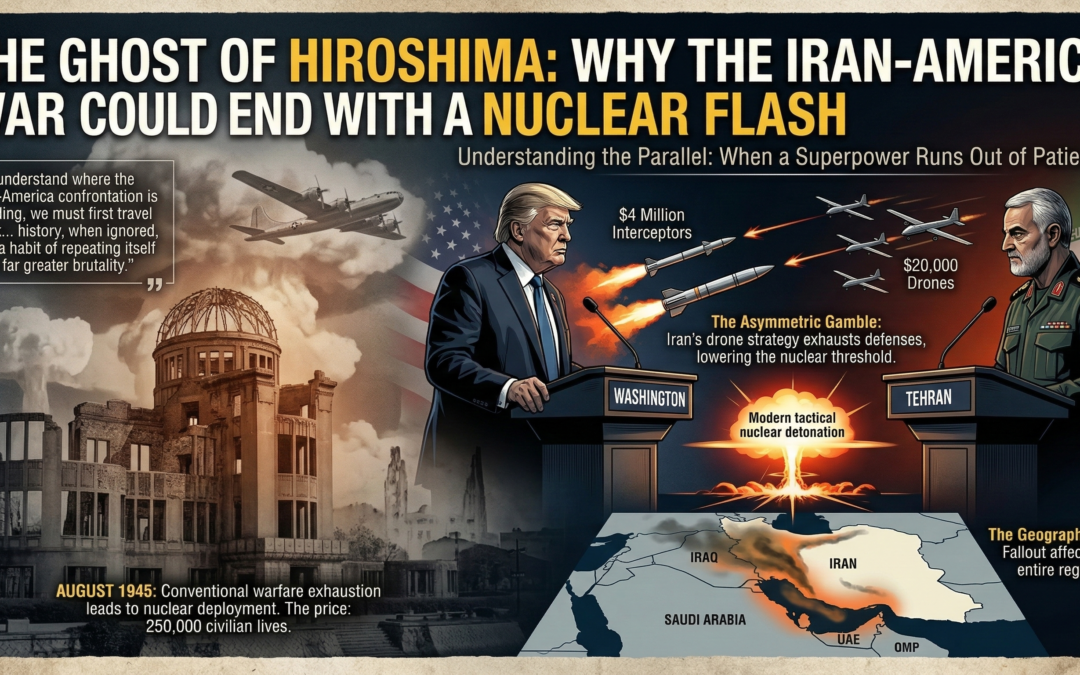
To understand where the Iran-America confrontation is heading, we must first travel back to the final months of World War II — because history, when ignored, has a habit of repeating itself with far greater brutality.
The Japanese Parallel: When a Superpower Runs Out of Patience
By March 1945, Nazi Germany was collapsing from within. Hitler had retreated to his underground bunker in Berlin, his armies were in full retreat, and Allied forces had reclaimed most of occupied Europe. But the Pacific theater told a different story. Japan refused to surrender. Despite catastrophic losses, Japanese forces continued fighting across multiple fronts, threatening British India from the east while nationalist movements destabilized it from within. The Allies faced the very real possibility of losing India — the strategic heart of their entire Eastern campaign.
Meanwhile, America was quietly reaching its limits. Its ammunition stocks were depleting, its manpower was exhausted, and its economy could not indefinitely sustain a two-front global war. Washington desperately needed Japan’s unconditional surrender — at any cost.
Then came the message that changed everything. The Manhattan Project had produced the world’s first functional atomic bomb. Only a test remained.
On April 27, 1945, the Target Committee convened in Washington and approved atomic strikes on seventeen Japanese cities. When the Manhattan Project responded that seventeen bombs could not be manufactured quickly enough, the list was reduced to five: Hiroshima, Kokura, Yokohama, Niigata, and Kyoto. Kyoto was slated to be struck first — until Secretary of War Henry Stimson intervened, personally removing it from the list out of respect for its historical and cultural significance as Japan’s ancient imperial capital. Nagasaki replaced it.
America then attempted to warn Japan about the nature of the new weapon. Japan dismissed the warnings. It remained convinced of its own eventual victory and fought on.
On July 16, 1945, the first successful nuclear detonation took place in New Mexico. America had become the world’s first nuclear power.
Within weeks, the bombs were transferred to Tinian Island, 1,500 kilometers from Tokyo. On the morning of August 6, 1945, the bomb fell on Hiroshima. It detonated above Shima Hospital. Within seconds, temperatures reached 3,000 degrees Celsius. The city — its buildings, bridges, roads, and 80,000 human beings — was incinerated in half an hour. Those who survived spent the rest of their lives wishing they had not.
Japan was again offered the chance to surrender. It refused, declaring it would fight to the last bullet and last drop of blood.
Three days later, Nagasaki ceased to exist. Seventy-five thousand people died in the first minute. Japan surrendered on August 15, 1945. The Second World War was over.
The Lessons the World Refused to Learn
Analyzing those final months of the war with strategic honesty, one can acknowledge both Japanese resolve and American technological supremacy. In a certain sense, both nations demonstrated what they were made of. But that “victory” came at the price of 250,000 civilian lives in Hiroshima and Nagasaki — people who bore no responsibility for the decisions of their leaders.
And here lies the eternal tragedy of great power conflict: ordinary people pay the price for the pride of states.
Human beings are a combination of reason and emotion. Reason, until the very last breath, urges survival. It whispers that endurance is the greatest achievement. Emotion, however, consistently drives the weak to challenge the powerful — and in almost every such confrontation, it is the weak who are destroyed.
Great powers carry great egos. When wounded, they do not negotiate — they annihilate. America demonstrated this in 1945. When it calculated that its conventional arsenal was insufficient to compel Japanese surrender, it reached for the most extreme weapon available and used it without hesitation. The descent from principle to mass slaughter took only a matter of minutes.
2026: The Anatomy of a Crisis in the Making
The United States has spent two and a half centuries constructing itself into the world’s undisputed superpower — superior in technology, military projection, financial architecture, and global reach. Since 1945, Washington has communicated a singular message to every nation on earth: you may have the Gulf’s oil reserves, Russia’s landmass and nuclear arsenal, Europe’s civilization and institutional stability, or China’s industrial and technological scale — and still you cannot challenge American primacy. There is one apex predator in this jungle, and it is the United States.
Now consider the strategic dilemma when a country like Iran — economically sanctioned, diplomatically isolated, and militarily outgunned — stands up and directly challenges that primacy.
If you were Donald Trump, what would you do? If your name were America, what would your response be?
The answer is not hypothetical — it is already playing out. And it illuminates a pattern visible even in Pakistan’s recent military operations against Afghanistan. When a weak neighbor persistently threatens a nuclear state’s dignity and security, the stronger party eventually responds with overwhelming force. The logic is simple: to back down is to invite permanent vulnerability.
America faces the same logic with Iran — amplified by the stakes of superpower credibility.
America cannot afford to lose this confrontation. If it is seen to be defeated — or even stalemated — by Iran, the global order collapses. Russia and China, already circling, would accelerate their challenge to American hegemony. The unipolar world that has structured international relations since 1991 would fracture irreversibly. This means that for Washington, Iranian defeat is not a preference — it is a strategic imperative.
Iran’s Asymmetric Gamble: Brilliant Tactics, Catastrophic Strategy
Iran is executing a militarily creative but ultimately self-defeating campaign. The logic of its drone and missile strategy is economically elegant: Iran manufactures drones for approximately $20,000 each and reportedly maintains a stockpile of 80,000 units. Intercepting a single drone requires two to three interceptor missiles, each costing around $4 million — meaning America and its allies spend up to $16 million to neutralize a $20,000 weapon. Secretary of State Marco Rubio has acknowledged that Iran can produce approximately 100 missiles per month while the United States is manufacturing only six to seven interceptors in the same period.
Iran also possesses four generations of missile technology. It is currently deploying only first and second-generation missiles — deliberately exhausting the interceptor stockpiles of Israel, the Gulf states, and American assets — before unleashing its third and fourth-generation systems. The strategic intention is clear: disable the defense architecture before deploying the weapons that can genuinely destroy it.
Emotionally and tactically, this deserves respect. As a piece of asymmetric warfare design, it is impressive.
But strategically, it is catastrophic — for exactly the same reason Japan’s defiance was catastrophic in 1945.
The more Iran depletes American and Israeli interceptor stockpiles, the more it recreates the conditions of August 1945. As conventional defenses erode, the threshold for nuclear use drops. Both the United States and Israel possess tactical nuclear weapons. Deploying them would not require the deliberate policy decision that preceded Hiroshima — it could emerge as the path of least resistance when conventional options are exhausted.
The scenario is not far-fetched: Trump distances himself rhetorically, gives Netanyahu a quiet signal, and Israel drops three or four tactical nuclear devices on Iranian territory. What follows would dwarf the destruction of Hiroshima by an order of magnitude.
The Geographic Trap No One Is Discussing
There is a dimension to this conflict that receives almost no serious analytical attention: geography.
In 1945, the vast Pacific Ocean separated America from Japan. The United States absorbed none of the nuclear fallout. Today, there is considerable distance between America and Iran — but there is almost no distance between Iran and its Arab neighbors. The Gulf states sit directly adjacent to Iran’s borders. Nuclear fallout would not respect sovereignty. The radioactive consequences of strikes on Iranian territory would devastate the Arabian Peninsula, rendering the Gulf — with its extraordinary concentration of wealth, infrastructure, and human development — uninhabitable.
The royal families currently funding and facilitating this confrontation would find themselves homeless in their own countries.
And if Iran were to develop a nuclear weapon during the course of this conflict — a possibility that cannot be dismissed — its primary targets would be American military bases embedded across the Arab world, along with Israel. In either scenario, Arab civilization becomes the collateral damage of a war between other parties.
The arithmetic is brutal: if America and Israel win — the overwhelmingly more probable outcome — the entire Islamic world will be compelled to formally recognize Israel, accelerating the project of Greater Israel and dismantling whatever remains of Palestinian political aspiration. If Iran somehow prevails, the Arab world from Iraq to Oman becomes a wasteland.
There is no scenario in which the Islamic world emerges from this conflict stronger.
The Only Exit That Preserves Anything
There is one path that avoids civilizational catastrophe, and it requires the Islamic world to subordinate its internal rivalries to a shared strategic interest.
The Muslim bloc must collectively engage Iran and persuade it to offer America and Israel a face-saving exit. Trump needs a victory he can announce. He needs to declare himself the champion of peace, the man who prevented a nuclear war, the dealmaker who succeeded where everyone else failed. Give him that. Let him take the trophy. The alternative is Tehran becoming Hiroshima and Isfahan becoming Nagasaki — and every responsible leader in the region knows it.
After a ceasefire, the Islamic world should quietly wait. Netanyahu faces profound domestic rejection — a significant portion of Israeli society views him as an existential threat to Israeli democracy. Trump is increasingly isolated within America’s own institutional architecture; the system is actively reasserting itself against his consolidation of power. Both men are kept politically alive by the wars they have started. Remove the wars, and their domestic crises consume them.
Beyond the immediate crisis, the Islamic world must begin building the architecture of collective security it has long discussed and never constructed. A mutual defense framework — a genuine Muslim security alliance with shared doctrine, joint command structures, and coordinated deterrence — is no longer an idealistic aspiration. It is a survival requirement.
The strategic window is narrow and closing.
The Pakistan Question
One final dimension demands honest acknowledgment. Saudi Arabia concluded a defense agreement with Pakistan in June. That agreement was not framed against Israel — it was framed against Iran. The recent meeting in Riyadh between Saudi Arabia’s Defense Minister and Pakistan’s Chief of Army Staff carries a clear signal: Pakistan’s distance from this conflict is shrinking by the day.
If that trajectory continues, Pakistan — the Islamic world’s only nuclear power, and a state already managing significant internal and external pressures — could find itself drawn into a confrontation whose consequences it is not positioned to absorb.
The time for strategic clarity is now. Not celebrations. Not tribalism. Not the intoxicating noise of short-term emotional satisfaction.
Reason — cold, honest, unsentimental reason — is the only thing that stands between the Islamic world and its own Hiroshima.
History does not warn. It simply repeats.