
|
Getting your Trinity Audio player ready...
|
The Future of AI in Education: How Schools Will Change by 2030
There is a version of this story that sounds like science fiction: personalized robot tutors, classrooms without teachers, exams graded by algorithm. That version makes for good headlines but misses what is actually happening. The real story is quieter, more complicated, and in many ways more interesting. AI is not about to replace schools. It is going to change what happens inside them — slowly in some places, rapidly in others — and by 2030, the classroom most of us grew up in will look noticeably different.
The numbers alone signal how serious the shift already is. The global AI in education market was valued at roughly $7 billion in 2025 and is projected to reach $136 billion by 2035. Student AI tool usage stands at 86%, with nearly a quarter of students using these tools every single day. These are not niche adoption figures. This is a technology that has already entered the classroom whether schools invited it or not.
The Personalization Problem — Finally Getting Solved
For most of the history of formal education, teachers have faced an impossible task: deliver one lesson to thirty students who learn at different speeds, have different gaps in their knowledge, and respond to completely different teaching styles. The best educators have always known this. They’ve just never had the tools to do much about it at scale.
AI changes that equation. Generative AI tools can instantly create learning content tailored to different academic backgrounds and levels, while also helping students address specific gaps in their knowledge. An AI tutoring system can identify, in real time, that a student understands the concept but struggles with its application — and adjust accordingly. No waiting for a test. No waiting for a parent-teacher meeting.
The results from early research are striking. A 2025 Harvard University physics study found that students using AI tutors learned more than twice as much in less time compared to those in traditional active-learning classrooms. Students using an enhanced AI tutor achieved a 127% improvement in outcomes, compared to 48% with a standard AI chatbot. These are not marginal gains.
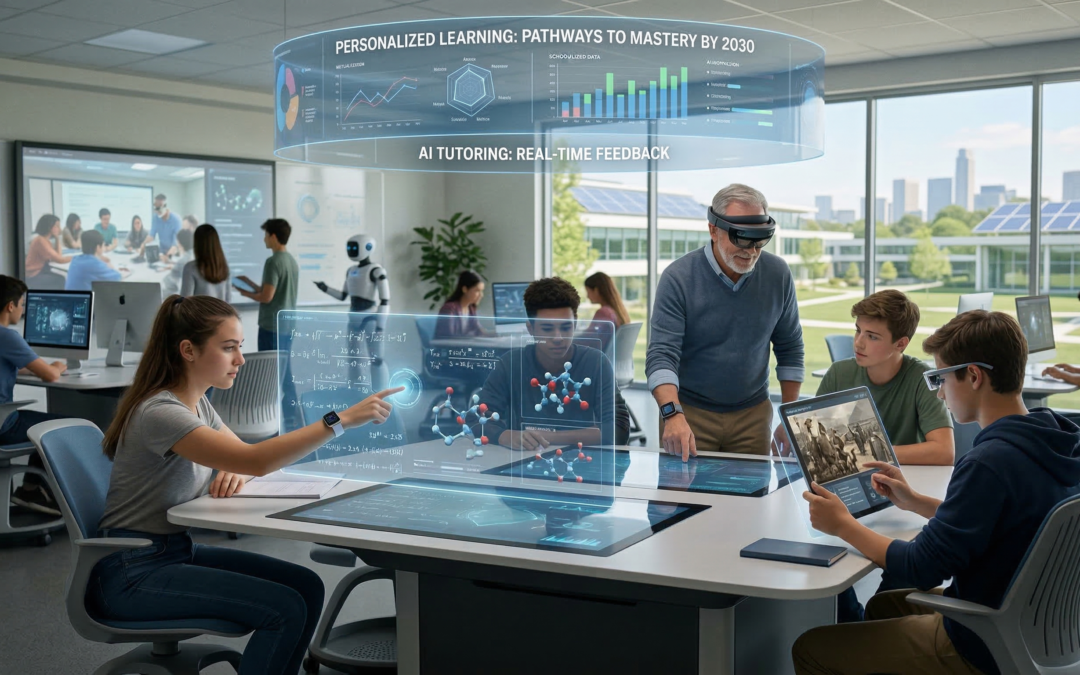
By 2030, personalized learning pathways will be standard in well-resourced schools. A student who masters fractions quickly will move on without waiting for the rest of the class. A student who keeps stumbling on the same concept will get a different explanation — maybe a visual one, maybe a simpler analogy — instead of hearing the same lesson repeated louder.
The Teacher’s Job Is Changing, Not Disappearing
Every conversation about AI in education eventually arrives at the same anxious question: are teachers going to lose their jobs? The honest answer is no — but their jobs are going to change, and significantly.
The more useful framing is not replacement but redistribution. Teachers spend enormous amounts of time on tasks that do not require a human being: generating lesson plans, writing routine feedback, managing administrative paperwork, designing quizzes. AI handles all of this. Teachers who use AI tools at least weekly save an average of 5.9 hours per week — roughly six extra weeks of reclaimed time over a school year.
What do teachers do with that time? Ideally, they do the things AI cannot: build relationships, notice when a student is struggling emotionally, inspire curiosity, make judgment calls about when a child needs encouragement versus challenge. Human tutors can interpret student emotional states with 92% accuracy, while even the most advanced AI tutoring systems currently manage only 68% accuracy. That gap matters enormously, and it is unlikely to close by 2030.
Between 80% and 90% of universities are planning to introduce AI-enabled teaching assistants in the near future, which points toward a model that will filter down to secondary education as well: human teachers supported by AI assistants, not replaced by them. The teacher becomes a mentor, a guide, a coach. The AI handles the drills.
A 2025 EdWeek survey found that 59% of teachers said AI had enabled more personalized instruction. That is a signal worth taking seriously. When teachers themselves report that a tool is making them better at their core job, adoption tends to stick.
Assessment Is About to Look Very Different
The traditional exam — a high-pressure, timed, closed-book test — was always a compromise. It measured something, but not necessarily what we cared about most. In a world where students have instant access to AI tools, the question “can you recall this information?” becomes almost beside the point.
By 2030, AI is expected to automatically score half of all college essays and nearly all multiple-choice exams. That will free up time for a different kind of assessment: project-based work, oral examinations, portfolio reviews, demonstrations of understanding that are much harder to outsource to an AI. Schools that figure this out early will have a genuine advantage. Schools that keep administering the same tests and simply try harder to detect AI use are likely to lose that arms race.
59% of students already agree that the way they are assessed is changing due to generative AI. Students have noticed what many administrators have not yet officially acknowledged.
Accessibility: The Underreported Upside
Lost in debates about academic integrity and job displacement is one of the most straightforward benefits AI brings to education: it dramatically expands access for students who have historically been left behind.
For students with learning disabilities, AI-powered speech-to-text, text-to-speech, and adaptive pacing tools remove barriers that previously made school an exercise in frustration. Students with physical and learning disabilities are achieving better results through AI tools, with speech-to-text and text-to-speech platforms among the most impactful.
For students in under-resourced schools — in rural areas, in low-income districts, in countries where qualified teachers are scarce — AI tutoring can provide consistent, patient, knowledgeable support that simply was not available before. A student in a small town with no advanced math teachers can access the same quality of instruction as a student at an elite private school. That promise is not yet fully delivered, but it is real.
The Problems Nobody Wants to Talk About
An honest account of where this is heading has to include the parts that are genuinely concerning.
First, training. Nearly 60% of educators and students say they have received no AI training, despite rising adoption. A major perception gap exists: 76% of leaders believe users are trained, but 45% of educators and 52% of students report zero training. A tool without training is not a tool — it is a liability. Schools are deploying AI faster than they are preparing the people who are supposed to use it.
Second, policy. According to a UNESCO survey covering more than 450 schools and universities, only 10% have established guidelines for using AI. Just 7% of schools worldwide have AI guidance, and of those, 40% have only informal guidance. This is not a sustainable situation. Without clear frameworks, students are left to guess what is acceptable, teachers are left to make inconsistent judgment calls, and the potential for AI to undermine learning rather than support it grows.
Third, equity. AI carries a real risk of widening existing gaps rather than closing them. The most pressing challenge ahead is ensuring that the benefits of AI in education reach students in low-income, rural, and under-resourced communities at the same rate as those in well-funded institutions. Without deliberate policy intervention, schools that are already well-resourced will adopt AI faster, train their teachers better, and pull further ahead. The technology is neutral. Its distribution is not.
Fourth, critical thinking. A January 2026 survey found that 95% of college faculty fear student overreliance on AI and diminished critical thinking. 60% of educators express concern that AI could negatively affect students’ independent thinking, writing, and research skills. These fears are not irrational. If students use AI to skip the hard, uncomfortable work of forming their own arguments and working through difficult problems, they may arrive at graduation with impressive grades and underdeveloped minds.
What 2030 Actually Looks Like
By 2030, the school that has handled this transition well will look something like this: students arrive with a baseline of AI literacy built into the curriculum from early grades. Teachers spend less time on administrative tasks and more time on mentorship, discussion, and the kinds of high-order thinking that cannot be delegated to an algorithm. Assessments are designed around what humans can do that AI cannot. Students with disabilities have access to tools that would have transformed their educational experience a decade earlier. And clear policies govern how AI is used — with enough flexibility to evolve as the technology does.
The school that has handled it poorly will look like an arms race: students using AI to complete assignments, teachers using AI detectors that produce false positives and erode trust, administrators issuing bans that nobody enforces, and the fundamental questions about what education is actually for going completely unanswered.
By 2030, approximately 70% of job skills are expected to change, primarily due to the impact of AI. Schools do not have the option of sitting this out. The question is not whether AI will change education. It already has. The question is whether schools will shape that change — or simply react to it.
The institutions that will serve students well are the ones asking hard questions now: What do we want students to be able to do that AI cannot do for them? What does genuine understanding look like in a world of instant answers? What is a teacher for, and what is a test for, when both can be bypassed by a phone?
Those are not technology questions. They are education questions. And answering them well — before 2030, not after — is the real work ahead.