
|
Getting your Trinity Audio player ready...
|
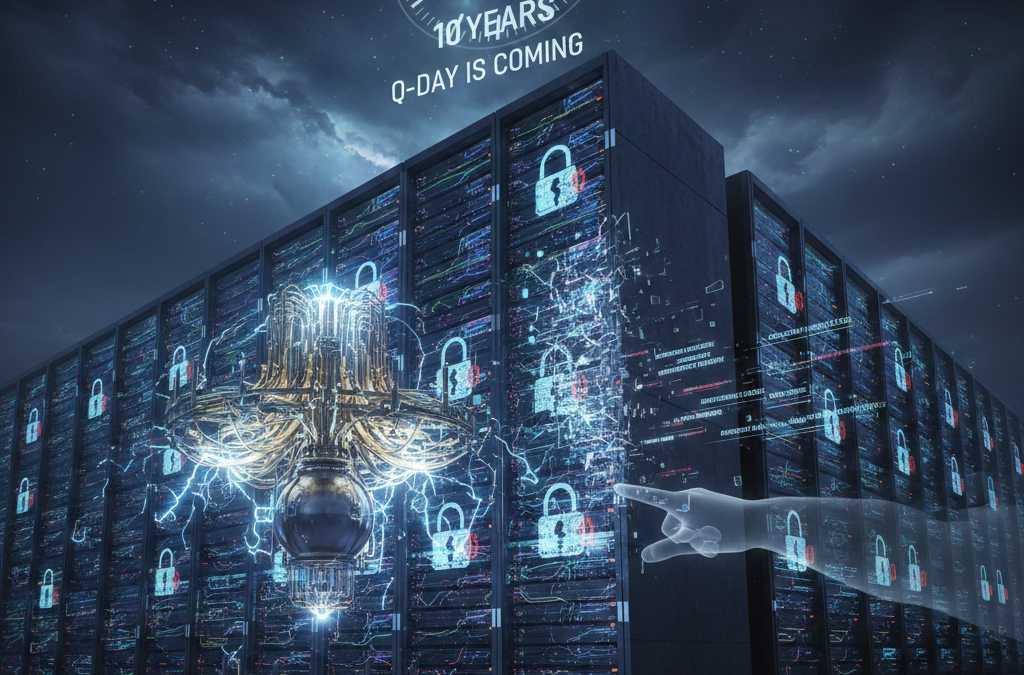
You know that padlock icon in your browser? The one that makes you feel safe when you’re shopping online or accessing your bank account? I need to tell you something that might keep you up at night: there are organizations right now harvesting and storing your encrypted data, waiting patiently for the day they can crack it open like a time capsule.
Welcome to the world of “Harvest Now, Decrypt Later.”
The Quantum Threat Nobody’s Talking About Enough
As IT professionals, we’ve built our entire digital security infrastructure on a mathematical promise: certain problems are just too hard for computers to solve in any reasonable timeframe. RSA encryption, for instance, relies on the fact that factoring large prime numbers would take classical computers thousands of years.
But here’s the plot twist: quantum computers don’t play by those rules.
A sufficiently powerful quantum computer running Shor’s algorithm could crack RSA-2048 encryption in hours, maybe minutes. And while we don’t have that quantum computer yet, experts estimate it could arrive within the next 10-15 years. Some say sooner.
The Harvesting Has Already Begun
This is where it gets genuinely unsettling. Nation-states and sophisticated threat actors are already intercepting and storing encrypted communications at massive scale. They can’t read it today, but they’re banking on quantum computers to unlock these archives tomorrow.
Think about what you’ve encrypted and transmitted over the past few years:
Medical records
Financial transactions
Proprietary business communications
Government secrets
Personal messages you assumed would stay private
All of it sitting in digital warehouses, waiting for Q-Day.
What This Means for Your Infrastructure
If you’re managing IT systems, here’s your wake-up call: data encrypted today with current standards could be exposed in 10 years. But some of that data needs to stay confidential for 20, 30, or even 50 years.
Healthcare records. Legal documents. State secrets. Your company’s IP.
The math is brutal: Your encryption has an expiration date, but your data doesn’t.
The Silver Lining: Post-Quantum Cryptography
Before you spiral into existential dread, there’s good news. The cryptography community saw this coming and has been working on “post-quantum cryptography” (PQC) – algorithms that even quantum computers can’t break.
In 2024, NIST finalized its first set of post-quantum cryptographic standards. These algorithms are based on mathematical problems that remain hard even for quantum computers – things like lattice-based cryptography and hash-based signatures.
The race is now on to implement these standards before quantum computers become a reality.
What You Should Be Doing Right Now
Here’s my practical advice as someone who lives in the trenches of IT security:
Start Planning Your Migration: You don’t need to panic, but you do need a plan. Inventory your systems, identify what needs long-term confidentiality, and map out a timeline for transitioning to PQC algorithms.
Implement Crypto-Agility: Design your systems so you can swap out cryptographic algorithms without rebuilding everything. Think of it as future-proofing through modularity.
Hybrid Approaches: Use both classical and post-quantum algorithms together. It’s like wearing both a seatbelt and having airbags – defense in depth matters.
Prioritize High-Value Targets: Not everything needs quantum-resistant encryption immediately. Focus first on data with long confidentiality requirements or high strategic value.
Stay Informed: This field is evolving rapidly. What’s cutting-edge today might be deprecated tomorrow. Subscribe to NIST updates, follow cryptography researchers, and keep your finger on the pulse.
The Bigger Picture
This quantum threat represents something rare in technology: a known, inevitable disruption that we can actually prepare for. We’re not scrambling after a zero-day exploit or responding to a breach. We have advanced warning.
The question is whether we’ll use it wisely.
As IT professionals, we’re the guardians of the digital realm. We build the locks that protect everything from personal photos to national security secrets. And right now, we’re in a unique moment where we know those locks are going to be picked, but we have time to install better ones.
Final Thoughts
The encryption apocalypse sounds dramatic, and maybe it is. But unlike Hollywood disasters, this one comes with a roadmap for survival. Post-quantum cryptography isn’t just theoretical – it’s here, it’s standardized, and it’s ready for deployment.
The organizations that take this seriously now will be secure in the quantum future. The ones that don’t? They’ll be explaining to their boards why decades-old communications just got leaked.
Time to start treating quantum computing not as some distant sci-fi concept, but as an imminent threat to everything we’ve encrypted.
Because somewhere, in a data center you’ll never see, your encrypted data is already waiting on death row.
What’s your organization doing to prepare for the quantum threat? Are you building crypto-agility into your systems? Let’s discuss in the comments – I’d love to hear how other IT professionals are tackling this challenge.
Follow me for more insights on emerging security threats and practical strategies for staying ahead of the curve.