|
Getting your Trinity Audio player ready...
|
When high-profile scandals resurface, the public pays attention. And when global conflicts erupt within days of those headlines, many begin to question whether the timing is coincidence — or something more deliberate.
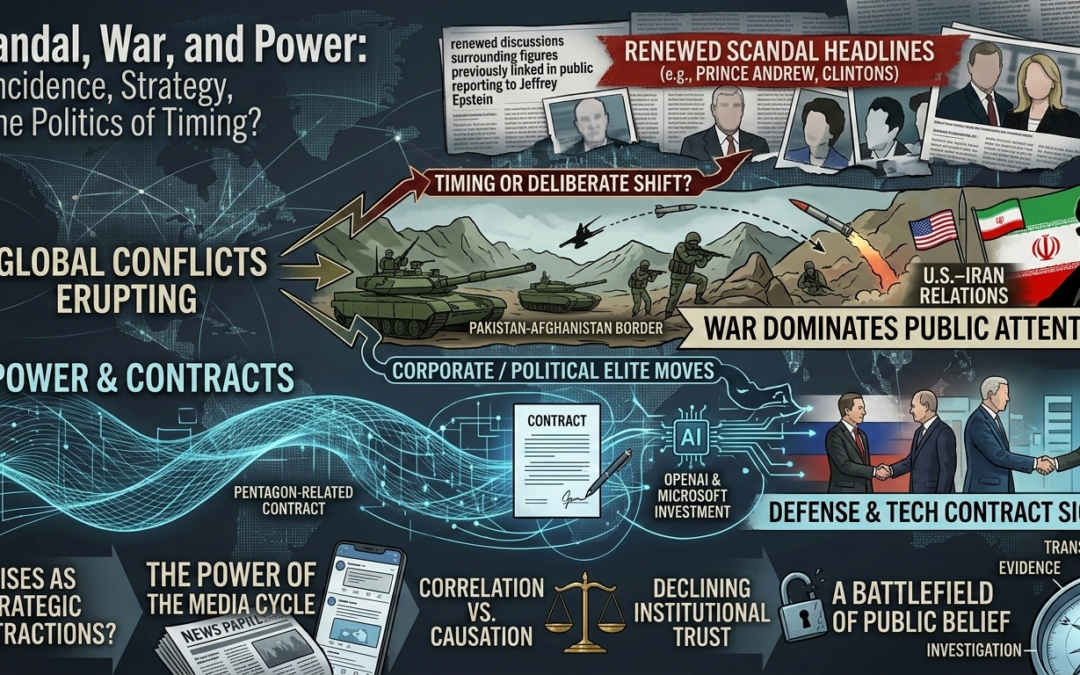
Recently, renewed discussions surrounding figures previously linked in public reporting to Jeffrey Epstein — including Prince Andrew, Bill Gates, Hillary Clinton, and Bill Clinton — once again circulated widely online. Almost immediately afterward, attention shifted toward escalating tensions between Pakistan and Afghanistan, along with claims of dramatic U.S. action involving Iran’s Supreme Leader, Ali Khamenei.
At the same time, reports highlighting a Pentagon-related contract involving OpenAI — a company that has received investment from Microsoft — fueled online speculation about coordinated power moves among political and corporate elites.
The narrative spreading across social media suggests a pattern: scandal emerges, war dominates headlines, major defense or technology contracts are signed, and public attention shifts. According to this view, crises are not random — they are strategic distractions designed to protect powerful individuals and institutions from accountability.
It is an argument built on timing.
The Power of the Media Cycle
Modern news cycles move at extraordinary speed. A scandal can trend globally for 48 hours — until something bigger takes its place. War, by its nature, overwhelms public discourse. It commands front pages, reshapes diplomatic priorities, and reorders national conversations.
This reality makes it easy for observers to suspect intentional diversion. If a damaging controversy disappears from headlines as soon as conflict begins, the assumption of strategy feels plausible.
History offers examples of governments leveraging crises to unify domestic opinion or redirect public focus. Political leaders have long understood that external threats can consolidate internal support. That historical memory fuels modern skepticism.
But skepticism alone is not proof.
Correlation vs. Causation
International conflicts rarely emerge overnight. Tensions between neighboring states such as Pakistan and Afghanistan stem from years of border disputes, security challenges, and political instability. Likewise, U.S.–Iran relations have been shaped by decades of geopolitical rivalry.
Defense contracts and government partnerships with technology firms follow procurement systems that typically involve long negotiations, regulatory processes, and strategic planning. While the optics of timing can appear dramatic, overlap does not automatically equal coordination.
Still, public suspicion should not be dismissed outright. Trust in institutions has declined globally. Many citizens believe powerful elites operate within interconnected political, financial, and media networks that shield them from consequences. When prominent names tied to controversy appear alongside major geopolitical developments, it reinforces the perception of an untouchable ruling class.
The Risk of Oversimplification
Complex global events are often reduced into singular explanations online. A scandal plus a war equals distraction. A corporate contract plus a political controversy equals collusion. These simplified formulas spread quickly because they offer clarity in chaotic times.
However, sweeping conclusions without verifiable evidence can distort reality. They can also unintentionally fuel harmful narratives that attribute global events to broad ethnic or religious conspiracies — claims that history has shown to be deeply dangerous and socially divisive.
Accountability for wrongdoing is essential. So is transparency in foreign policy and government contracting. But credible accountability requires documented evidence, investigative reporting, and due process — not assumption based solely on proximity in time.
Why These Narratives Persist
Three forces drive the endurance of such theories:
Declining Institutional Trust – Governments, corporations, and media organizations face widespread skepticism.
Information Saturation – In a nonstop digital environment, simultaneous crises feel interconnected.
Historical Precedent – Past instances of political manipulation create fertile ground for present-day suspicion.
In this climate, patterns feel persuasive — even when proof is absent.
The Larger Question
The deeper issue may not be whether elites coordinate scandals and wars, but whether public confidence in transparency has eroded to such a degree that any coincidence appears calculated.
When citizens believe that power operates without consequence, they interpret global events through that lens. War becomes a smokescreen. Contracts become rewards. Media silence becomes complicity.
Rebuilding trust requires openness, credible journalism, and institutions willing to withstand scrutiny. It also requires citizens to distinguish between legitimate investigation and narrative construction.
Timing alone cannot convict. But ignoring public distrust is equally unwise.
In an era where information travels faster than verification, the responsibility lies on both institutions and individuals: institutions must earn trust through transparency, and individuals must demand evidence before drawing conclusions.
Because while wars reshape borders and scandals test reputations, the most fragile battlefield today may be public belief itself.