
|
Getting your Trinity Audio player ready...
|
Part III of the Series: Prophets, Empires & the Modern World
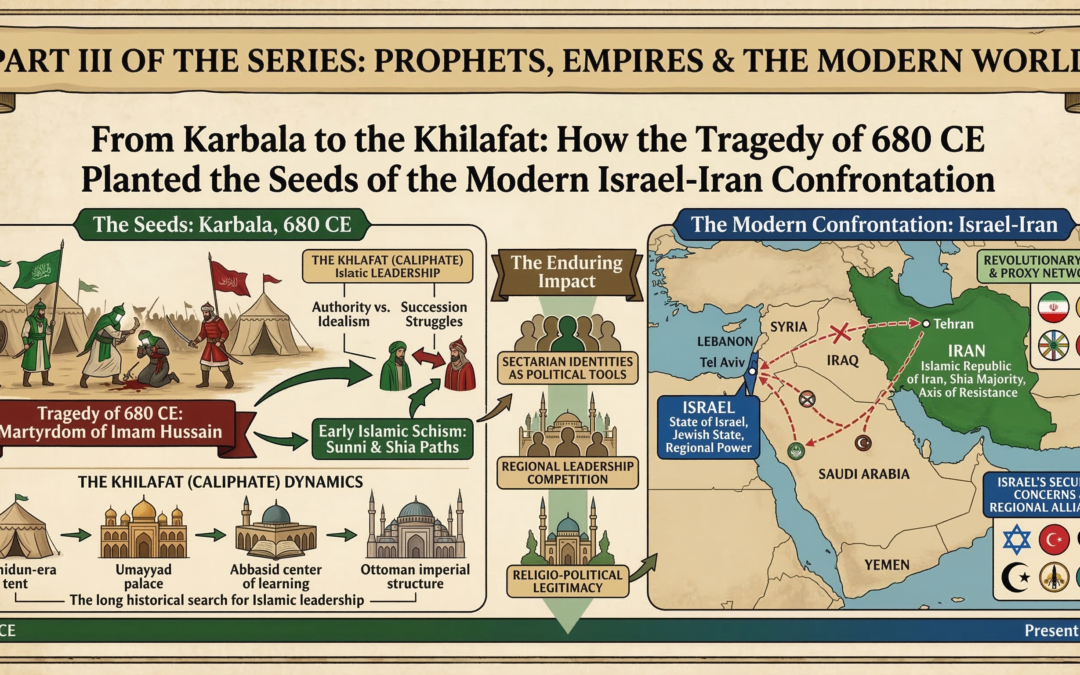
From Karbala to the Khilafat: How the Tragedy of 680 CE Planted the Seeds of the Modern Israel-Iran Confrontation
At the end of Part II, we arrived at a question that most historians and analysts have failed to ask seriously: if Jews and Muslims lived largely in peace for over a thousand years, when did the modern conflict between them actually begin? And more specifically — why is Iran, of all nations, the most implacable enemy of the Israeli state today?
The conventional answer points to 1948, the founding of Israel, or to 1979, the Iranian Revolution. Both answers are wrong — or rather, they are correct only at the surface level. The true roots of this confrontation stretch back thirteen centuries, to a desert plain in Iraq, on a single day in October of the year 680 CE.
That day was the Battle of Karbala. And to understand it is to understand nearly everything about the modern Middle East that our newspapers fail to explain.
The Background: Who Was Husayn ibn Ali?
To understand Karbala, we must first understand who Husayn was and why his death mattered so profoundly.
Husayn ibn Ali was born in January of 626 CE. His father was Ali ibn Abi Talib — the cousin and son-in-law of the Prophet Muhammad (?), and the fourth Caliph of Islam. His mother was Fatimah al-Zahra — the beloved daughter of the Prophet, described in hadith as the leader of all women of paradise. Husayn was therefore the grandson of the Prophet Muhammad (?) through the Prophet’s own daughter. The Prophet himself is recorded in multiple hadith as expressing extraordinary love for Husayn and his brother Hasan. In one famous hadith, he said: “Husayn is from me, and I am from Husayn. Allah loves whoever loves Husayn.”
This is not a minor genealogical detail. In Islamic culture — and in the broader Semitic cultural world — the family of a prophet carries a sanctity that is almost without parallel. Husayn was not a distant relative. He was the flesh and blood of the Prophet of Islam, raised in his household, loved by him personally. His death, and the manner of it, would shake the Muslim world to its foundations.
The Rise of the Umayyads and the Breaking of the Covenant
To understand why Husayn died, we must go back further — to the question of succession after the Prophet’s death.
The Prophet Muhammad (?) passed away in 632 CE. The question of who would lead the Muslim community — the Ummah — after him became the central political fault line of early Islamic history. The first three caliphs — Abu Bakr al-Siddiq, Umar ibn al-Khattab, and Uthman ibn Affan — were chosen through consultation and community consensus. Ali ibn Abi Talib became the fourth Caliph in 656 CE, but his tenure was marked by civil conflict. He was assassinated in 661 CE by a member of the Kharijite faction.
After Ali’s assassination, his son Hasan ibn Ali briefly assumed leadership but concluded a peace treaty with Muawiyah ibn Abi Sufyan — the powerful Governor of Syria and founder of the Umayyad dynasty. The treaty had one crucial condition: Muawiyah would not appoint a hereditary successor. The Caliphate would revert to the family of the Prophet after Muawiyah’s death. This was a solemn covenant.
Muawiyah violated it completely. Before his death in April 680 CE, he appointed his own son Yazid as his heir — transforming the caliphate from an institution of religious leadership into a hereditary monarchy. This was not merely a political act. It was, in the eyes of the Muslim community, a profound corruption of the entire structure of Islamic governance. Yazid, by all contemporary accounts, was a man known for drinking wine, keeping hunting dogs, and conducting himself in ways incompatible with the gravity of the caliphate.
Husayn ibn Ali refused to pledge allegiance to Yazid. His refusal was not merely political ambition — it was a principled moral stand. As he said himself: “Anyone like me will never accept anyone like Yazid as a ruler.” He was choosing principle over safety, and he knew what it would cost him.
The Journey to Karbala
Husayn left Medina in late 679 CE, eventually making his way to Mecca. There, he received hundreds of letters from the people of Kufa — a city in what is now southern Iraq, which had been a stronghold of Ali’s caliphate and remained deeply loyal to the family of the Prophet. The Kufans begged Husayn to come to them. They pledged their allegiance, their swords, their lives. They promised that tens of thousands would rally to him when he arrived.
Husayn sent his cousin, Muslim ibn Aqeel, to Kufa in advance to assess the situation. The initial report was encouraging — Muslim found the city brimming with support, and wrote to Husayn that conditions were favorable. But then Yazid’s new governor, the ruthless Ubaydullah ibn Ziyad, arrived in Kufa. Within days, he had arrested Muslim ibn Aqeel and had him executed. The promised supporters melted away under the threat of violence. Kufa went silent.
The news of Muslim’s execution reached Husayn while he was already on the road, deep in the desert. His companions urged him to turn back. Some left. But his closest followers — family members, lifelong companions, and a small number of devoted men who refused to abandon him — stayed. By the time the caravan arrived at the plain of Karbala on October 2, 680 CE, Husayn’s force numbered approximately 72 fighting men, accompanied by women and children of the Prophet’s family.
Facing them was a Umayyad army of thousands — some accounts say four thousand, others far more.
The Tenth of Muharram: The Day the World Changed
For eight days, Husayn’s small camp sat in the open desert. Yazid’s forces cut off their access to the Euphrates River. The children of the Prophet’s family — including an infant — went without water in the scorching Iraqi sun.
On the night before the battle, Husayn gathered his companions. He told them plainly: the enemy wants only me. Whoever wishes to leave in the darkness of night has my blessing and my thanks. Every one of them refused to leave.
On the morning of October 10, 680 CE — the 10th of Muharram in the Islamic calendar, known as Ashura — the battle began. One by one, Husayn’s companions and family members were killed. His brothers. His nephews. His sons. Including, according to various accounts, his infant son Ali al-Asghar, who was killed while Husayn held him in his arms pleading for water for the child.
Husayn fought until he was too wounded to continue. He was surrounded, struck repeatedly, and beheaded. His severed head and the heads of his companions were placed on spears and carried to Damascus, to Yazid’s court. The women and children of the Prophet’s family — including Husayn’s sister Zaynab bint Ali, a woman of extraordinary courage who would bear witness to the world about what had happened — were taken as prisoners.
The Umayyad forces won the battle. They lost the war for history.
The Earthquake That Created Shia Islam
Before Karbala, “Shia” — from “Shiat Ali,” meaning “the party of Ali” — was largely a political faction, not a distinct religious sect. It was a group of Muslims who believed that leadership of the Ummah rightfully belonged to the family of the Prophet. There were no separate theological doctrines, no distinct rituals, no separate religious identity.
Karbala changed everything.
The German scholar Heinz Halm, one of the foremost Western authorities on Shia Islam, wrote that there was no religious aspect to Shi’ism prior to 680 CE. The death of Husayn and his followers was, in his words, the “big bang” that created the rapidly expanding cosmos of Shi’ism and brought it into motion.
Karbala gave the followers of Ali’s family something they had not had before: a theology of martyrdom, a sacred narrative of sacrifice, and a burning sense of collective grief and injustice that has never been extinguished in fourteen centuries. The story of a small band of righteous people — the family of the Prophet — being abandoned by the masses, surrounded by an army of power, and slaughtered in the desert while standing on principle became the founding myth and the living wound of an entire civilization.
The Shia commemorated Ashura — the 10th of Muharram — not as a distant historical event but as a wound that was re-opened and re-lived every year. The phrase that became the defining cry of Shia consciousness across generations captures it perfectly: “Every land is Karbala. Every day is Ashura. Every month is Muharram.”
Iran: The Nation That Made Karbala Its Identity
Here the story turns to Persia — and this is where the bridge to the modern world becomes visible.
When the Muslim armies conquered Persia in the 7th century CE, they ended the ancient Sasanian Empire. Persia had been a great civilization for over a thousand years. Its people had their own language, their own culture, their own imperial identity. The Arab conquest was, from a Persian cultural perspective, a humiliation — however much many Persians eventually embraced Islam with genuine devotion.
For centuries, Persia remained largely Sunni — it was home to some of the greatest Sunni scholars in Islamic history, including Imam al-Bukhari, Imam al-Tirmidhi, and Imam al-Ghazali, all of whom were from the Persian cultural world. But underneath the surface, there was always a current of sentiment — both religious and cultural — that looked toward Ali’s family, toward the oppressed, toward resistance against Arab political dominance.
Then came the Safavids.
In 1501 CE, a young military leader named Shah Ismail I of the Safavid dynasty conquered Tabriz and declared himself Shah of Iran. His first act — before consolidating military control, before establishing administration — was to declare Twelver Shia Islam the official state religion of Iran. This was a political as much as a religious decision. Iran was surrounded by Sunni powers: the Ottoman Empire to the west, the Uzbek khanates to the east. By making Shia Islam the state religion, Ismail gave Iran a distinct religious identity that would permanently differentiate it from its rivals and unify its diverse population around a single, emotionally powerful narrative — the narrative of Karbala.
For the next two centuries, the Safavids pursued this conversion with enormous force. Sunni scholars who refused to convert were executed. Shia scholars were imported from Lebanon and Iraq to staff religious institutions. Public rituals of mourning for Husayn — weeping, lamentation, the dramatic re-enactment of Karbala — were institutionalized across the country. Within roughly a century, Iran was transformed from a predominantly Sunni nation into the world’s most Shia state. Today, approximately 90–95% of Iran’s population is Shia Muslim.
What the Safavids understood — and what has remained true ever since — is that for Iranian Shia Muslims, Karbala is not merely a historical event. It is the central organizing story of their civilization. Husayn is not merely a historical martyr. He is the supreme symbol of justice against tyranny, of standing alone against overwhelming power, of refusing to submit to illegitimate authority even at the cost of one’s life. Every Iranian ruler who has invoked Husayn’s memory has tapped into something deep and inexhaustible.
The Thread That Connects Karbala to Israel
Now we arrive at the connection that most analysts miss entirely.
The Umayyad dynasty — the force that killed Husayn, that cut off the water supply from the Prophet’s grandchildren, that carried his head on a spear to Damascus — was headquartered in Damascus, in Syria. The Umayyads were Arab in identity, Syrian in base, and their political culture was shaped in significant part by the Levantine region — which included the Jewish communities of Palestine and the broader Fertile Crescent.
From the Shia Iranian perspective — formed over fourteen centuries of commemorating Karbala — the Umayyad tradition represents something specific: the tradition of illegitimate power, of worldly authority dressed in religious clothing, of those who killed the family of the Prophet in the name of political control. This is not merely a medieval grievance. It is a living theological framework through which Iranian political culture understands power, justice, and resistance.
When the modern State of Israel was founded in 1948 — backed by Western powers, built on Palestinian land, governed by Ashkenazi political leadership — what Iranian Shia religious culture saw was a pattern it recognized completely: a powerful, externally-backed political project, claiming religious legitimacy, dispossessing and oppressing the weaker party, with the full support of the dominant world powers. The parallel to the Umayyad caliphate — powerful, politically backed, claiming Islamic credentials while oppressing the righteous — was not lost on Shia scholars and clerics.
When Ayatollah Ruhollah Khomeini framed the Israeli state in the language of Karbala — as a Yazidian power, as a force of oppression that the heirs of Husayn were bound to oppose — he was not inventing a new ideology. He was plugging the Palestinian cause into the oldest and deepest story in Iranian religious consciousness. He was telling Iranian Shia Muslims: this is your Karbala. These are your people. This is the moment you stand up, as Husayn stood, and refuse to submit.
That is why the slogan of the Iranian Revolution — “Every day is Ashura, every land is Karbala” — was applied directly to Palestine. And that is why, unlike most Arab states which have made peace with or accommodation toward Israel, Iran’s opposition is not transactional or political. It is theological. It is civilizational. It is rooted in a grief and a sense of justice that is fourteen centuries old.
What This Means for the Modern Conflict
Several conclusions flow from understanding this history properly.
First, the Iran-Israel conflict is not a conflict between Judaism and Islam. It is a conflict between, on one side, an Ashkenazi-led political state founded on European Zionist ideology with Western military backing, and on the other side, a Shia Iranian civilization that has for five centuries defined itself through the prism of Karbala — through resistance to unjust power, through solidarity with the oppressed, through refusal to acknowledge illegitimate authority regardless of the cost.
Second, Iran’s support for Hamas, Hezbollah, and Palestinian resistance movements is not primarily an expression of Arab solidarity — Iran is not Arab. It is an expression of Shia theological conviction. The Quds Force is named after Jerusalem — al-Quds in Arabic. The annual Al-Quds Day rally, established by Khomeini in 1979 on the last Friday of Ramadan, frames Jerusalem not as a foreign policy interest but as an Islamic obligation. This framing is Karbala in modern dress.
Third, the conflict will not be resolved by the methods being applied to it. No military campaign, no diplomatic agreement between Arab states and Israel, no American-brokered deal will address the roots of Iranian opposition to the Israeli state — because those roots are not in policy. They are in theology and civilizational identity. Iran does not oppose Israel because of this or that military action. Iran opposes the Israeli state because, from a Shia Iranian perspective, its very existence represents an act of Yazid — an act of worldly power crushing the righteous, backed by the dominant empire of the age.
Fourth — and this is perhaps the most important insight — the Palestinian people themselves occupy a particular place in this framework. They are the Husayns of the modern age: the small band, the family, the people abandoned by much of the world, surrounded by overwhelming force, denied water and bread, dying in the desert of history while the powerful look on. Whether one agrees with this framing or not, understanding that this is how Iran genuinely understands the situation — not as a calculation but as a sacred obligation — is essential to understanding why the conflict looks the way it does.
A Note on Perspective and Responsibility
This analysis does not endorse violence, nor does it assign collective guilt to any people or faith. It is the responsibility of an honest historian and analyst to trace causes accurately, even when those causes are uncomfortable or when they challenge simplified narratives on all sides.
The tragedy of Karbala was a genuine human catastrophe — the killing of the Prophet’s grandson and family by a political power that had usurped legitimate authority. Its grief is real. Its lessons about justice and standing against tyranny are genuinely profound, recognized even by Sunni Muslims and by non-Muslims who have studied it seriously.
At the same time, the people of Gaza and Palestine are real people suffering real dispossession and violence in the present. The Iranian revolutionary state has its own complexities, contradictions, and abuses of power that exist alongside its invocation of Karbala’s memory. And the Jewish people — all three branches of them — carry their own centuries of suffering and legitimate fears.
What the history tells us — from the Babylonian exile, through the ministry of Jesus, through Karbala, through the Safavid transformation of Iran, to the founding of modern Israel — is that the Middle East is not a region of simple conflicts between simple enemies. It is a region where the wounds of the past are very much alive in the present, where the words “justice” and “martyrdom” and “promised land” carry the weight of millennia, and where no solution that ignores history will last.
What Comes Next
In Part IV, we will trace the thread from the Abbasid revolution — which overthrew the Umayyads with the help of Persian and Shia forces in 750 CE — through the fragmentation of the Caliphate, the Crusades, the Mongol invasions, and the Ottoman Empire, to ask a question that ties all of these threads together: what does the collapse of the Khilafat in 1924 have to do with the birth of Israel in 1948 — and why are these two events, separated by just twenty-four years, not a coincidence?
(To be continued)