
|
Getting your Trinity Audio player ready...
|
From Shepherds to Rulers:
The Story of Prophet Dawud (David) and the Rise of the Jewish People
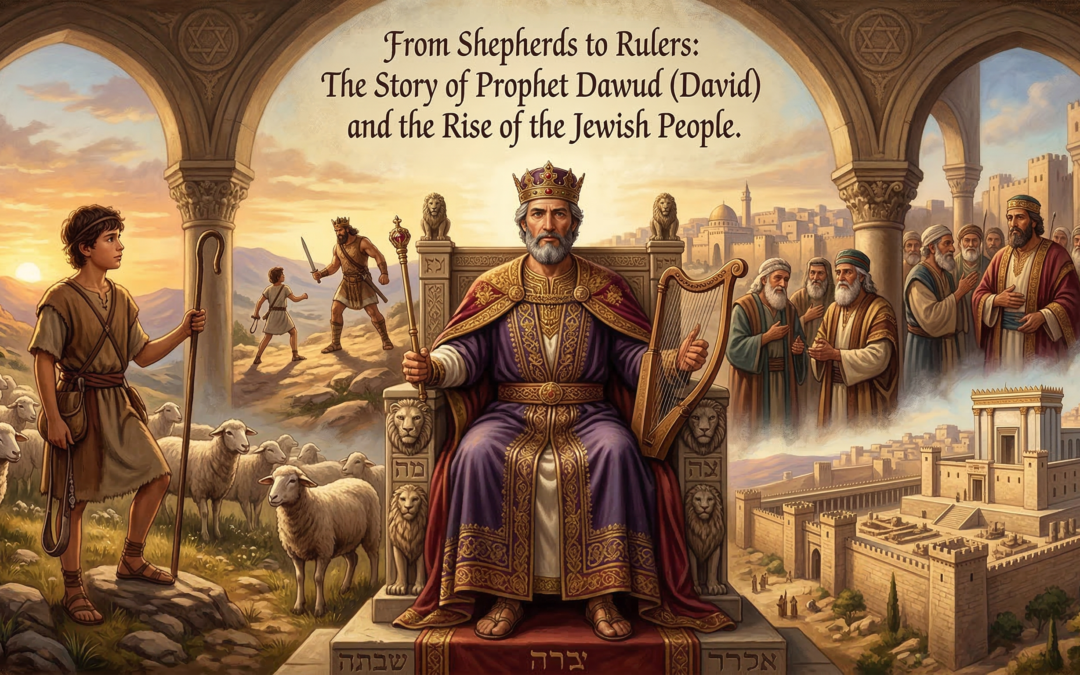
After the return of the Israelites to Palestine, the tribe of Judah (Banu Yahuda) found itself expelled from Jerusalem by the other ten tribes of Israel. The reason, according to biblical tradition, was economic — the Judahites had become notorious moneylenders who, within a few generations, had brought the entire economic system under their control, making the other ten tribes financially dependent on them. Eventually, the ten tribes united and drove Banu Yahuda out of Jerusalem. The exiled tribe settled on the western bank of the Jordan River, barred from trade and left with only two occupations: herding sheep and goats, and working as laborers in Jerusalem’s ironworks — though they were not permitted to remain in the city after sunset. In their hardship, they prayed fervently to God for relief. God answered their prayers by sending Prophet Dawud (David) among them.
Even in childhood, God had blessed Dawud with two remarkable gifts. The first was his voice — extraordinarily beautiful and deeply moving. When he sang, people stopped in their tracks, as though their hearts had momentarily ceased beating. This gift would soon carry him to the royal court. At the time, Palestine was under the rule of the tribe of Benjamin — the tribe of Benjamin, the youngest son of Prophet Jacob. The king was Saul (known in the Quran as Talut). When the king heard the young Dawud sing and play music, he was captivated and brought him into his court as a musician. Dawud was an expert in two instruments of the era — the harp and the lyre. The Quran mentions his magnificent recitation (Lahn Dawudi), while the biblical details about his early career as a court musician come from the Book of Samuel in the Bible.
Dawud was between ten and fifteen years old at the time. His second gift was marksmanship. From childhood, he had practiced with a sling — a length of rope or leather used to hurl stones — and had become the most accurate marksman of the tribe of Judah. He could identify a single fruit on a tree laden with hundreds, swing the sling, and bring down only that fruit. The Prophet Samuel, who belonged to the tribe of Levi and was the spiritual authority of the time, recognized something extraordinary in the boy and prophesied that Dawud would be Israel’s next king and prophet. (The full account of Dawud’s life is recorded in the Book of Samuel in the Bible.)
The defining moment came around 1012 BCE, when the Philistines — a powerful people from the coastal plain of Canaan — launched an assault on the Israelites. Their champion was Goliath (called Jalut in the Quran), a giant warrior from the Philistine city of Gath, standing approximately nine feet tall. The two armies faced each other in the Valley of Elah. Goliath stood in the middle of the field, his body covered in iron and bronze armor from head to toe — with only his forehead left bare. He taunted the Israelites day after day, challenging them to send out a single champion to face him, but no one dared step forward.
Dawud had come to the battlefield merely to bring food to his brother, who was serving in the Israelite army. He arrived to find Goliath mid-taunt. In his bag, Dawud carried his sling and five smooth stones. Without hesitation, he loaded a stone into the sling and ran forward to face the giant. Dawud barely reached Goliath’s knees. Goliath initially refused to fight what he saw as a shepherd boy, mocking both him and the Israelites. But as Goliath turned to address the crowd, Dawud released the sling. The stone flew straight and struck Goliath on the bare forehead — the one unprotected spot. The giant collapsed like a felled tree. Dawud then took Goliath’s own sword and beheaded him. It was over in seconds. The watching armies stood stunned. The Philistines fled in panic, and the Israelites won the battle.
King Saul rewarded Dawud by giving him his daughter Michal in marriage and bringing him into a position of power. This marked the beginning of the restoration of the tribe of Judah’s honor and standing. By 1010 BCE, after Saul’s death, Dawud became king, and the kingdom passed into the hands of Banu Yahuda.
God then bestowed upon Dawud three extraordinary gifts simultaneously: prophethood, kingship, and a revealed scripture. The Psalms (Zabur in Arabic) — the second divinely revealed book after the Torah — were sent down to him. God also gave him a miraculous mastery over iron: in his hands, iron became as pliable as wax. This was particularly significant because the tribe of Judah, during their years of hardship, had worked as ironworkers and metalworkers. Dawud’s family had also made armor as a side trade alongside herding. With iron made soft in his hands, Dawud could bend and shape it with his fingers alone, without tools, crafting chainmail and armor until the end of his life. This tradition of metalworking would become one of the lasting legacies of the Jewish people — to this day, global trade in metals and precious materials is substantially dominated by Jewish business networks.
Under Dawud’s rule, the Judahites transformed from shepherds and laborers into rulers. His kingdom stretched from the Nile to the Euphrates, encompassing present-day Saudi Arabia, the Gulf states, much of Iraq, and all of Jordan and Syria — with Jerusalem as its capital. He reigned from 1010 to 970 BCE, a period of forty years.
A brief but fascinating linguistic digression: the Judahites were also skilled goldsmiths and silversmiths. In the Moroccan city of Fez, there was a Jewish quarter where they crafted and sold jewelry. The word “Yahudi” (Jew) traveled through Arabic and Persian into Old English, eventually becoming “Jew” and “Jewish.” The Jewish craftsmen of Fez were also called “Jew” by traders, and their wares became known as “Jewels” — and so the English word “jewelry” traces its roots, through a long linguistic journey, back to these Jewish artisans of North Africa.
After Dawud, God granted both prophethood and kingship to his son, Prophet Sulaiman (Solomon). Sulaiman’s kingdom was vast and his reign legendary. Among his many wives was the Queen of Sheba — known in Islamic tradition as Bilqis, and believed by Ethiopian tradition to have been an ancestor of the Beta Israel (Ethiopian Jews). Their descendants settled in what is today Ethiopia, Zimbabwe, South Africa, and Uganda. Ethiopia still has a synagogue said to be over 2,700 years old, belonging to this community.
In 957 BCE, Sulaiman built the First Temple in Jerusalem, constructed around the ancient mosque (place of worship) that Prophet Ibrahim had established there. This Temple became the holiest site in Judaism. Beneath it, Sulaiman entombed the Ark of the Covenant — a wooden chest containing the stone tablets that Prophet Musa brought down from Mount Sinai, along with other sacred relics. The Temple, built over this ark, became the axis of Jewish religious identity and remains so to this day.
This age of glory, however, eventually came to an end. In 586 BCE — roughly 2,600 years ago — the Babylonian King Nebuchadnezzar II (whom the Jews call Nebuchadnezzar, and who is sometimes referred to in Islamic oral history as Bukht Nasr) attacked Jerusalem. He destroyed the First Temple, leaving only its outer western wall standing. He then razed the city, enslaved the Jewish population, and marched them back to Babylon — the capital of the Neo-Babylonian Empire, located in what is now Iraq. There, they were put to work as laborers and builders, in conditions reminiscent of their ancestors’ bondage in Egypt under Pharaoh. This was the most difficult period in Jewish history. Many of the later prophets were sent during this era of captivity, including Prophet Daniel (Daniyel), whose tomb stands to this day in the Iranian city of Susa (Shush).
The Jews remained in Babylonian captivity for approximately fifty years. Then came Cyrus the Great — founder of the Achaemenid Persian Empire — who conquered Babylon in 539 BCE and issued what is known as the Edict of Cyrus, freeing all captive peoples and allowing them to return to their homelands. He permitted the Jews to return to Jerusalem and even financed the rebuilding of their Temple. Cyrus is so revered in Jewish tradition that the Hebrew Bible calls him “anointed” (Messiah) — the only non-Jewish figure in all of Jewish scripture to receive that title.
After this liberation, the Jewish people split into two groups. One group returned to Jerusalem. Upon arriving, they found the outer western wall of the First Temple still standing. They embraced it and wept — and from that moment, it became known as the Wailing Wall (in Hebrew: HaKotel). This group then rebuilt the Temple (known as the Second Temple), completed around 516 BCE. They came to be known as Sephardic Jews (Sephardim). The Second Temple would later be destroyed by the Romans in 70 CE — but that is another chapter entirely.
The second group chose to remain in Persia. Initially called Persian Jews, they eventually came to be known as Ashkenazi Jews — a name derived from “Ashkabad,” the city that was then part of the Persian Empire and is today the capital of Turkmenistan. From there, branches of these Ashkenazi Jews spread into Germany, Poland, Russia, and Lithuania. Their language was Yiddish — a blend of Persian, Arabic, Hebrew, and Eastern European tongues.
The Ashkenazi Jews have historically been the most politically assertive and influential Jewish group. Today, approximately 75% of the Israeli military is composed of Ashkenazim. Benjamin Netanyahu himself is of Ashkenazi descent — his father Ben-Zion Netanyahu was from Poland, and his mother Tzila Segal from Lithuania.
A significant portion of the Ashkenazi Jews, however, remained in Iran, where they lived for over 2,700 years. Until the 1980s, Iran had the largest Jewish population outside of Israel in the world. After the Islamic Revolution, many Iranian Jews emigrated — and they hold the Iranian revolutionary establishment largely responsible for their displacement. That grievance, simmering for more than four decades, has shaped their political outlook ever since. (Ironically, today Iranian Jews are widely regarded within Israel as among the most cultured, refined, and well-integrated members of Israeli society.)
Returning to the Ethiopian Jews: in the 1980s and 1991, Israel undertook two major covert airlifts to bring this ancient African Jewish community home. Operation Moses (1984–1985) evacuated approximately 8,000 Ethiopian Jews through Sudan to Israel. Operation Solomon (May 24–25, 1991) was even more remarkable: in just 36 hours, 35 Israeli aircraft made continuous flights and transported 14,325 Ethiopian Jews from Addis Ababa directly to Israel. To accommodate as many people as possible, the seats were stripped from the planes. One El Al Boeing 747 carried 1,122 passengers in a single flight — a world record that still stands. Eight babies were born during the airlift. The entire operation was conducted in near-total secrecy.
These Ethiopian Jews — known as Beta Israel — are today integrated into Israeli society, though not without facing significant social and economic challenges. They are often called Yemeni Jews or Beta Israelis. Within Israel, they have a reputation for toughness and resilience, which sometimes creates friction with other communities. The tensions within Israeli society — between Ashkenazim, Sephardim, Ethiopian Jews, and others — are one of the lesser-discussed but deeply significant fault lines of the modern Israeli state.