
|
Getting your Trinity Audio player ready...
|
Why Continuous Upskilling Is Non-Negotiable
Teachers have always been the heart of education. But in 2026—and certainly by 2040—their role is transforming in ways we must actively prepare for.
The question is no longer if AI will reshape classrooms, but how well we equip educators to lead that change.
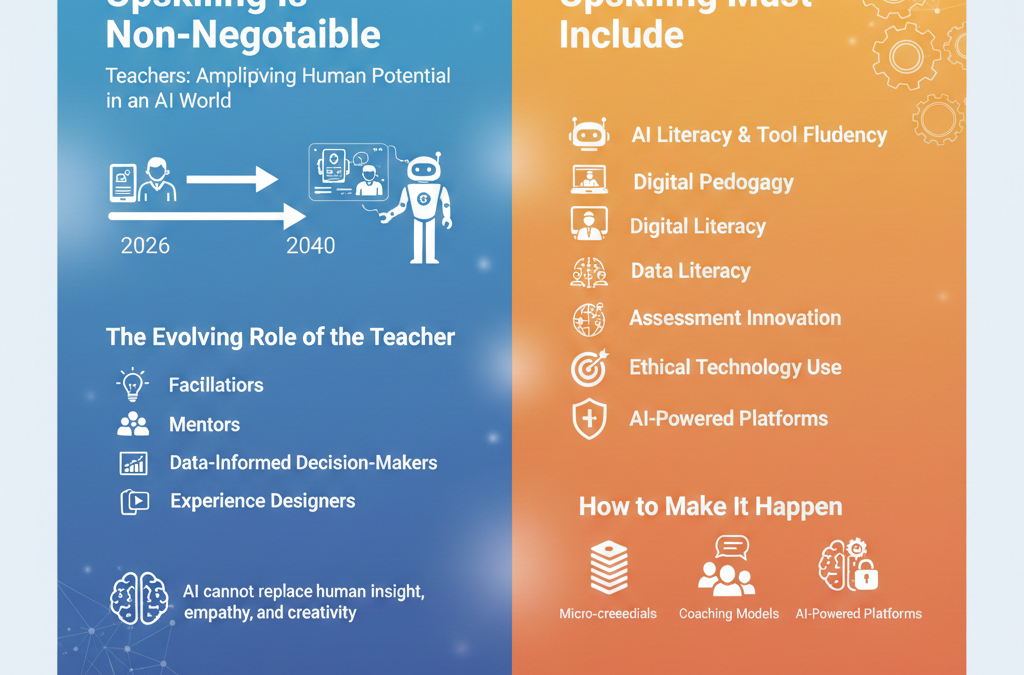
The Evolving Role of the Teacher
In an AI-ready school, teachers are no longer simply knowledge transmitters. They become:
Facilitators who guide personalized learning journeys
Mentors who nurture critical thinking and emotional intelligence
Data-informed decision-makers who interpret insights to support each student
Experience designers who craft meaningful, inquiry-driven learning environments
AI can handle adaptive content delivery, grading, and pattern recognition. But it cannot replace the human insight, empathy, and creativity that define great teaching. Teachers amplify what AI enables—but only when they understand how to work with these tools, not beneath them.
What Continuous Upskilling Must Include
Professional development can no longer be a once-a-year workshop. It must be embedded, personalized, and ongoing. Here’s what matters:
AI literacy and tool fluency. Teachers need hands-on experience with AI platforms—not just theory, but practical application in lesson planning, formative assessment, and student support.
Digital pedagogy. How do you design learning experiences that blend human interaction with intelligent systems? How do you maintain agency and creativity in AI-assisted environments?
Data literacy. Educators must interpret learning analytics, recognize algorithmic biases, and make ethical, student-centered decisions based on data insights.
Assessment innovation. Traditional testing is obsolete in an AI world. Teachers need new frameworks for evaluating creativity, collaboration, and problem-solving.
Ethical technology use. From privacy concerns to equity gaps, teachers must navigate the moral dimensions of AI in education with clarity and confidence.
How to Make It Happen
Micro-credentials offer flexible, stackable pathways for skill development. Coaching models—peer-to-peer or AI-supported—provide real-time feedback and sustained growth. AI-powered training platforms can personalize professional learning just as they personalize student learning.
The infrastructure exists. What’s needed is institutional commitment and cultural shift: treating teacher growth as strategic investment, not professional obligation.
The Bottom Line
When teachers grow, students thrive. Schools that prioritize educator upskilling don’t just adopt AI—they lead with it. They become innovation hubs, resilient to disruption and aligned with the demands of a future workforce we’re only beginning to understand.
The future of education isn’t about replacing teachers with technology. It’s about empowering teachers to do what only humans can—while leveraging AI to do what it does best.
The choice is ours. The time is now.
What would you add? How is your school investing in teacher growth? Let’s discuss in the comments.