Personal Improvement, Research & Reports
The Buddha once claimed that desire creates suffering. On the surface this seems to make sense. You feel pain when you don’t get what you want. The solution, in Buddhism, is to cease desiring things and therefore your suffering will end. Somehow, that doesn’t feel right.
Sure, desire may create pain, but doesn’t it also provide meaning to life? In trying to remove the pain, don’t you also erase the joy, leaving you with a dull, gray existence. In this article I’d like to explore a third alternative, and how you can still experience joy without clinging to things.
Why Be Without Desire?
Before I go off into the high mountaintops of philosophical inquiry, let’s look at the practical matters. What does being without desire for things mean and why might it seem like a good idea?
For this example, let’s say you crave to be rich. I’m using wealth as an example but it could be anything, a healthy body, great relationships, academic or career success. Your craving to be rich leads to a couple side-effects:
- Until you become rich, you are dissatisfied. Like a man starving for food, you will feel hungry until your desire is satiated.
- You might never become rich. This may seem pessimistic, but you can’t entirely reject the possibility that the wealth you seek may never come. You are forever hungry.
- Even if you do achieve great sums of money, the feeling of fullness won’t last. Either you will find a new goal to crave, or you will become bored with your accomplishment.
Here’s a simple diagram showing your level of satisfaction with your current situation:
Even in the best circumstances, feeling full only lasts a moment.
Enjoyable Craving
The common counter-argument to this is that craving can be enjoyable. Feeling desire strongly can be a good feeling. So it isn’t fair to say that the entire build-up to a goal is painful.
I disagree. Pure craving is pain. Few people starving for food would describe the feeling as enjoyable. Loneliness is rarely referred to as being fun. Feeling poor, restricted or lacking are all forms of pain. Hope that tomorrow might be a bit better is only a small relief for the pain of craving. The Buddha is right, desire is suffering.
Should You Just Give Up?
With such a depressing outlook on the human condition, does this mean I recommend giving up your goals, selling your clothes and living in a hut smoking whatever pleasure inducing drugs you can manage to afford? Of course not.
There’s a third alternative. The decision isn’t between craving and emptiness. The third option is what I’m going to call a process focus. When you have a process focus, from an objective standpoint you don’t appear much different, you still set goals, have challenges and learn from failures. The difference is that craving no longer creates the pain it once did and you are free to live happier without wanting more stuff.
A Focus on Process
The problem with craving is that it is incomplete. It places the entire emphasis on only one moment, the goal. In your desire to be rich, this means that the entire emphasis is placed on the moment you reach a particular income. Everything before is merely a lead-up to this moment, and everything after is simply a consequence of it.
The alternative is to emphasize the entire process. This means that the moment of achievement is no more or less important than the first step or two months in.
“Life is a journey, not a destination.” It’s a nice platitude, but I don’t think it captures the real impact of what I’m suggesting. Small snippets of wisdom like this feel nice, but rarely communicate anything important. “Be yourself,” is another piece of frequently-cited wisdom that has become essentially meaningless.
What a Process Focus Means
A process focus means that successes and failures are equal. This has a nice ring to it, but it’s a system few people follow. How often can you say that you feel just as good with a win as you do with a loss? Instead, most people operate from craving, where success means satisfaction and failures are pain.
A process focus treats any pursuit as you would a game. In a game, the act of playing is the real motivation, not the win. After a heated chess match, you are generally no better off now that you’ve won. The only reason to play was the process of playing.
When you approach an area of life from a process focus, you see the entire path, not the goal as the reason to start. Run a business because you love running a business, not just because of the status, wealth or service it might bring. Interest in the process is more important than the result of a goal.
Examples of a Process Focus
Now I’d like to climb down the philosophical mountain for a bit and deal with the day-to-day. What does a process focus look like? Here are a few examples, in them you can easily imagine the opposite of operating from desire:
John decides to start dating. Instead of making it his goal to get a girlfriend, sleep with a bunch of women or become a modern-day Casanova, he becomes interested in other people and how dating works. Rejections and failures don’t bother him, because he is driven by an interest in other people and the process, not curing loneliness, lust or validating himself.
Julie begins school. She makes it her goal to become a doctor, but doesn’t focus on it. Instead she focuses on the classes, becoming curious about the material and how she can apply it to her interests. She even writes down goals for her term marks and GPA, but these are just constraints to make the process more fun and challenging for her, whether she achieves them or not doesn’t diminish her interest in what is happening right now.
Patrick is overweight. He sets a goal to lose twenty pounds, but doesn’t obsess over it. He starts by trying out different forms of exercise, eventually settling on running as something he enjoys. He tries to beat his previous records and makes a game out of putting on his shorts and jogging out each morning. He meets his weight-loss goal in record time, but sees it as only a minor bonus to a process he loves.
Hopefully these can give a picture of what a process orientation looks like from the inside-out. These are people who effortlessly achieve their goals. Not because they never challenge themselves, but simply because they don’t crave. They don’t want things, but are still happy because they engage themselves in the process.

Personal Improvement, Research & Reports

Every once in awhile I get an email from someone who is starting a new blog. This person is enthusiastic to get started and is hoping to become the next Darren Rowse or Steve Pavlina. In sending a few emails back and forth, however, I find that almost everyone underestimates how long it will take.
Typically I hear expectations that they will be cashing big paychecks in six months. I think I made less than $50 in my sixth month. Don’t get me wrong, ambition is good. If I didn’t have big ambitions I wouldn’t have started this website to begin with. But I think it can be dangerous to be ambitious with the deadline.
If You Want to Know How Long, Ask an Expert
I’ve always found that if you want to know how long something will take, ask someone who has already done it. Sounds obvious, but few people do it. When you’re motivated, it’s easy to think that somehow you can beat the odds and compress the years of work from someone else into a few months.
Setting unrealistic deadlines is a recipe for stress. If you quit your job with the expectation that you can become a professional blogger in three months, you’ll probably be living on the street. Motivation is good. Blind overconfidence isn’t.
When I first got interested in the idea of owning my own online business, I was told that the average time it took to become financially independent was 3-5 years. At the time, this seemed ridiculously long. Clearly, I, with all my motivation and ideas could do it in less time.
I’ve been running this website for 2 years and it seems to be right on schedule with that initial 3-5 year timeline.
Be Ambitious With Your Goals, Patient With Your Deadlines
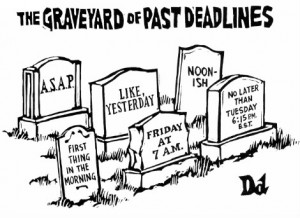 One of my biggest mistakes I made a few years ago was to get frustrated when things wouldn’t manifest as quickly as I’d like. I’d be working incredibly hard, and few results would come. So, I’d work even harder and results would still trickle in. I’d burn myself out trying to speed up a timeline that already had it’s own pace.
I realized that my mistake was that I was trying to run a marathon as if it were a sprint. When you run a marathon, you need the motivation to get started and go the distance. But you need to have the patience to not burn yourself out early on. Sprinters won’t last three miles, never mind the full twenty-six.
Ask the People that Come Before You
When I used to do software projects, I frequently heard the mantra, “Figure out how much time the project will take in the worst conditions. Now double that. That is your expected finishing time.” The experts had the battle scars that come with trying to accelerate projects that needed more time.
My new rule for setting goals is to find someone who has accomplished what I want to do (or something similar). Then, I try to ask them to give me an estimate of how long it will take. That number will be far more accurate than any estimate I can make up.
The Path is Long, Learn to Enjoy It
If you can’t enjoy the process leading up to a goal, it probably isn’t worth starting. The time spent enjoying a win is far shorter than the work leading up to it. If reaching the end is your only motivation to keep going, you probably won’t make it very far.
I enjoy writing. I enjoy going to the gym. I enjoy taking classes in school. I enjoy reading. If I don’t enjoy something intrinsically, I can’t push through more than a few weeks. I’m sure I’m not alone in this case.
If you want to reach a goal, ask an expert. If they tell you 2, 4 or 10 years, ask yourself whether you can enjoy doing something for that long. Don’t just reject the number because you feel you can do it faster. Find a way to enjoy it for that entire time, because it’s the most realistic estimate you’re going to get.

Personal Improvement, Research & Reports

Just because it’s common, that doesn’t mean it’s not risky. Many people fall into the misconception that if a lot of people are doing something, it must be the safest path. If you were born several decades ago, you would have thought smoking was safe because everyone was doing it.
Is Having a Job Safer?
I earn my entire income from running this website. I love working on it and there is incredible potential for growth. But one of the common criticisms I get is that I’m taking on a riskier path than someone getting a job. In their minds, because a job is more common than online entrepreneurship, it must be safer.
Tell that to the factory workers from big auto companies that recently lost their jobs. Was it safer to adapt to an overpaid job in an aging industry? My income in the next few years may suffer because of the recession, but at least I can’t be fired.
Unconventional Wisdom
The common self-help dichotomy is the safe and mediocre path versus the risky and virtuous one. Entrepreneurship is risky, but it’s also more satisfying than being a widget producer.
This dichotomy is false. Often the best option is actually the least risky over a period of time.
Take this online business. I didn’t pay any start-up costs, so if it flopped, I would only lose a bit of my time. My income stream is split through multiple different sources (and I have the option of easily pursuing new ones), so I’m diversified if one stream dries up. Finally the intangible assets I’ve built up in terms of skills and connections mean that, even if the worst case were to happen, I could use those skills to earn revenues elsewhere.
I’m not arguing that you should pursue an online business because it isn’t risky. You should do what you’re passionate about. However, I reject the argument that because I’m taking an unconventional approach to income generation, I’m at a bigger risk.
Don’t Shortcut Your Thinking
Conventional wisdom is a shortcut from actual thinking. When you rely on the majority to give you career, diet and spiritual advice you avoid thinking about these issues for yourself. Often when you peel off the covering, and start to understand the systems behind it, you can come up with more satisfying and less risky solutions to your problems.
When you peel off the outer layer from your career, you see that a job isn’t just working for money, it’s building skills that provide value in exchange for money. That’s why programs designed to give people jobs, but don’t provide value are insane. It’s also why, if you don’t produce value at your job, you are in a far riskier position than any entrepreneur.
Peeling off the layers to your diet and you’ll see that, while people have been omnivorous throughout their evolution, few societies have consumed the same volume of meat as people do today and none ate as much processed foods. Look closely and it makes more sense for meat to be a side-dish than the main course.
The Only Security is Within You
Personal development, far from being a risky choice, is probably one of the safest. You can always lose your job, but only rarely can you lose your skills. Businesses can die, but the lessons learned from failed ventures make future businesses stronger. Your health can falter, but your skill in changing your habits can stay strong.
If any investment of your time doesn’t build internal assets, it isn’t worth doing. Even the most lucrative job isn’t worth the paycheck if you aren’t becoming more skilled or knowledgeable as a result. One of the reasons I believe running a business is safer than working at a job is that I’ve learned far more from entrepreneurship than I have from any job or class. Even if my external assets fail, I’ve still built internal assets that can’t be taken away.
The Illusion of Security
“Security is mostly a superstition. It does not exist in nature, nor do the children of men experience it as a whole. Avoiding danger, in the long-run, is no safer than outright exposure.” – Helen Keller
Security doesn’t come from following the masses. With an economic collapse, terrorist attacks, obesity epidemics, and third-world flood-relief efforts in an industrialized country, I don’t think anyone can argue that the world is inherently safe. But in that fear you have two choices: to blindly follow the masses over the edge of a cliff, or to think for yourself.
Personal development and unconventional choices often lead to the most success. But despite their appearance, they often hold the least risk. Businesses can fail and diets can be flawed, but every day people lose their jobs and eat hamburgers. There is no such thing as complete safety, and if there was, it certainly wouldn’t be existing in the millions of mediocre choices made by the majority today.

Personal Improvement, Research & Reports
As the adage goes, all work and no play make Jack a dull boy. Being constantly involved in our professional careers is a demanding task.
Sooner or later, it takes its toll, mentally as well as physically. Everyone experiences this slowdown in their careers at least once, if not more often. It is vital that we remain motivated and enthusiastic towards our work. Here are a few steps we can take to stay motivated.
1. Perspective
Our perspective is what defines what we are and what we do. Why is it that we work? It is but obvious that our careers are in our fields of interest and expertise. Then why not justify our decision and realize our potential? Constantly reiterate the fact that besides the pay, work is about doing all we can towards fulfilling our dreams. Our professional lives should be about working smart, not only working hard and should give us a feeling of accomplishment.
2. Goal-oriented approach
All the hard work that you put in is going to be fruitful only if you are working systematically towards achieving a goal or meeting a target. Working haphazardly just for the sake of working is not going to help you in any way. It might actually deter you from working on the right things which could make achieving your goals an easier task. Focus on the target from the very beginning. Never try to do too much; take one goal at a time.
3. Plan, plan, plan
A goal can never be achieved without meticulous planning. A big task can be broken down into smaller and easy-to-achieve tasks. These milestones help us in setting deadlines and working in a focused manner to complete each task individually. It also prevents the entire task from turning into a single over-bearing problem. This is essential when it comes to completing a project within a preset deadline. Proper planning always brings about a sense of calm and level headedness. It keeps insecurity and panic attacks at bay. It also ensures that there will be no last moment rush to get the work done, which may lead to unforeseen complications.
4. Do not over exert
Achieving a target is no mean feat. It requires all our concentration, diligence and hard work. There is no shortcut to success, as they say. However, this does not call for exerting oneself to such an extent that it renders us unavailable for the later part of the task. We do not want to be sidelined due to stress or illness during the final execution of the project. It is always advisable to know our limits and work within them. It helps us maximize our efficiency.
5. Scheduled breaks
There is nothing wrong in taking a break every now and then to keep the mind fresh and kicking. Ensuring that monotony does not creep into our work is a very good way to keep up the motivation level. Taking coffee breaks or just stretching your legs about is a good way to get recharged.
6. Work-Life balance is a must
Do remember that while work is an integral part of our lives, it is not everything. There are people waiting for us at home – family and friends. Discussing issues at work, with people close to us is fine, but we should make sure we don’t take carry any negatives from the work place back home and sully the mood over there since the home is a place to relax, to live life apart from work.
7. Treat yourself
This is one of the easiest and effective ways to remain motivated. Giving ourselves a small treat or reward on completing every small task goes a long way in keeping us excited and focused on the overall scheme of things. The reward should be appropriate to the nature of the task completed. Big task, big treat!